
Sinking funds categories are the non-monthly costs you save for a little at a time: car repairs, car insurance and registration, gifts and holidays, travel, medical and dental visits, home upkeep, pet care, yearly subscriptions and school costs. You give each one its own small monthly amount, so the bill is covered when it lands.
You don't need all 20 categories below. Start with the three to five costs most likely to break a normal month, size each one by dividing its cost by the months left until it's due, and keep them separate from your emergency fund. The list below helps you check that nothing is missing.
Disclosure: FloosYo is our app. The last part of this guide shows how to track sinking funds in FloosYo, but the list and the math work with any app or a notebook.
What are sinking funds?
A sinking fund is money you set aside each month for a cost you know is coming but don't pay every month. Experian describes it as a way "to help you save for a planned expense." YNAB calls the same idea true expenses. The cost is predictable. Only the timing is uneven.
The word "sinking" comes from older finance, where companies set money aside to pay down a bond over time. In a household budget it simply means one labelled pot per future cost, filled a little each month.
Which categories were missing from our list?
One of us on the FloosYo team had the monthly bills under control: rent, phone, groceries, the streaming services. The budget looked complete. What it was missing were the costs that show up once or twice a year, and those were the ones that kept breaking the month.
The gaps were the same kinds of costs other people describe. Car insurance paid once a year. The registration notice. Holiday gifts in November. A vet visit. A flight home for a wedding. None of them were surprises. They just had no line in the plan.
The second cost was quieter. With no fund for those bills, they came out of the emergency money, so the next real emergency found less there. The fix was not a bigger budget. It was a longer list of categories, each with its own monthly amount.
Sinking funds categories everyone needs
Most households need a fund for car costs, gifts and holidays, travel, medical and dental, home upkeep and yearly bills like insurance or subscriptions. These six show up on nearly every published list. The Penny Hoarder gives example monthly ranges for a household taking home about $5,000 a month, shown below.
| Category | What it covers | Example monthly range (The Penny Hoarder) |
|---|---|---|
| Car maintenance and repairs | Tires, brakes, oil changes, repairs | $50 to $100 |
| Home maintenance and repairs | Appliances, plumbing, small fixes | $100 to $200 |
| Holiday gifts | Gifts for holidays and family | $50 to $150 |
| Vacation | Trips, hotels, travel costs | $100 to $200 |
| Flights for family events | Weddings, visits home | $50 to $100 |
| Dental work and cleanings | Checkups and treatment | $30 to $50 |
These ranges are examples from one source, not targets. Your own past year of bank statements is a better guide. Yearly bills with a fixed amount, like car insurance or registration, belong here too. They are the easiest to size because the bill tells you the number.
What are 20 sinking funds examples to plan for?
This list combines the categories that Empower and Envelope Budgeting each publish as a list of 20, minus a few that don't fit a household budget. Scan it once and mark the ones that hit you in the last 12 months.
1. Car repairs and maintenance
Tires, brakes and the repair you can't plan the date of. YNAB's example puts this at about $2,000 a year.
2. Car insurance paid yearly
If you pay the premium once a year instead of monthly, it needs its own fund.
3. Vehicle registration and fees
A fixed yearly bill with a known date. One of the easiest funds to start.
4. Home insurance or renters insurance
Same idea as car insurance: a known amount, once a year.
5. Home repairs and maintenance
The water heater, the roof, the leaking tap. Homeowners feel this one most.
6. Appliance and furniture replacement
A washer or a sofa doesn't fail on schedule, but it does fail.
7. Medical and dental
Checkups, glasses, deductibles and treatment that isn't covered.
8. Pet care
Yearly vet visits, vaccines and the visit you didn't expect.
9. Holiday gifts
The November and December gift run. Spread over the year, it stops being a shock.
10. Birthdays and celebrations
Gifts and dinners for family and friends through the year.
11. Weddings and big life events
Gifts, outfits and travel for other people's weddings, or your own.
12. Travel and vacation
Flights, hotels and the trip home to see family.
13. Yearly subscriptions and memberships
Software, a gym paid yearly, warehouse club fees. Our guide on how to manage subscriptions helps you find them.
14. Technology
Replacing a phone or laptop before it dies, not after.
15. Clothing
Seasonal clothes and shoes, especially for growing kids.
16. School and back-to-school costs
Supplies, fees, books and uniforms that land in late summer.
17. Kids' activities and hobbies
Sports fees, camps, lessons and equipment.
18. Entertainment and events
Concerts and tickets. Our guide to average entertainment costs per month covers how to size this one.
19. Charitable giving
Planned yearly giving, so it doesn't have to wait for a good month.
20. Taxes not taken from pay
Property tax, or tax on side income. What you owe depends on where you live, so check what applies to you.
Envelope Budgeting suggests that five to ten categories cover the major disruptions for most households. That matches our experience: the list is for checking, not for opening 20 funds at once.
Sinking funds examples by life stage
Your sinking funds categories change more with life stage than with income. A student and a parent can earn the same and need very different lists. The table shows which categories tend to appear or grow at each stage, based on the examples in The Penny Hoarder, Empower and Envelope Budgeting.
| Life stage | Categories that appear or grow |
|---|---|
| Student | Books and fees, flights home, laptop replacement |
| First job, renting | Car costs, moving and deposit, renters insurance, gifts, travel |
| Couple | Weddings to attend, shared yearly bills, holiday travel to two families |
| Parent | Baby and child costs, school, activities and camp, clothing |
| Homeowner | Home repairs, appliance replacement, property tax, home insurance |
| Pet owner | Vet visits, vaccines, pet emergencies |
A useful habit: each time your life changes, add one fund. A move, a new car, a baby or a dog each brings a cost that comes once a year or less. For bigger one-off goals, like replacing a car, see our list of things to save up for.
How much to put in each sinking fund per month
Divide what the cost will be by the number of months until it's due. YNAB puts it the same way: "Divide the cost by the number of months until you'll have to pay it." Empower's example is a $1,200 cost due in 12 months, which means $100 a month.
Bills with a fixed amount are simple. The hard ones are costs without a bill, like car repairs or gifts. For those, look back at what you spent last year, then guess and adjust. YNAB's own example sizes car repairs at about $2,000 a year, or $167 a month.
If you have no history, national averages give you a first guess. The U.S. Bureau of Labor Statistics reports that households spent $81,905 on average in 2025. Some of the yearly line items, divided by 12:
| Category (BLS 2025 average) | Yearly | Per month |
|---|---|---|
| Apparel and services | $2,010 | $167.50 |
| Cash contributions (giving) | $2,237 | $186.42 |
| Entertainment | $4,084 | $340.33 |
These are averages across all U.S. households, not a target for yours. Replace them with your own numbers once you have them.
Two adjustments matter. If a bill is due sooner than 12 months, divide by the months left: a $600 bill due in 6 months needs $100 a month, not $50 (example only). And if you start late, the first year is a catch-up year. After that, each fund just keeps filling at the normal rate.
Sinking fund vs emergency fund: what's the difference?
A sinking fund pays for costs you can predict. An emergency fund pays for ones you can't, like a job loss. Experian also notes the emergency fund is usually bigger, with a common guideline of "three to six months' worth of essential living expenses." A sinking fund is sized to one bill.
| Sinking fund | Emergency fund | |
|---|---|---|
| Pays for | Known costs: registration, gifts, travel | Unknown events: job loss, urgent repairs |
| Size | The cost of one bill or category | Often three to six months of essentials (Experian) |
| How many | One per category | Usually one |
| When it's used | On a date you can plan | Whenever it's needed |
Our preference, not a must: keep them apart. If car registration comes out of the emergency fund, it isn't an emergency fund anymore. One big pot also hides which money is for which cost. To set the size of the emergency side, see our guide on how to set savings goals.
Which sinking funds do you actually need?
Our view: a few funds you keep feeding beat 20 funds you abandon. Lists of 20 are useful to scan. The Penny Hoarder and Envelope Budgeting both suggest starting with three to five, and The Penny Hoarder adds "add more as the habit takes hold."
A simple test decides it. If a cost is predictable but doesn't come every month, it gets a fund. If it comes every month, it stays in your monthly budget. If you can't predict it at all, it's what the emergency fund is for.
How to track sinking funds without a spreadsheet
You need three things for each fund: the cost, the due date and how much is set aside so far. A spreadsheet can hold that, but you have to update it by hand. A budgeting app can do the math and show which fund needs money next. Our roundup of budget goals apps compares a few options.
Whatever you use, check one number each month: the total to set aside across all funds. If that total fits your budget, the plan works. If it doesn't, cut a category or lower an estimate, rather than skipping months.
How do you set this up in FloosYo?
In FloosYo, each sinking funds category is an expense that repeats yearly. The app adds up every yearly expense, divides each by 12 and shows the total as "Set aside each month." You can use FloosYo on iPhone or on the web.
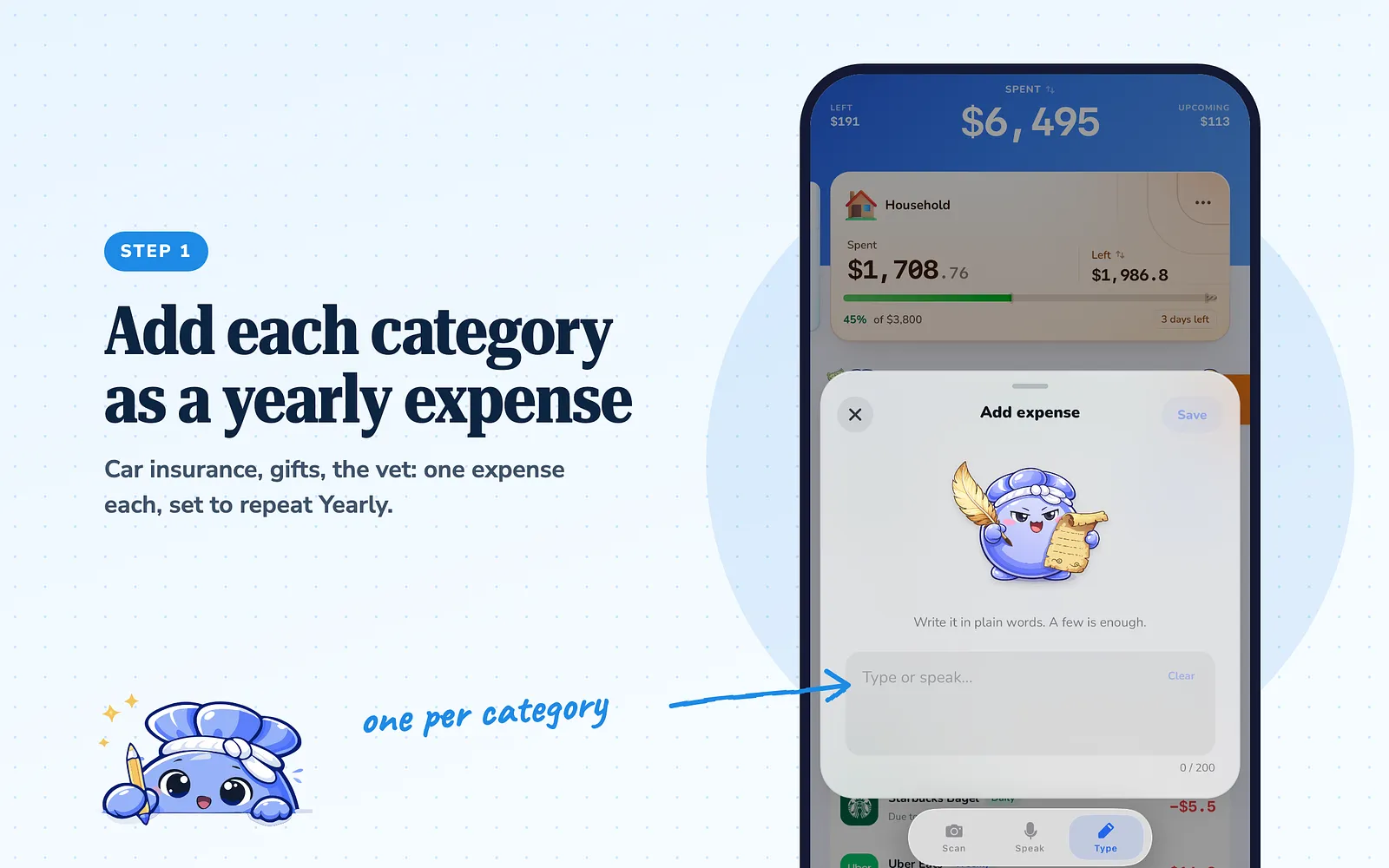
Step 1: Add each category as a yearly expense
Add one expense per category, with its amount and date, and set it to repeat Yearly. For costs without a fixed bill, like car repairs or gifts, enter your estimate and the month you expect to pay it.
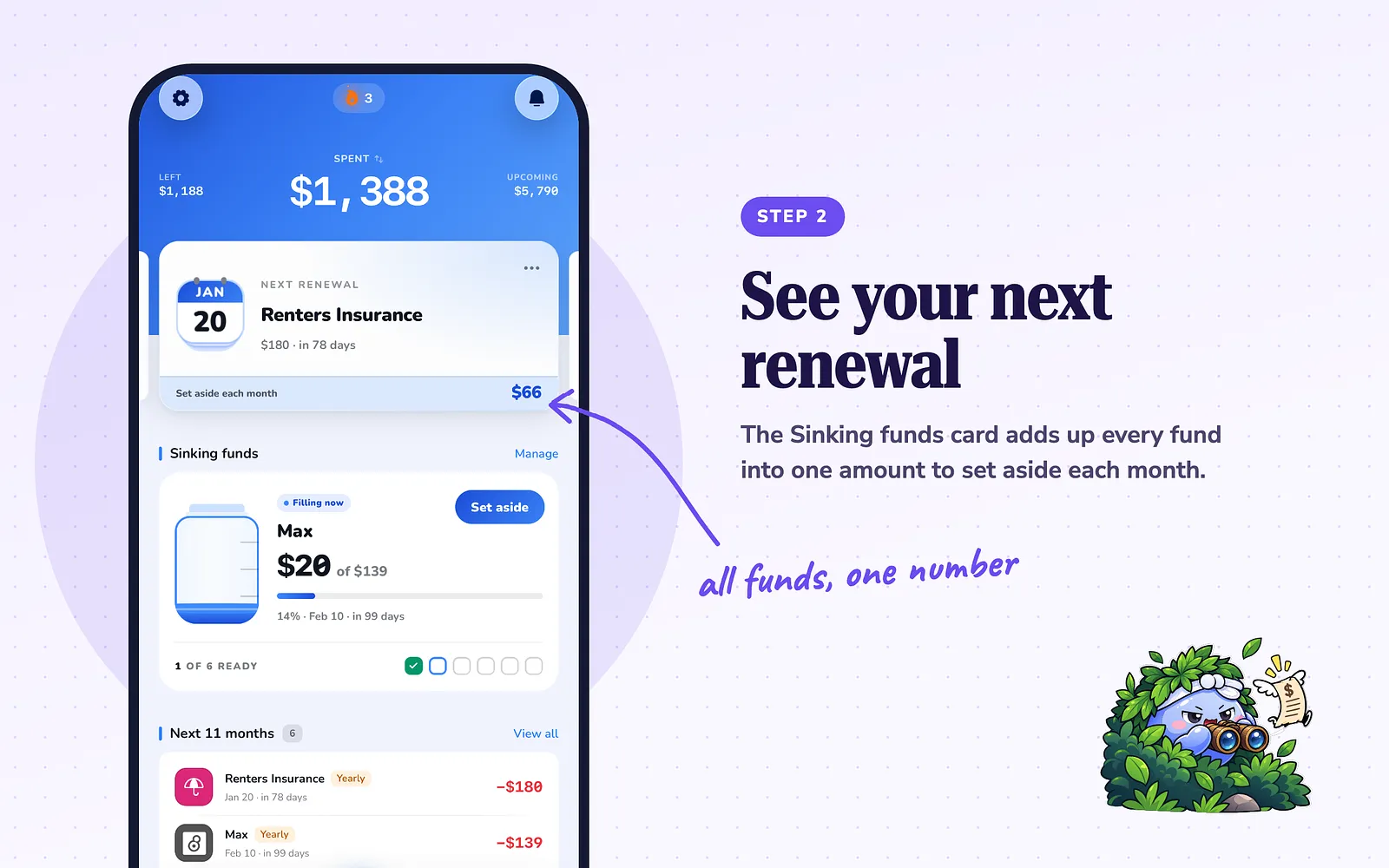
Step 2: See your next renewal and monthly total
The Sinking funds card shows when you have yearly expenses. You can add it from Actions, then Edit dashboard. At the top you see the Next renewal and the amount to set aside each month for all your funds together.
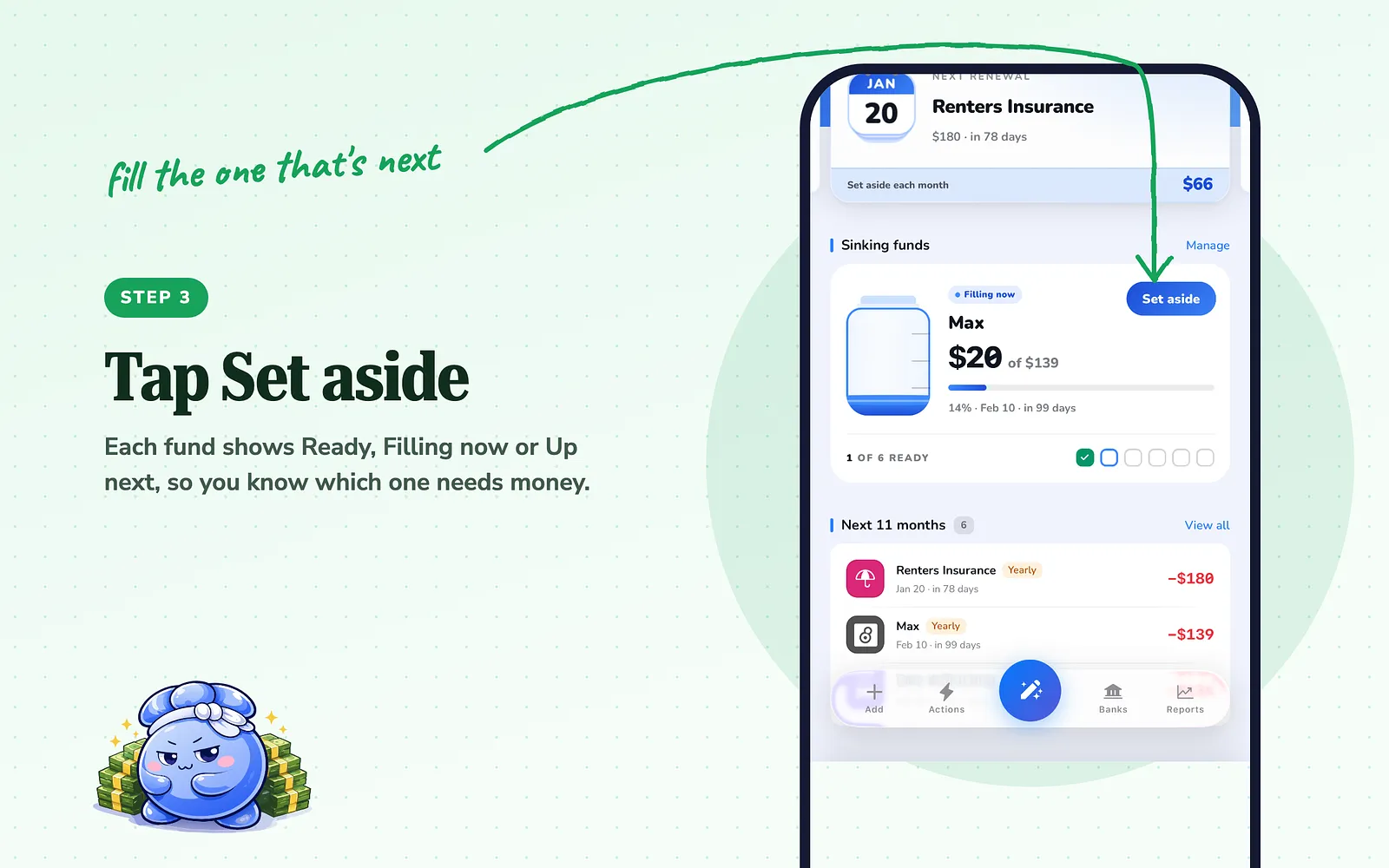
Step 3: Tap Set aside to fill the fund
Each fund shows a chip: Ready, Filling now or Up next. Tap Set aside to put money toward the fund that's filling. When a yearly bill charges, the money set aside pays it, and the budget shows the amount "from Sinking funds."
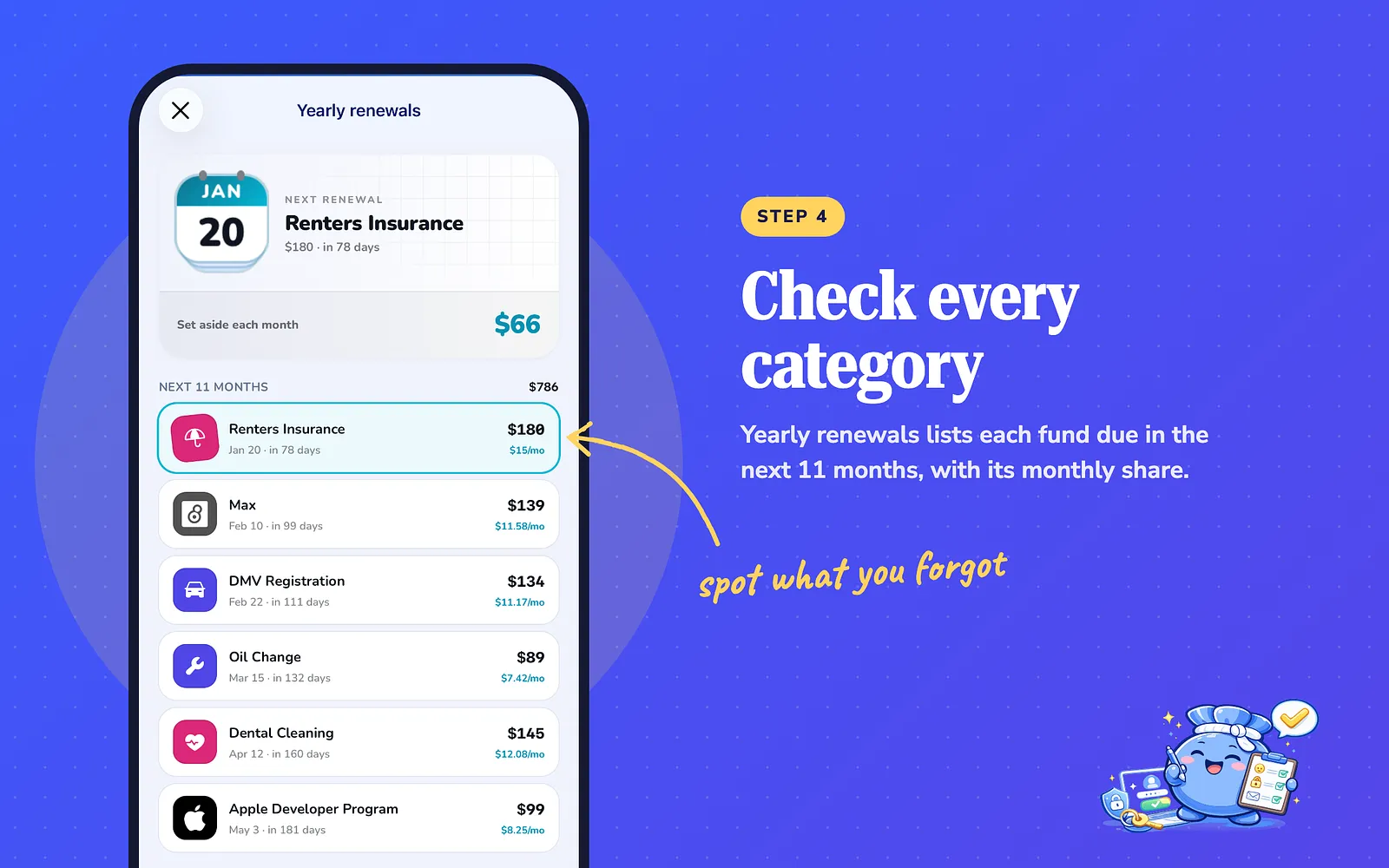
Step 4: Check every category in Yearly renewals
Open Yearly renewals to see every category due in the Next 11 months, with its date and its monthly share. It's the quickest way to spot a category you forgot.
What to do today
Open the last 12 months of bank statements. Circle every cost that didn't come monthly. Pick the three that hurt most, divide each by the months until it's due, and start setting that amount aside this month. Add the next category the next time a non-monthly bill shows up.
Common questions
These are the questions people ask most about sinking funds categories, how many to keep and how to size them. Each answer is short and uses only the sources listed below.
What are the most common sinking funds categories?
Car repairs, car insurance and registration, gifts and holidays, travel, medical and dental, home maintenance, pet care, yearly subscriptions and school costs.
How many sinking funds should I have?
Start with three to five. Envelope Budgeting says five to ten covers the major disruptions for most households.
How do I size a sinking fund with no fixed bill?
Look at what you spent on it last year, divide by the months until you expect the cost, then adjust after a few months.
Can I use my emergency fund instead?
You can, but then it stops being ready for a real emergency. A sinking fund is for costs you can predict.
Does FloosYo track costs without a fixed date, like car repairs?
Yes, if you add them as a yearly expense with an estimated amount and the month you expect to pay.
Do I have to connect my bank to use FloosYo?
No. Bank linking is optional and is done in the iPhone app. You can log everything yourself.
Sources
Every number and quote in this guide comes from one of the pages below. We read each of them in November 2026 and linked the exact page.
- Experian: Sinking fund vs. emergency fund
- YNAB: What is a sinking fund
- Empower: 20 sinking fund categories
- The Penny Hoarder: What is a sinking fund
- Envelope Budgeting: Sinking fund categories
- U.S. Bureau of Labor Statistics: Consumer Expenditures 2025
- FloosYo features described here: checked in the app, November 2026.
Keep reading
If this list helped, these three guides go further on bigger savings goals, setting targets you can keep, and budgeting when your pay changes from month to month.
Coming from another budgeting app? See how FloosYo compares to YNAB, Mint, Monarch or Rocket Money.
Which budget fits me: See which split fits the amounts you enter. Budget my income: Give every dollar a job before the month starts.