

Make Small Charges Fund Bigger Goals
Meaningful savings goals don't require a dramatic lifestyle change. They require a specific target, a deadline, and a clear view of the outflows you can change. Forgotten subscriptions, automatic renewals, delivery memberships, app purchases, and daily habits can become a defined monthly contribution when you see their full cost before the next charge lands.
That approach matters because saving intentions are strong, but execution often breaks down. 76% of respondents in a 2026 savings study said saving more was their top financial goal, while emergency readiness remains weak, with only 46% of Americans reporting enough savings for three months of expenses. Bankrate's emergency savings report shows why a visible, practical plan matters.
The following things to save up for cover protection, travel, housing, transport, education, family priorities, health, and personal enjoyment. For each goal, use one simple formula: target amount minus what you already have, divided by the months available. FloosYo helps by detecting recurring charges, projecting monthly and yearly costs, sending renewal reminders, prompting skip-or-stop decisions, and tracking the savings from one active goal at a time.
This approach excludes interest-based products, speculation, gambling, and spending that conflicts with the plan. The focus stays on reducing outflows, setting money aside, and funding a clear goal consistently.
Table of Contents
- 1. Emergency Fund for Three to Six Months of Living Expenses
- 2. Vacation or Travel
- 3. Home Down Payment or Home Repairs
- 4. Vehicle Purchase or Replacement
- 5. Education or Professional Development
- 6. Wedding or Major Life Event
- 7. Debt Payoff Beyond Minimum Payments
- 8. Health, Wellness, and Fitness Investments
- 9. Children's Education or Family Planning
- 10. Hobby, Equipment, or Creative Pursuit Investment
- Top 10 Savings Goals Comparison
- Turn One Decision Into a Savings System
1. Emergency Fund for Three to Six Months of Living Expenses
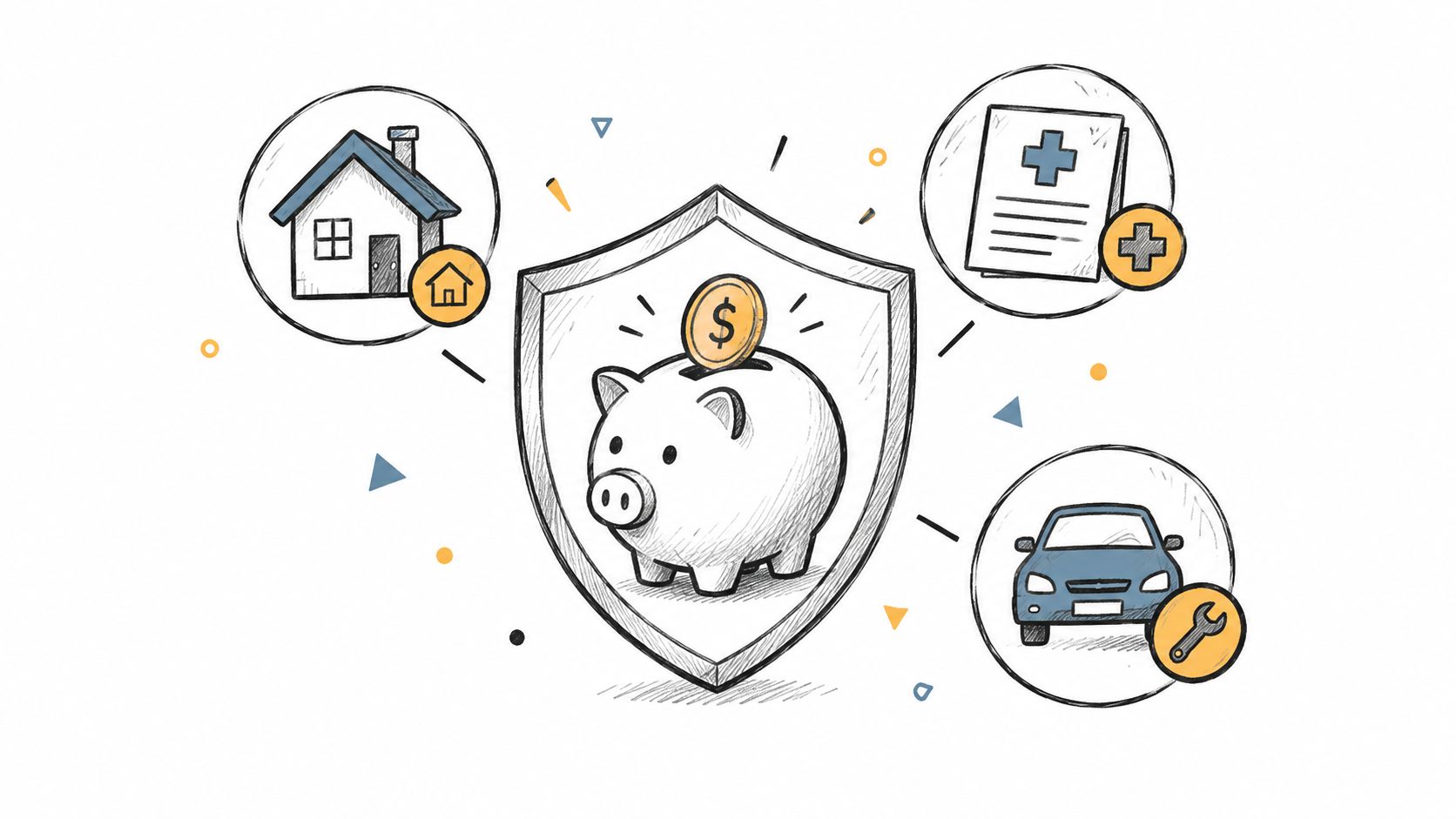
An emergency fund protects your plan when income stops or an unavoidable bill arrives. Job loss, medical costs, urgent home repairs, and vehicle problems can all disrupt regular cash flow. A dedicated reserve lets you handle those expenses without turning a short-term shock into long-term borrowing.
The established benchmark is three to six months of living expenses, but current conditions show why households still need to treat it as a priority. In a 2026 U.S. consumer survey, 43% said they couldn't cover a $1,000 emergency from savings, about one-third couldn't cover one month of living expenses, and only 46% had enough for three to six months. The 2026 Financial Wellness Survey also reported that 24% had no emergency savings at all.
Build the reserve in visible milestones
Start with one month of essential expenses, then work toward three months before extending the target to six. A freelancer, contractor, or household exposed to layoffs should choose the higher end because income may not arrive on a predictable schedule.
Use FloosYo to identify recurring charges you no longer value. Skip or downgrade them, then route the saved amount into the emergency-fund goal. Keep the reserve separate from everyday spending, and update the target when rent, household size, or essential bills change.
Practical rule: Fund protection before optional upgrades. A skipped renewal is useful only when the saved amount becomes visible progress toward the reserve.
For more guidance on where emergency savings fit into a broader financial plan, see what savings accounts are used for.
2. Vacation or Travel
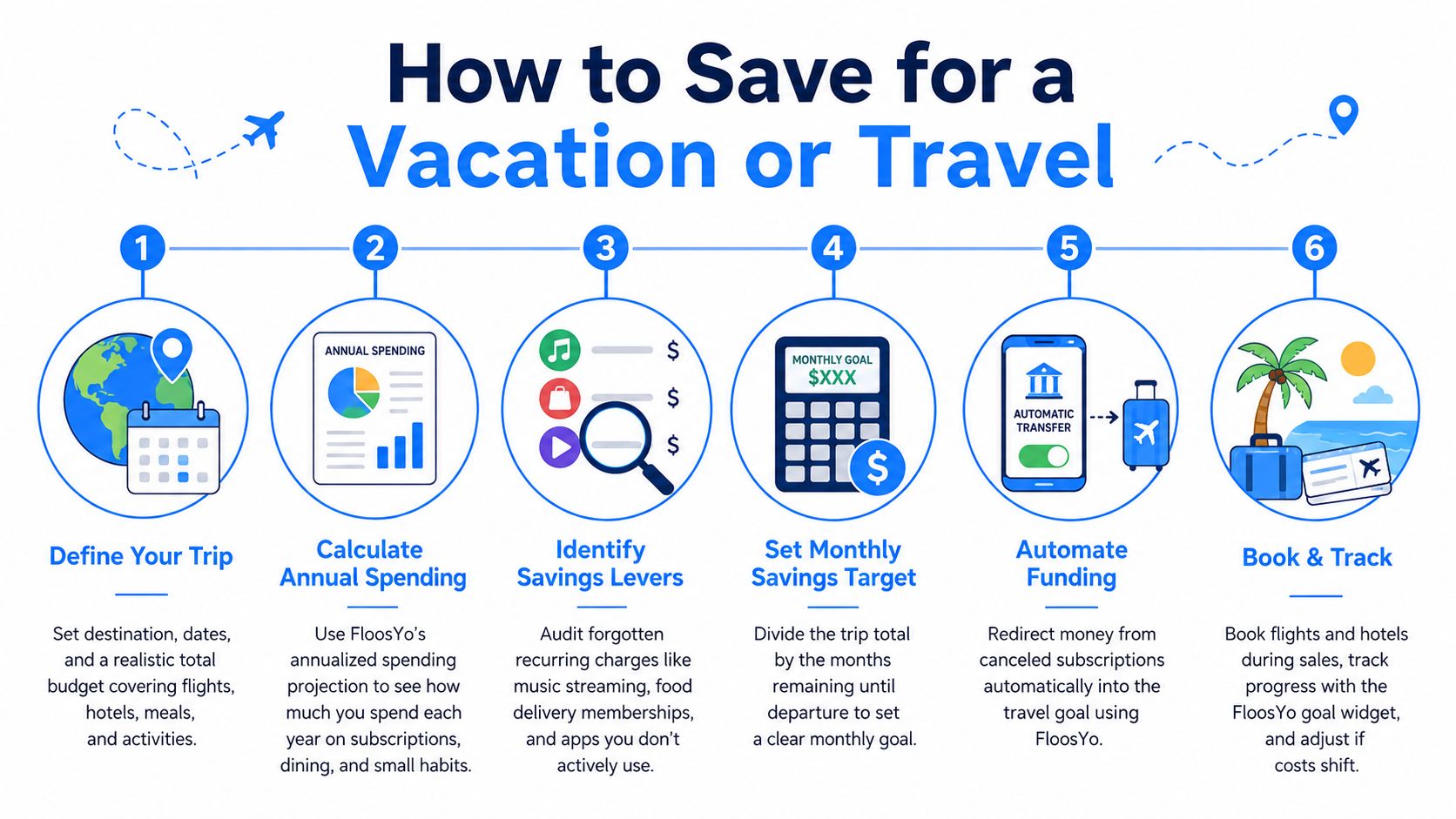
A vacation should not be funded by optimism. Price the complete trip first, then decide whether it earns a dedicated savings goal or should wait behind a more urgent financial priority. Include accommodation, meals, local transport, activities, travel documents, and a contingency amount.
Vacations remain a common savings priority. A 2025 survey found that 33% of respondents were saving for vacations, alongside respondents saving for emergencies, vehicles, or homes. Treat that finding as context, not permission to borrow. Set a Sharia-compliant plan that uses savings rather than interest-bearing debt, and use this guide to saving for a vacation to organize the target.
Turn recurring spending into a travel timeline
Start with the deadline and destination cost. Divide the total by the months available, then assign specific recurring charges to the goal. A $15 monthly music subscription and a $40 monthly food delivery membership produces $660 over a year, enough to contribute meaningfully toward transport and accommodation.
Review subscriptions, memberships, travel alerts, and delivery services before their next renewal. Cancel a service you will not use, or pause it during the saving period. Redirecting $55 each month creates a visible monthly contribution and a clear annual projection, while keeping the trade-off explicit.
FloosYo can display both projections and prompt you before a renewal. Use those skipped or canceled expenses to fund one trip, then create a separate goal if you travel more than once a year. Keep the plan grounded in actual destination costs, and adjust the deadline when the monthly target does not fit your budget.
A practical rule: protect the trip from daily spending. Move each redirected charge into a separate travel goal as soon as it is saved, so progress stays visible and the vacation remains funded without compromising your broader financial priorities.
3. Home Down Payment or Home Repairs
Housing goals need separate accounts because a down payment and a repair reserve serve different purposes. A down payment supports a planned purchase. A maintenance fund pays for plumbing, roofing, heating, or structural work when a problem cannot wait. Combining them invites an urgent repair to consume years of purchase savings.
Price the full target, choose a deadline, and work backward. For a home purchase, include the down payment and other expected buying costs. For repairs, list likely projects, rank them by urgency, and set a monthly sinking-fund contribution. Keep the plan Sharia-compliant by building the fund with savings rather than interest-bearing debt.
Make the annual view support housing
An annual projection exposes whether the goal is realistic. Review the amount available each month, then calculate what that contribution produces over a year and by the chosen deadline. If the timeline fails, extend it, lower the project scope, or redirect more recurring spending. Do not protect an unrealistic date by cutting insurance, utilities, or necessary maintenance.
FloosYo can surface streaming, app, cloud-storage, and food-delivery charges that renew automatically. Check them before renewal, cancel services you no longer use, and assign each skipped charge to the housing goal. A recurring charge redirected every month becomes a visible contribution, while the annual total shows the trade-off clearly.
Keep the goal separate from emergency reserves. If you withdraw money for a repair, record the amount, revise the deadline, and restart the contribution. Read this practical guide on how to save for a house for a structured housing plan.
A dedicated account makes every renewal decision visible and keeps planned housing savings from disappearing into daily spending.
Here is a practical explanation of separating reserves from planned housing savings:
4. Vehicle Purchase or Replacement
A vehicle goal should include more than the purchase price. Plan for registration, essential equipment, maintenance, and the operating costs that begin once the vehicle is yours. If your current car is becoming unreliable, start a replacement fund before the next major repair forces a rushed decision.
Choose a deadline and work backward. If the target is $20,000 and the deadline is three years away, the required monthly contribution is $556, before considering what you already have. That calculation makes the trade-off immediate. If the amount doesn't fit your cash flow, extend the deadline, choose a less expensive vehicle, or redirect more recurring spending.
Separate replacement money from running costs
Use FloosYo to list car insurance, parking, roadside assistance, car-share memberships, and maintenance-related charges separately. Set renewal reminders before insurance and service charges arrive, then review whether each remains necessary. Keep the vehicle fund distinct from routine fuel and maintenance spending.
A household might discover that several subscriptions and delivery charges could be skipped without affecting essential transport. The saved amount can then fund the replacement goal, while a smaller maintenance sinking fund handles predictable upkeep.
Don't wait for the dashboard warning light or a failed inspection to start saving. A replacement deadline gives you more choices than an emergency purchase.
Once you buy the vehicle, redirect the old purchase contribution into maintenance. That keeps the next repair from competing with your emergency fund or another major goal.
5. Education or Professional Development
Education can create access to a new role, a trade, or a practical skill, but the target must be specific. Choose the course, certification, software, equipment, and time commitment before deciding how much to save. A vague goal such as “learn data analysis” doesn't tell you what amount or deadline to fund.
Break the cost into milestones. You might save for enrollment first, then required materials, then the next course or assessment. If an employer offers reimbursement, confirm the conditions and timing before relying on it. Save the out-of-pocket amount first so the plan doesn't depend on uncertain repayment.
Cancel learning clutter after the course ends
People often accumulate video platforms, software trials, professional memberships, and tutorial subscriptions without reviewing whether they still use them. FloosYo's recurring-charge detection can separate active tools from abandoned ones. Set a reminder for the end of the course and cancel or downgrade services that no longer support the skill.
For example, a $3,000 certification with a one-year deadline requires $250 per month. If you identify $200 per month in unused video and app subscriptions, those cancellations cover most of the required monthly contribution. C+R Research's subscription analysis shows why itemized review matters, since respondents estimated subscription spending at $86 per month, while itemized spending averaged $219.
Use voice entry in FloosYo for irregular course fees or materials. That keeps the education goal accurate without forcing you to search for every transaction manually.
6. Wedding or Major Life Event
A wedding, engagement, family celebration, or other milestone deserves a complete budget before you set the savings amount. List the venue, food, clothing, photography, transport, invitations, and any event-related deposits. Then decide which elements are essential and which can change without reducing the meaning of the occasion.
Set the deadline first. If the event costs $15,000 and is 18 months away, the required contribution is $833 per month. That number may lead you to change the guest count, choose a different date, or extend the timeline. A clear trade-off is better than discovering the gap shortly before the event.
Use renewal decisions as event decisions
FloosYo can surface streaming, gaming, app, restaurant, and delivery charges that you stopped considering. Review each one with a simple question: would you choose this expense again today, knowing its monthly and yearly cost? Cancel or skip the low-value charges, then route the saved amount into the event goal.
Use voice entry to record deposits, tastings, fittings, vendor consultations, and other irregular costs. This prevents one-time spending from disappearing outside the plan. Renewal reminders also help you avoid paying for event-related tools or services after the event is complete.
A smaller celebration funded in advance is stronger than a larger event that creates financial pressure afterward.
Review the target whenever income or essential expenses change. Negotiate vendor packages where possible, and record the saving from each change so the decision contributes visibly to the final goal.
7. Debt Payoff Beyond Minimum Payments
Debt payoff is a savings goal because every payment you eliminate releases future cash flow. Prioritize the balance that creates the greatest ongoing cost, while continuing required payments on every account. Avoid adding new interest-based borrowing to solve an existing shortfall.
FloosYo can identify recurring expenses to cut and redirect toward extra principal payments. A person with $5,000 in medical bills and a $150 monthly minimum would take 33 months to repay the balance if no other factors changed. Adding $120 from unused subscriptions creates a $270 monthly payment, which changes the timeline to roughly 18 to 19 months. Treat this as an illustrative calculation, not a promise, because actual results depend on the creditor's terms and fees.
Make the freed payment the next goal
Set a payoff deadline and record every extra payment. Log bonuses, tax refunds, or side-income contributions only when they are available. Don't build the plan around uncertain money.
Once the balance is cleared, redirect the old payment immediately into an emergency fund, education goal, vehicle fund, or another priority. Otherwise, the cash flow can disappear into new recurring spending.
For debts that charge interest, prioritize repayment rather than presenting interest as a benefit or using another interest-bearing product. FloosYo's role is outflow visibility. It reads transactions, shows recurring drains, and helps you decide which charges to stop so more of your existing money reaches the balance.
8. Health, Wellness, and Fitness Investments
Health spending deserves a deliberate goal because the cheapest recurring option isn't always the most useful. You might need counseling, dental work, glasses, physical therapy, a gym, coaching, or equipment. Decide what outcome you need, then fund that service instead of paying for several overlapping tools.
Audit fitness and wellness subscriptions monthly. One person might pay for three fitness apps at $15, $20, and $30 per month, or $65 monthly and $780 annually, while using only one. Canceling the two unused services saves $50 per month and $600 annually, which can fund a more focused program. Those calculations use the scenario's stated charges, not a general market benchmark.
Fund the service you will actually use
FloosYo can send renewal reminders for gyms, meditation apps, training platforms, and other recurring services. When a renewal approaches, choose to continue, skip, downgrade, or cancel. Record one-time medical and wellness expenses by voice so the goal includes costs that never appear as subscriptions.
Use a primary health goal rather than collecting several overlapping memberships. If therapy or counseling is the priority, compare its cost with wellness apps you rarely open. If a gym is useful, cancel redundant home-workout platforms instead of paying for both.
The best health subscription is the one that supports a defined routine. Everything else needs to justify its next renewal.
Review the goal when your needs change. A service that was valuable during rehabilitation may not deserve another renewal once your routine has stabilized.
9. Children's Education or Family Planning
Family goals need an early, separate target because they combine long timelines with expenses that can arrive on short notice. Possible goals include school costs, vocational training, childcare, fertility treatment, adoption, or other family-planning needs. Name the goal precisely so the contribution reflects an actual future expense.
Start with the amount you know, the amount you can estimate, and the deadline. If a parent wants to save $150,000 over 18 years, the required contribution is about $694 per month, before considering existing savings or changes in the target. This calculation makes the gap visible and gives the household a reason to review recurring spending.
Give every family priority its own target
Create separate goals for children or separate purposes. That makes it easier to see whether education savings are progressing without confusing them with childcare, medical costs, or a family emergency reserve.
FloosYo can surface delivery services, apps, memberships, and subscriptions that the household no longer uses. Redirecting $300 per month from those charges would cover a meaningful portion of the example contribution, but don't cancel essentials or services that support childcare, education, or health.
Use voice entry for irregular childcare invoices and school costs. Review the target when income, family circumstances, or essential expenses change. A visible contribution is more useful than a large target that no longer matches the household's cash flow.
10. Hobby, Equipment, or Creative Pursuit Investment
A hobby can be a worthwhile savings goal when you fund a specific purchase instead of accumulating small costs without direction. Photography, music, painting, woodworking, sport, and creative software can all require equipment, lessons, or materials. Choose one high-impact purchase first, then decide which ongoing costs the hobby can support.
Suppose someone wants a guitar costing $300 to $600 and lessons costing $50 to $100 per month. They also identify $40 for music streaming, $25 for a gaming subscription, and $20 for an unused hobby app, which totals $85 per month or $1,020 per year. Redirecting those charges could fund the instrument in several months and support lessons afterward.
Track the real cost before upgrading
FloosYo can record subscriptions, software, lessons, materials, and equipment purchases. Use voice entry for irregular expenses, then review the monthly and yearly projections before buying more gear. A hobby becomes expensive when every new tool feels justified but no one tracks the total.
Prioritize one purchase that supports practice. Consolidate overlapping software, skip services during periods when you aren't using them, and set reminders before renewals. If equipment sits unused, consider selling it and directing the proceeds toward a different goal.

The point isn't to remove enjoyment. It's to replace scattered spending with one purchase or practice routine you value enough to fund consistently.
Top 10 Savings Goals Comparison
| Goal | Implementation Complexity 🔄 | Resource Requirements ⚡ | Expected Outcomes 📊 | Ideal Use Cases ⭐ | Quick Tip 💡 |
|---|---|---|---|---|---|
| Emergency Fund (3–6 Months) | 🔄 Low, set up accessible saving and recurring transfers | ⚡ Moderate liquidity needed; months to build | 📊 High resilience; reduces emergency borrowing | ⭐ Short-term shock protection (job loss, repairs) | 💡 Start 1→3→6 months; separate account; auto-fund skipped subscriptions |
| Vacation or Travel | 🔄 Low, define trip budget and timeline | ⚡ Variable; often short-term monthly targets | 📊 High satisfaction; one-time experience | ⭐ Discretionary travel, motivating short-term goals | 💡 Annualize small habits with FloosYo; create per-trip goals |
| Home Down Payment or Repairs | 🔄 High, long horizon, market tracking, discipline | ⚡ Large capital over years; consistent contributions | 📊 High wealth-building (down payment) / shock protection (repairs) | ⭐ Long-term buyers or homeowners needing a sinking fund | 💡 Automate contributions; audit subscriptions quarterly |
| Vehicle Purchase or Replacement | 🔄 Moderate, set target, include fees and maintenance | ⚡ Significant one-time or down-payment funds; 1–5+ years | 📊 Asset acquisition; lower financing costs if saved | ⭐ Replacement or first-time buyers prioritizing ownership | 💡 Redirect canceled subscriptions; set deadline and maintenance fund |
| Education / Professional Development | 🔄 Moderate, select program and timeline; assess ROI | ⚡ Varies: low (online) to high (degree); time investment | 📊 Potential long-term earnings and skill gains | ⭐ Career switchers, upskillers, certification seekers | 💡 Use employer reimbursement; fund via subscription savings; set milestones |
| Wedding / Major Life Event | 🔄 Moderate, multi-vendor budgeting and timelines | ⚡ Large one-time cost; 6 months–2+ years to save | 📊 High emotional value; no financial return | ⭐ Couples planning events who want to avoid debt | 💡 Break budget by category; cancel/downgrade subs; negotiate vendors |
| Debt Payoff (Beyond Minimum) | 🔄 Low, reallocate cash flow to extra principal payments | ⚡ Requires steady extra payments; quick impact if prioritized | 📊 High financial benefit: interest saved and freed cash flow | ⭐ Holders of high-interest consumer or revolving debt | 💡 Prioritize high-interest first; funnel subscription savings to principal |
| Health, Wellness & Fitness | 🔄 Moderate, choose effective services and track usage | ⚡ Ongoing subscriptions or one-time treatments; possible tax rules | 📊 Long-term quality-of-life gains; potential reduced medical costs | ⭐ Preventive care, therapy, or focused fitness improvements | 💡 Consolidate overlapping apps; track usage and fund primary program |
| Children's Education / Family Planning | 🔄 High, long horizon, tax-advantaged planning, uncertainty | ⚡ Large, sustained monthly contributions; start early for compound growth | 📊 Significant future cost reduction; lower student debt risk | ⭐ Parents saving for K–12, university, fertility or childcare | 💡 Use 529s where appropriate; start small monthly contributions early |
| Hobby, Equipment or Creative Pursuit | 🔄 Low, set a purchase goal and timeline | ⚡ Moderate one-time cost; ongoing lessons/materials | 📊 Personal fulfillment; possible secondary income; resellable asset | ⭐ Creative learners needing gear or lessons | 💡 Prioritize one high-impact purchase; fund with canceled subscriptions |
Turn One Decision Into a Savings System
The strongest savings plan starts with one priority, not ten open goals. Choose the target that protects your household or enables the next important step. Then price the complete goal, including the costs that are easy to overlook, and set a date by which you want the money ready.
Use a simple calculation:
- Price the target: Include the main purchase, required fees, maintenance, and likely one-time costs.
- Subtract what you have: Count only money already assigned to this goal.
- Divide by the months available: This is the monthly contribution your deadline requires.
- Audit recurring outflows: Review subscriptions, memberships, bills, delivery services, apps, and other repeating charges before cutting essentials.
- Choose the decision: Continue, downgrade, skip, or cancel each low-value expense.
- Route the saving: Move the amount saved into the one goal you're funding now.
FloosYo supports this process by connecting to your bank with read-only access, detecting recurring charges, and showing what each expense costs over a month and a year. It can send pre-charge notifications, consolidate upcoming renewals, and let you record expenses that your bank doesn't capture through voice or text. That combination is useful because it turns an overlooked charge into a decision before the money leaves your account.
Use annualized projections to compare trade-offs. A recurring charge that feels harmless monthly may become a much clearer choice when you see its yearly total. The Federal Trade Commission's guidance on auto-renewals describes a renewal notice as a reminder of when a subscription expires and when the customer will be automatically charged. FloosYo's reminders apply that practical principle before the charge arrives.
Small daily habits deserve the same treatment. Redirecting $10 each day produces $3,650 over a year, as shown by MarketWatch's example of annualizing small expenses. You don't need to eliminate every enjoyable purchase. You need to identify the habits that no longer feel worth their full annual cost.
Review the goal monthly. Check whether the saved amount arrived, whether an essential bill changed, and whether your deadline still works. Reset the target when income changes, household needs change, or an emergency uses part of the reserve.
The best goal is the one you can fund consistently without interest-based borrowing, speculation, gambling, or spending that conflicts with your priorities. Choose one target, make the next renewal decision, and let each skipped charge become visible progress.
FloosYo detects recurring spending, projects monthly and yearly costs, sends renewal reminders, and lets you route money saved from skipped charges into one named goal. Visit FloosYo to turn forgotten renewals and everyday outflows into a practical savings plan.