
U.S. households spent about $300 per month on entertainment in 2024, but that broad average isn't a target for streaming subscriptions. It includes much more than media, so use it as context, then build a budget around the recurring charges you choose and the events you attend.
The practical fix is to separate entertainment into two parts: a fixed monthly baseline for subscriptions and other recurring charges, and a sinking fund for tickets, games, and occasional outings. When you put both into monthly and yearly terms, small renewals stop hiding inside the noise.
Table of Contents
- What Average Entertainment Costs Per Month Really Mean
- How Category Definitions Shape Every Average
- Where Your Household Falls in the Distribution
- Why the Biggest Entertainment Drain Is Not the Subscription
- How to Annualize Small Charges Before They Add Up
- When Streaming Prices Rise Without Notice
- How FloosYo Turns Recurring Spending Into Decisions
- Your 30-Day Plan to Lower Entertainment Costs
What Average Entertainment Costs Per Month Really Mean
The U.S. average entertainment cost per month was about $303 in 2023, based on average consumer-unit spending of $3,635 that year, according to the Bureau of Labor Statistics' Consumer Expenditure Survey. That's a broad category benchmark, not a sensible subscription budget for every household.
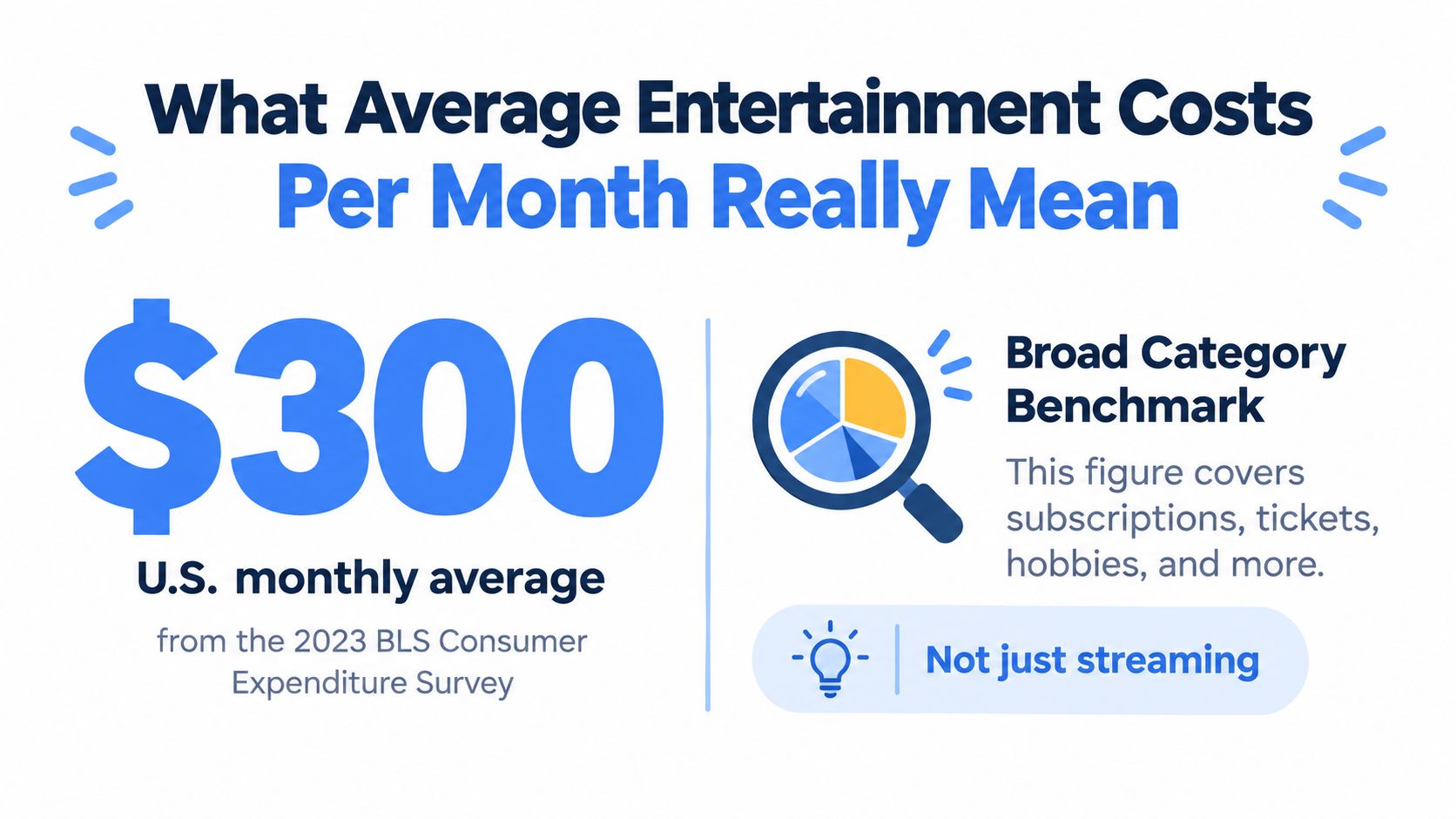
The BLS category includes fees and admissions, audio and visual equipment and services, pets and related products, toys, hobbies, playground equipment, and other entertainment goods and services. It captures far more than video subscriptions. The figure represented 4.7% of total annual consumer-unit spending, with average spending across all categories at $77,280, so it's useful for understanding the scale of the category, not for deciding what your household should spend on streaming.
Make recurring charges visible
A monthly service can look harmless in isolation. A $12 charge, for example, costs $144 over a year. Put several modest charges together with annual renewals and occasional purchases, and the total can become a meaningful part of your discretionary outflow.
That's why entertainment belongs in a household budget even when no single charge looks alarming. Don't ask only, “Can I afford this subscription today?” Ask whether you'd choose to pay its full yearly cost again.
Practical rule: Keep recurring media and episodic entertainment in separate budget lines. One is predictable; the other needs room for uneven spending.
Your fixed baseline should include subscriptions and other regular media costs. Your sinking fund should cover irregular plans such as a concert, a cinema visit, a game release, or an annual membership. That distinction makes it easier to see what you've committed to and what you're choosing as you go.
How Category Definitions Shape Every Average
An average only makes sense when you know what the source counted. The BLS entertainment category includes a wide range of household spending, while European statistics use categories that slice culture and recreation differently. Comparing figures without reading the definitions can make unlike budgets look directly comparable.
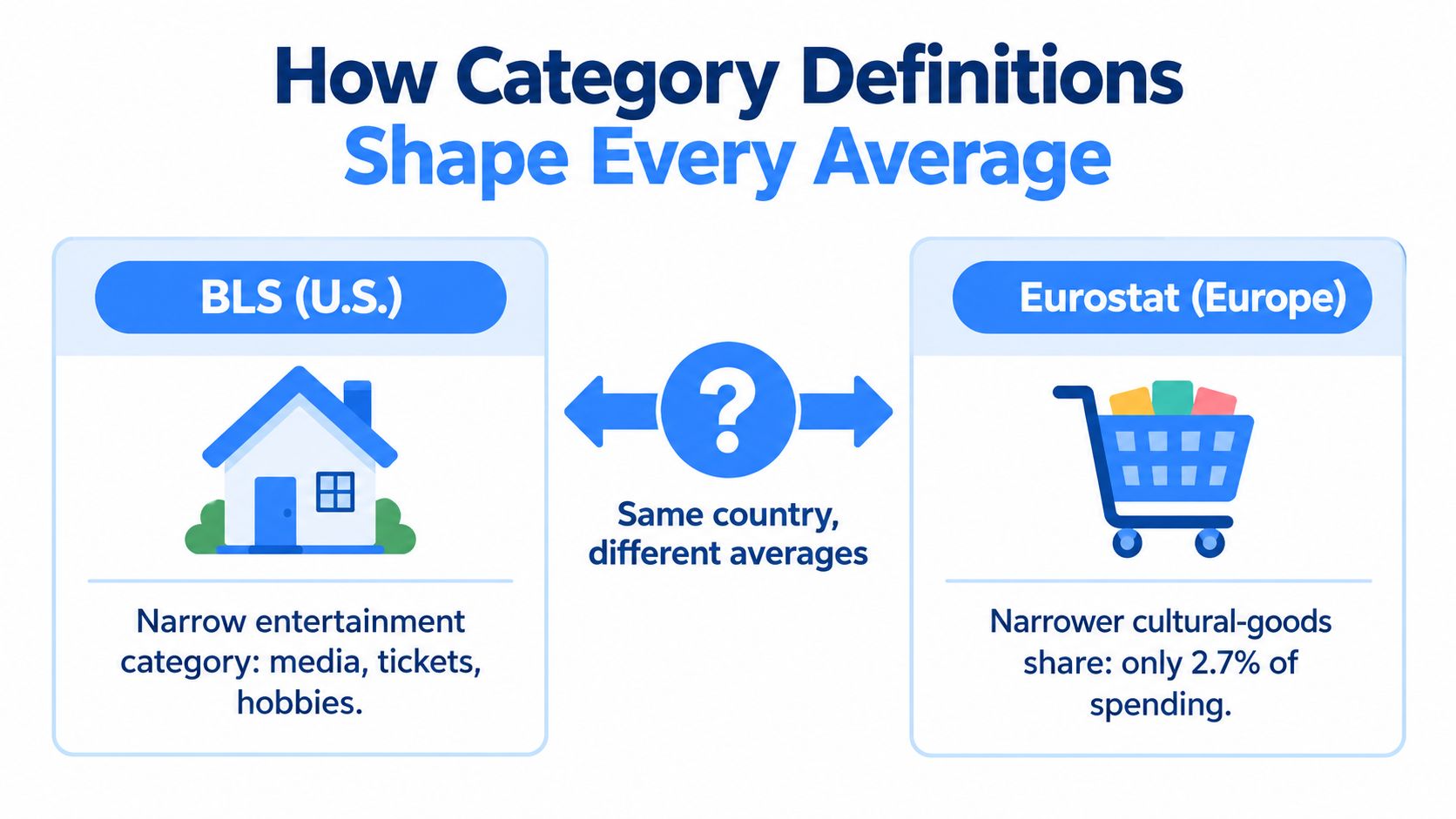
In 2020, EU households devoted 2.7% of total consumption expenditure to cultural goods and services, while the broader recreation-and-culture classification accounted for 8%. Those measures aren't additive. The 2.7% figure is narrower; the 8% figure includes a wider range of recreational goods and services, as described in Eurostat's household spending data.
Read the category before the headline
Within the narrower cultural budget, 27.0% went to information-processing and audio-video equipment and recording media, 25.1% to books and newspapers, 20.9% to broadcaster fees and equipment hire, and 13.6% to attendance and entertainment. Those figures show why “entertainment” doesn't mean the same thing in every dataset.
The reference year matters, too. Eurostat's figures describe 2020, when COVID-19 restrictions disrupted in-person attendance and changed the mix between live entertainment, equipment, and media access. Treat that year as historical context, not a clean template for a typical year of outings.
For a broader look at how budgets are organized, FloosYo's guide to personal budget categories can help you decide where these charges belong in your own records. Whatever tool you use, check whether a number measures cultural goods, recreation, subscriptions, or a wider entertainment basket before treating it as an affordability standard.
Where Your Household Falls in the Distribution
Two households can both spend near the average on entertainment and have nothing in common. One pays for nothing beyond broadcast TV. The other carries five subscriptions, a sports package, and monthly tickets. A single mean hides both of them.
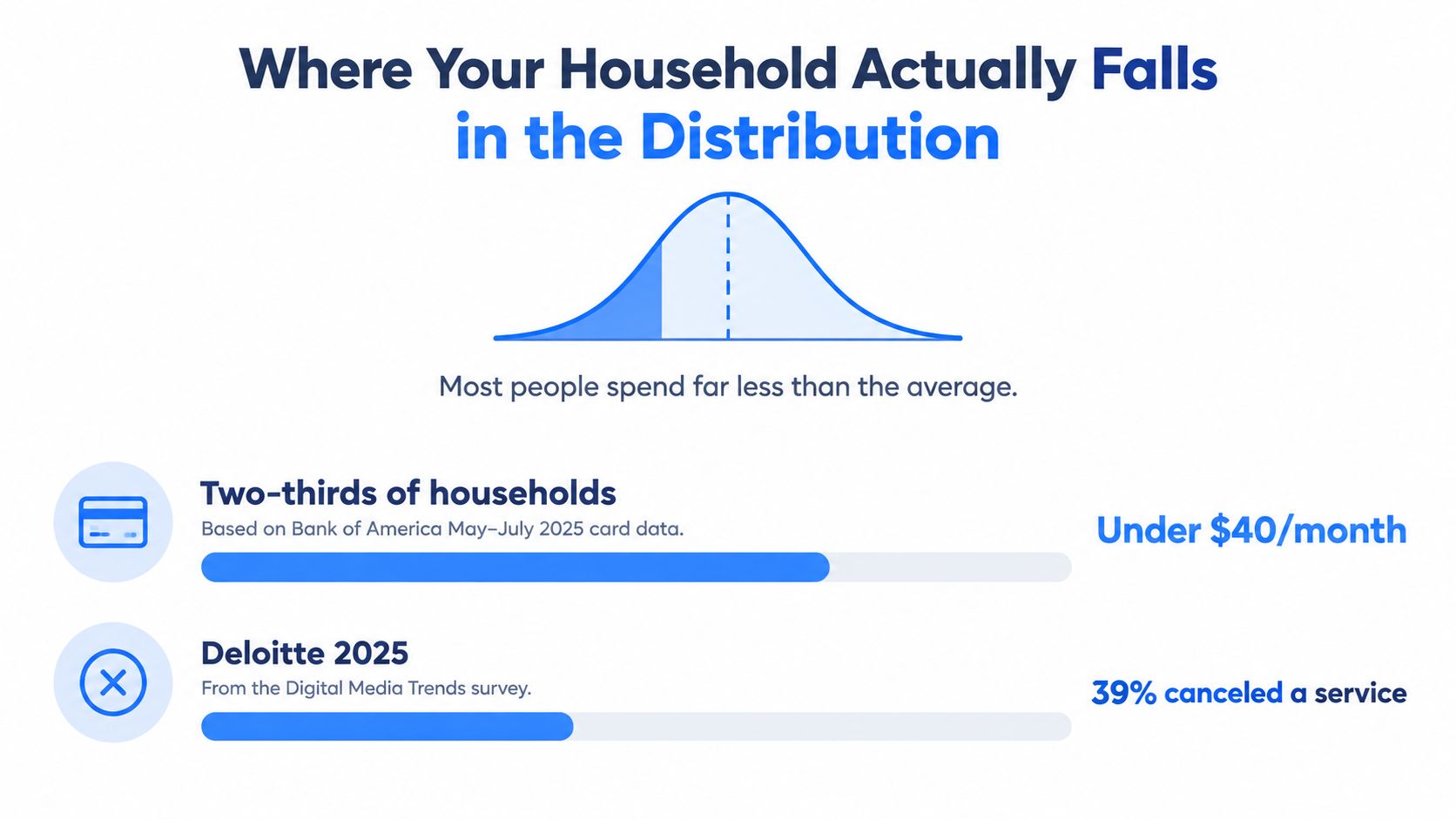
Bank of America card data for May through July 2025 found that two-thirds of households spent under $40 per month on TV and music streaming, while roughly 16% spent more than $80 and around 10% spent over $100. Read that spread carefully. Most households pay a modest amount, and a meaningful minority pays two to three times more. If your bill sits near the top, that says nothing about waste on its own. It says you have more to audit.
Deloitte's 2025 survey covers a narrower group, households that pay for streaming at all. It found an average of about $69 monthly across four paid services, up from $61 a year earlier, with millennials averaging roughly $76 per month.
Sort your spending into two buckets before you compare
Stop comparing your total to anyone else's. Split your entertainment spending into a fixed baseline, meaning every subscription that bills monthly, and a sinking fund for tickets, outings, and one-off purchases. Then run the questions that matter on each bucket.
For the baseline: is anyone still watching this service? Did a premium tier replace the basic one? Are two people in the same house paying separately for the same access? For the sinking fund: did last month's events fit the limit you set, or did they blow through it?
A bill above the national average fails no test on its own. A bill above what you planned does.
Compare the decision, not the household: Your entertainment cost is what you spend and choose to keep, not what a national mean says you ought to spend.
Why the Biggest Entertainment Drain Is Not the Subscription
Canceling a streaming service can help, but it isn't automatically the biggest available cut. The harder-to-see expense is episodic spending: an event ticket here, a special outing there, and an annual renewal that doesn't arrive with a monthly reminder.
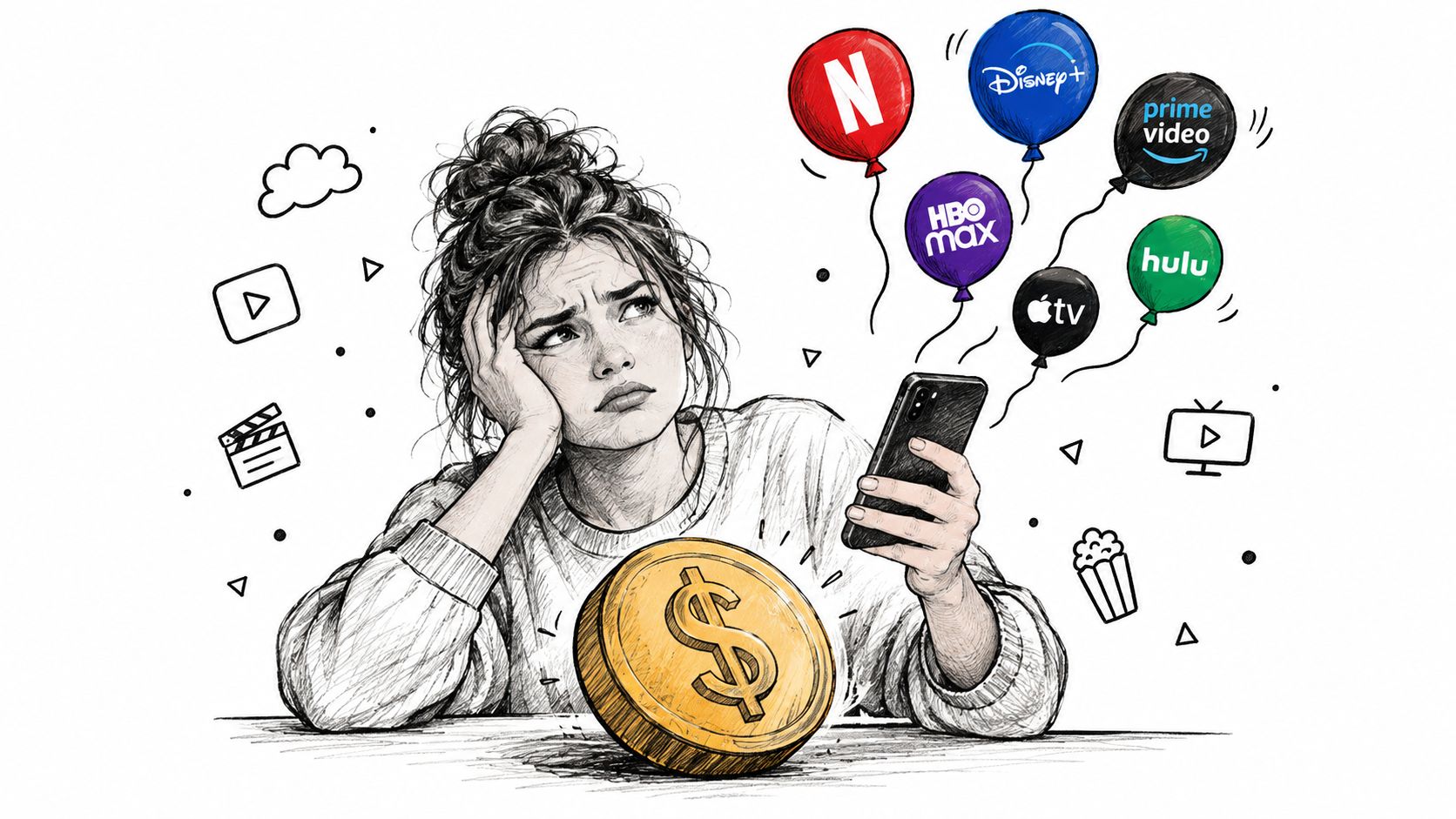
Deloitte's 2025 survey found that 39% of subscribers had canceled at least one streaming service in the previous six months, while 41% said the content wasn't worth the price, according to its Digital Media Trends findings. That's a clear reason to review subscriptions. But live entertainment prices have also risen: movie, theater, and concert admission increased 20% between 2021 and early 2025, according to the same survey.
Budget for both predictable and lumpy spending
Keep subscriptions in a fixed monthly baseline. Then set a separate sinking fund for events and irregular purchases. The first line tells you what you've committed to pay; the second gives you a planned limit for choices that don't arrive on a predictable billing schedule.
This changes the question from “Which service should I cancel?” to “Which costs are fixed, and which keep surprising me?” If subscriptions are already lean, trimming one more might save less than planning for the events you enjoy and deciding which ones fit your budget.
The point isn't to eliminate entertainment. It's to stop letting irregular spending masquerade as an exception every time it appears. A sinking fund makes those choices visible before you commit, so a large event purchase doesn't derail the rest of the month.
A short visual can also help prompt a subscription review. Use the video below as a reminder to inspect the recurring charges you still want, then apply the same scrutiny to episodic purchases.
How to Annualize Small Charges Before They Add Up
Annualizing converts charges with different billing rhythms into numbers you can compare. A monthly subscription, a once-a-year membership, and an occasional ticket don't look alike on a bank statement. Put them on the same yearly and monthly footing before deciding which one to keep.
The BLS recorded average U.S. entertainment spending of $3,609 in 2024, or about $300.75 per month, down 0.7% from $3,635 in 2023 even as total consumer expenditures grew, according to its 2024 Consumer Expenditure Survey. This is still a broad category, but it gives you a reference point for the exercise.
Convert each charge to a comparable amount
- A $12 monthly subscription costs $144 per year.
- A $300 annual event or membership works out to $25 per month when spread across the year.
- A $69 monthly streaming bundle amounts to $828 per year.
These are arithmetic examples, not a recommended spending level. Add your own recurring charges and irregular purchases, then compare the total with the budget you've chosen.
A month-by-month view can make the subscription look small while the yearly total changes your mind. The same applies to annual renewals: they may not appear in an ordinary month, but they still belong in the plan. Make both views available for every expense, rather than waiting until the charge lands to decide whether it was worth it.
For another way to think about accumulated charges, use this guide to calculate the annual total cost. The useful habit is straightforward: record the amount, billing frequency, and expected annual cost before a renewal or purchase turns into a surprise.
When Streaming Prices Rise Without Notice
Streaming is where your fixed baseline leaks without a single decision from you. You add nothing and change nothing, yet the bill still climbs. That is why the subscription half of your entertainment budget works best as a hard cap, checked against real statements instead of a rough estimate.
Across the ten largest paid U.S. streaming services, average subscription prices rose 12% in 2025, according to research reported by the Los Angeles Times. HBO Max's ad-free standard plan went up $1.50 per month to $18.49, and its annual plan rose $15 to $184.99. The monthly bump adds $18 across a full year. The annual version arrives as one renewal charge, all at once.
Put the increase beside the renewal date
Hulu's ad-supported plan moved from $7.99 to $9.99 per month in October 2024, with its annual price going from $79.99 to $99.99. Disney+ Premium's ad-free plan rose from $13.99 to $15.99 per month, and its annual price from $139.99 to $159.99, according to PCMag's streaming price guide.
| Service and plan | Old price | New price | Extra yearly cost |
|---|---|---|---|
| HBO Max ad-free standard, monthly | $16.99/month | $18.49/month | $18 |
| HBO Max ad-free standard, annual | $169.99/year | $184.99/year | $15 |
| Hulu ad-supported, monthly | $7.99/month | $9.99/month | $24 |
| Hulu ad-supported, annual | $79.99/year | $99.99/year | $20 |
| Disney+ Premium ad-free, monthly | $13.99/month | $15.99/month | $24 |
| Disney+ Premium, annual | $139.99/year | $159.99/year | $20 |
Treat the renewal date as the decision date. An annual plan locks in the price for twelve months, so it is the cheaper choice only for a service you open every week. Anything you watch in bursts belongs on a monthly plan you cancel between seasons. When a price rise lands, run one test: if you have not opened the app since the last increase, the service already answered for you. Cancel it, and move the freed amount into your events fund, where the money buys something you chose.
How FloosYo Turns Recurring Spending Into Decisions
A tracker that only reports last month's spending leaves you to do the hard part. The useful workflow identifies recurring charges, shows their projected monthly and yearly costs, and prompts a decision before the next payment.
FloosYo connects to bank accounts through Plaid and automatically detects repeating transactions, filing them as recurring expenses with merchant details and logos. It also lets you capture expenses by voice or text when a bank transaction doesn't show the full picture. Each expense can be viewed in monthly and yearly terms, so the actual cost is visible before the next charge lands.
Decide before the charge
For each item, choose whether to keep it, skip a cycle, or cancel it. The app can show estimated savings scenarios, and its renewal reminders and consolidated digests help you act before billing rather than after it. When you skip a bill, the amount not spent can move automatically toward a savings goal, so the decision is recorded rather than left to memory.
That makes the app a decision tool, not just a record of what already happened. If you want to see how recurring expense tracking can save time and money, focus on whether a tool helps you act on a projected cost, not merely chart it after the fact.
Bank access is read-only, so the app can read transactions but can't move money. FloosYo states that bank credentials don't reach the app, sensitive account details are encrypted at rest, and inbound Plaid messages are signature-verified. Its workflow is based on tracking, reminders, and user-directed spending choices.
Your 30-Day Plan to Lower Entertainment Costs
You don't need a perfect budget to make a clear decision about entertainment. Use the next month to expose the recurring charges, make deliberate cuts, and give irregular events their own limit.
Week one, find the full baseline
List each recurring subscription and entertainment-related bill. Use bank transactions where available, and add charges the bank doesn't reveal clearly, such as a membership you paid another way. Convert every recurring amount to a yearly total and separate it from one-off events.
Week two, make the keep-or-cut decisions
Pick the services that have risen in price, aren't being used, or overlap with something you already have. For each one, choose: keep it, downgrade it, skip a cycle, or cancel it before the next charge. Don't keep paying because the subscription has been on the statement for a long time.
Week three, plan for events
Set a separate sinking fund for concerts, cinema visits, games, and other occasional entertainment. This gives you room to spend on experiences without pretending they're predictable monthly bills. If the planned amount isn't enough for an event, choose whether to wait, spend less elsewhere, or skip it.
Week four, protect the decisions
Turn on renewal reminders and review the yearly totals before the next billing dates. Track what you chose to skip and where the savings are going, so a cancellation becomes a visible change rather than a vague intention.
The U.S. average is roughly $300 per month, but that broad figure isn't a streaming target. Some households spend far less on streaming; others may overlook the larger effect of lumpy events and renewals. Your entertainment cost is a decision, not a fixed line.
FloosYo identifies recurring charges, projects monthly and yearly costs, and provides renewal reminders, skip or cancel choices, and savings tracking. Review your entertainment baseline and event spending with FloosYo before the next renewal lands.