
Consumers estimate they spend $86 a month on subscriptions, but after listing each service, the average rises to $219, creating a $1,596 annual blind spot. The fix is simple: identify every recurring charge, see its yearly cost before renewal, and make a keep, skip, downgrade, or cancel decision in time.
You check your bank account and recognize the balance, but not the pattern. A phone plan charged last week, a cloud-storage fee due tomorrow, an old fitness app billing next month, and several small daily purchases have blended into one vague feeling that money is disappearing. You don't need another chart explaining what already happened. You need a decision before the next charge lands.
Table of Contents
- The Subscription Blind Spot
- How FloosYo Detects Hidden Spending Automatically
- Turning Monthly Costs Into Yearly Decisions
- Why Pre-Charge Alerts Beat Post-Spending Charts
- The Skip-to-Goal Workflow
- Overcoming Cancellation Friction
- Building Sustainable Financial Habits
The Subscription Blind Spot
A renewal can pass without notice while you are checking your balance, paying bills, or handling routine purchases. One small charge rarely changes your plan for the month. Repeated can redirect money from savings, debt payments, or other household priorities.
In a 2022 survey of 1,000 U.S. consumers, C+R Research found that respondents estimated subscription spending at about $86 per month. After listing services individually, the reported average rose to $219 per month, a gap of $133 monthly, or roughly $1,596 annually (C+R Research subscription spending findings).
The problem is visibility, not arithmetic. A charge feels harmless when it appears alone, then becomes expensive when it repeats for months. Autopay removes the payment decision from the moment money leaves the account, so the customer often notices the cost only after the spending has accumulated.
C+R Research also found that 42% of participants continued paying for at least one subscription they no longer used but had forgotten to cancel. Seventy-four percent said recurring charges were easy to forget, and 72% had placed subscriptions on autopay. Those findings point to a specific failure in the process: discovering a charge does not guarantee that anyone will act before the next renewal.

Visibility must lead to action
Finding an unused service is only the first job. If cancellation waits until later, the discovery has not saved money. It has created another task that can be forgotten.
Use the pre-renewal window to answer four questions:
- What is the service? Confirm the merchant and whether the charge is a subscription, household bill, or habitual purchase.
- When is the next charge? Treat the renewal date as a deadline for action.
- What does it cost yearly? Convert the recurring amount into a total you can compare with a real goal.
- What will you do? Keep it, monitor it, downgrade it, skip a cycle, or cancel it.
FloosYo connects recurring transactions with projected monthly and yearly totals, then gives each charge an action choice. That approach turns a record of past payments into a decision ahead of renewal. Set the decision before the charge arrives, or the money will leave first and the review will come too late.
How FloosYo Detects Hidden Spending Automatically
Manual expense tracking fails for a predictable reason. It asks you to remember every merchant, open every statement, classify every transaction, and keep doing it long after the initial motivation fades. A system that imports transactions removes much of that administrative work, leaving you with the part that requires judgment.
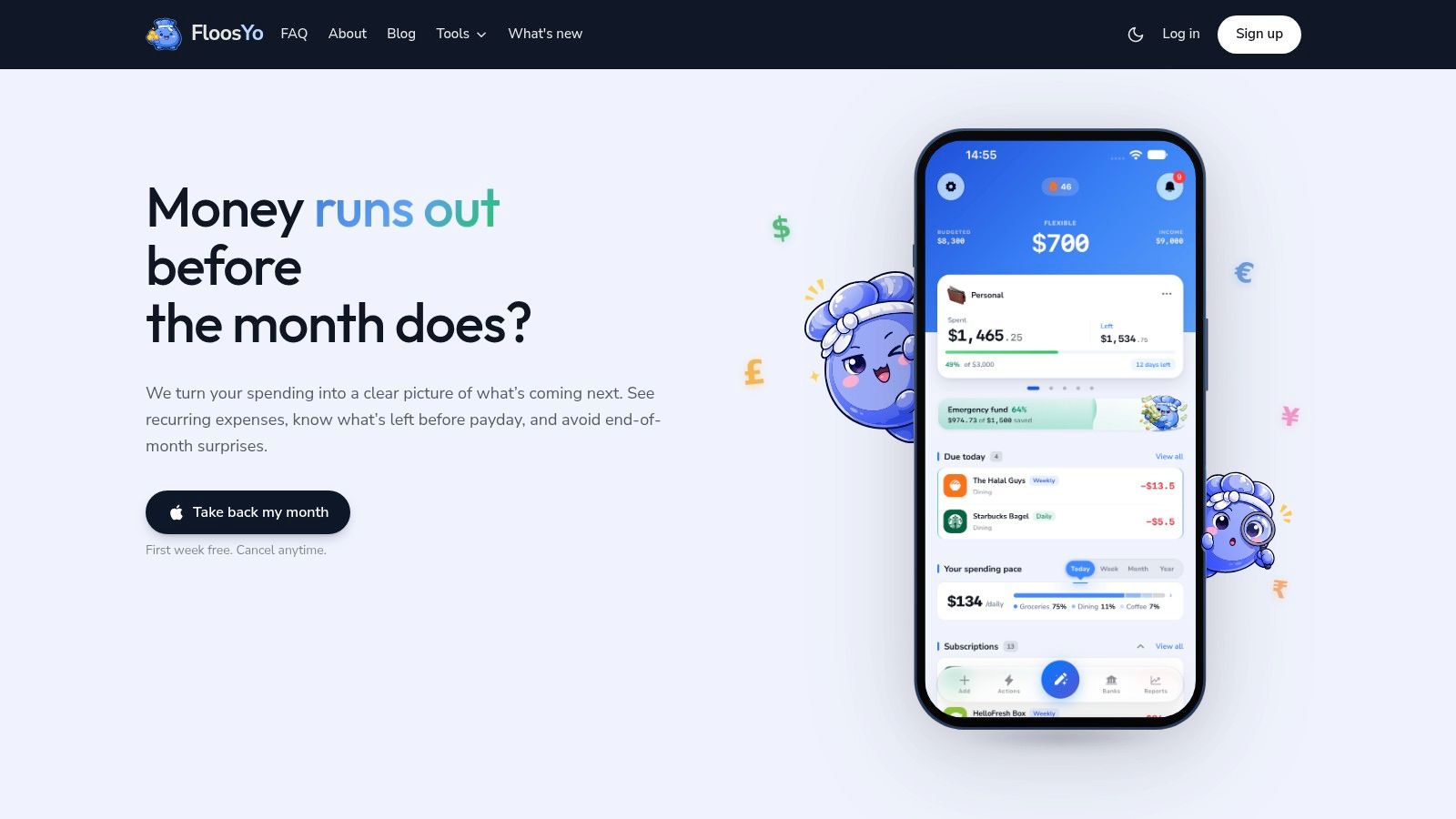
FloosYo connects through Plaid to 12,000 financial institutions across 20 countries, with sign-in taking place on the bank's own screen. Credentials don't reach FloosYo. The app reads transaction data, detects charges that repeat, and files them as recurring expenses according to their amount and rhythm.
Automation removes repetitive work
Transactions arrive pre-categorized and can include the merchant's real logo, drawn from a library of 298 brands. That detail isn't decorative. A recognizable logo helps you identify a charge quickly, especially when the bank statement uses a legal entity or payment processor that doesn't match the name you remember.
Bank data still doesn't capture everything. Cash purchases, informal bills, and work-related expenses may never appear as recurring bank transactions. Voice or text entry covers those gaps. You can describe an expense in ordinary language, and the app parses the amount, category, and frequency instead of forcing you through a long form.
Practical rule: Automate discovery, then reserve your attention for the decision.
Automation saves time and money together. McKinsey Global Institute scenario modeling estimated that automation could raise global productivity growth by approximately 0.8 to 1.4 percentage points annually, assuming displaced workers return to productive employment. Its analysis also connects automation with improvements in throughput, quality, safety, and downtime, not only labor-cost reduction (McKinsey Global Institute automation analysis).
For household finance, the principle is straightforward. When a tool finds transactions, identifies merchants, calculates recurring totals, and remembers renewal dates, you stop spending your limited attention on clerical work. You can then decide whether an expense still earns its place.
A bank-connected tracker can provide the foundation, but a useful workflow must also include expenses the bank misses, future projections, and a clear action. Expense tracking with bank sync is most valuable when synchronization leads to a timely decision rather than another passive dashboard.
The interface should make the result obvious: this merchant charges this amount, the next payment is approaching, the annual projection is this much, and these are the available choices. That is the difference between collecting data and using it.
Turning Monthly Costs Into Yearly Decisions
Monthly pricing is designed for easy acceptance. A $15 charge feels minor because your mind evaluates it against the current month. The better question is what the service costs across the period you expect to keep it.
A $15 monthly charge becomes $180 over 12 months. That calculation is not complicated, but visibility changes the decision. You can compare $180 with a household need, a planned purchase, or a savings goal instead of treating the charge as too small to matter.
The annual number creates a deadline
A monthly view answers, “What leaves my account now?” An annual view answers, “What am I agreeing to spend if I keep this?” The second question is more useful when a subscription renews automatically.
Consider three recurring expenses:
| Expense | Monthly view | Yearly decision |
|---|---|---|
| Cloud storage | $15 | $180 over 12 months |
| Phone add-on | Recurring monthly fee | Compare the yearly total with a cheaper plan |
| Food delivery habit | Repeated purchases | Decide whether convenience justifies the projected outflow |
Only the first example has a specific amount provided here. For the others, the method matters more than an invented figure. Use the actual transaction history, then compare the projected total with what the service delivers.
The same approach works for annual billing. The FTC's required disclosures for recurring-payment offers include whether charges recur, the deadline for stopping them, the amount or possible range of costs, and the cancellation method. A $120 annual renewal should be compared with the equivalent recurring total before you decide to continue (analysis of the FTC cancellation rule).
A cost becomes easier to challenge when you can name its deadline and its yearly consequence.
Annual subscription cost calculations turn small repeat payments into comparable choices. FloosYo's projections show monthly and yearly totals for recurring expenses, then attach possible savings to actions such as skipping or canceling. The point isn't to eliminate every convenience. It's to make the tradeoff visible before another payment becomes history.
A service you use frequently may deserve to stay. A service you rarely open may not. A valuable service with an inflated price may deserve a downgrade or negotiation. Annualization doesn't make the decision for you, but it removes the excuse that the cost was too small to notice.
Why Pre-Charge Alerts Beat Post-Spending Charts
A retrospective chart can tell you where money went last month. It can't stop next week's renewal. That makes most budgeting dashboards useful for diagnosis but weak at prevention.
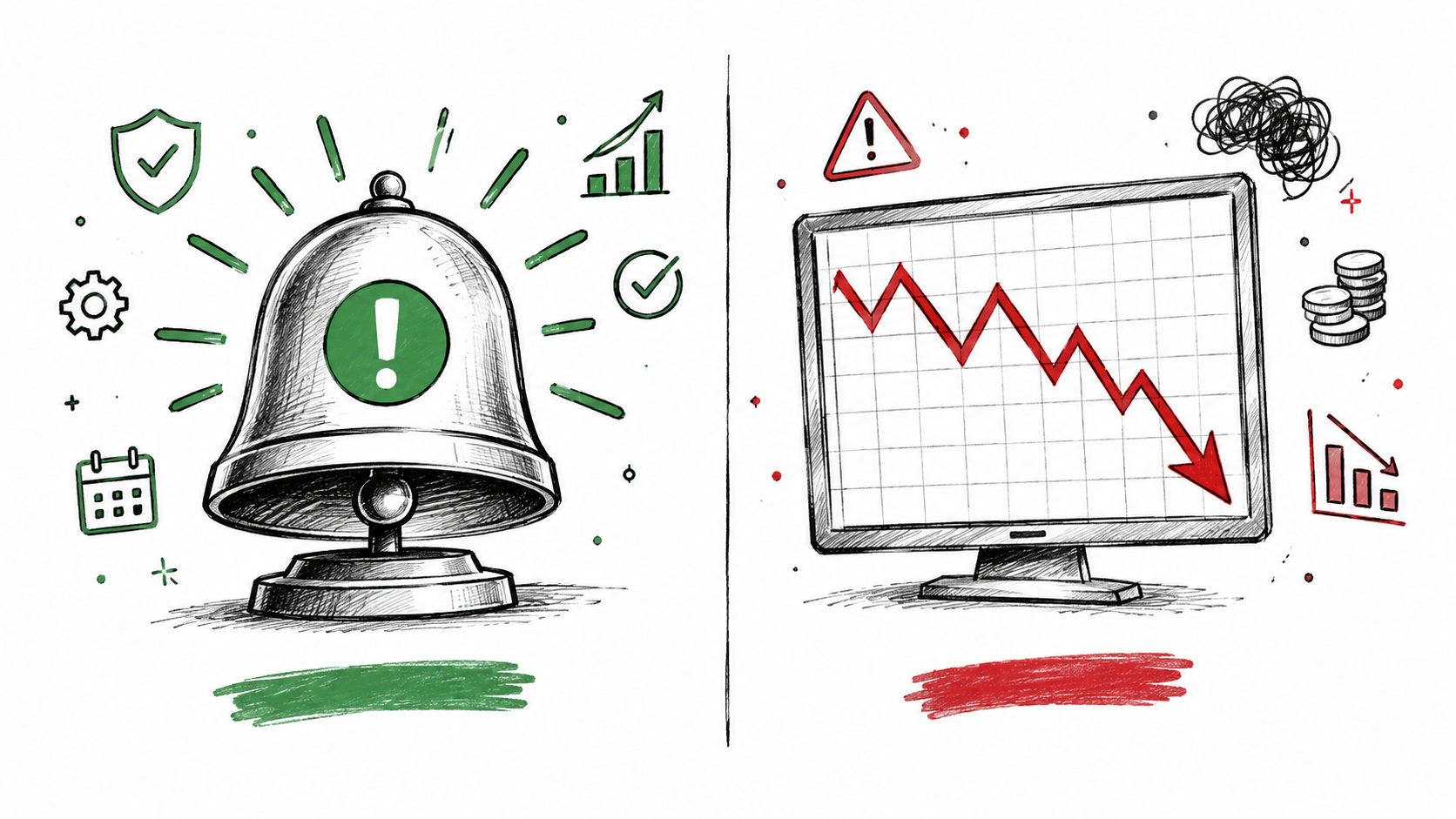
A pre-charge alert arrives while you still have options. You can check whether the service is still useful, verify the amount, find the cancellation route, or choose to skip a cycle. The alert turns an automatic event into a deliberate decision.
Regulation supports the decision point
The Federal Trade Commission's 2024 final Negative Option Rule applies to almost all recurring-payment programs, including automatic renewals and free-to-paid conversions. Before charging a customer, sellers must clearly disclose material terms, obtain express informed consent to the recurring feature, and provide a simple cancellation mechanism that immediately stops recurring charges (FTC announcement of the final rule).
The FTC also requires cancellation to be at least as easy as enrollment. If you joined online, the seller must provide an accessible online cancellation method instead of burying the option behind unnecessary obstacles (FTC guidance on cancellation requirements).
Those rules don't cancel a subscription for you, and they don't replace attention. They give you a stronger basis for reviewing the renewal date, recurring amount, and cancellation route before payment.
Prevention beats explanation
Field experiments across three banks found that reminders increased the probability customers reached a defined savings goal by 3 percentage points and increased the total amount saved at the reminding bank by 6% (research on reminders and savings behavior). The useful design lesson is timing. A reminder should arrive close enough to the expense to prompt action, with a clear amount attached.
A generic monthly report says you spent too much. A pre-charge notification says a specific expense is about to happen and shows what you can preserve by stopping it. That is a far more actionable message.
The Skip-to-Goal Workflow
Awareness doesn't automatically become savings. People often recognize an unnecessary charge, intend to move the money elsewhere, and then let the next task take over. The missing link is an automatic follow-through step.
The workflow should be short:
- Receive the alert. The notification identifies the recurring expense, its upcoming charge, and the projected monthly or yearly impact.
- Make the decision. Keep the service, monitor it, downgrade it, skip a cycle, or cancel it.
- Choose the goal. Direct the avoided amount toward one defined savings target.
- Record the result. Track the amount preserved and the cumulative progress without entering the same transaction again.
FloosYo supports this pattern with pre-charge notifications, skip and cancel decisions, estimated savings scenarios, and automatic goal funding. The bank connection is read-only, so the app doesn't move money from your bank. Instead, it records the saved amount and makes the intended allocation visible, which keeps the workflow focused on outflow prevention and goal progress.
Why the second action matters
The first action is cancellation. The second is what happens to the money you didn't spend. If you don't assign it, the amount can blend into ordinary purchases and disappear from your plan.
Research summarized by the National Bureau of Economic Research found that automatic enrollment increased retirement-plan participation by 50 percentage points, a 135% relative increase, while increasing contribution rates by 1.14 percentage points (NBER research on automatic enrollment). That evidence concerns retirement plans, not subscription cancellation, but the behavioral principle transfers: removing repeated initiation and memory requirements makes follow-through more likely.
One goal at a time is a sensible constraint. It prevents a skipped bill from being divided across multiple vague intentions. You see the amount preserved, the goal receiving it, and the cumulative result.
Decision standard: Don't call a charge “saved” until you know what the money will do next.
For example, skipping six $15 monthly charges prevents $90 of spending, without assuming any return on the money (subscription cancellation analysis). The honest calculation is the avoided outflow. Automatic goal tracking then gives that decision a visible destination.
Overcoming Cancellation Friction
The problem starts after you spot a charge. A subscription may be buried in an account menu, hidden behind a support chat, or tied to a login you last used months ago. By the time you remember it, the renewal clock is already working against you.
Recent survey data found that 75% of subscribers who tried to cancel encountered obstacles, while only 39% succeeded on their first attempt. Twenty-four percent couldn't find the cancellation option, and 25% had to contact customer support (subscription cancellation friction report).
That gap changes the playbook. Review the expense before renewal, find the cancellation path, and leave enough time to finish while the charge is still avoidable.
Use a pre-renewal checklist
Start with value, not habit. If you no longer use the service, cancel it. If you still use it but the price is too high, look for a downgrade, pause, lower tier, or a direct price discussion.
Then work through the job in order:
- Confirm the next charge: Record the amount and renewal date.
- Open the account: Use the merchant's website or app rather than relying on a bank description.
- Find the control: Look for billing, plan, membership, or account settings.
- Choose the least expensive adequate option: Cancel, pause, downgrade, or skip if available.
- Save confirmation: Keep the cancellation reference or confirmation screen.
- Check the bank record: Make sure a later charge doesn't appear.
The FTC requires recurring-payment disclosures to identify the deadline for stopping charges and the cancellation method. It also requires cancellation to be as easy as enrollment, which matters most when you signed up online (FTC cancellation guidance). A hard-to-use interface is friction, not a dead end.
FloosYo's guide to canceling subscriptions fits this workflow because it focuses on the task itself. The app can surface the recurring charge and the decision point, but you still have to finish the merchant cancellation and verify that the charge stops.
Price increases need their own check. The same survey found that price hikes caused more frustration than cancellation trouble or automatic renewal. That is the number to watch when a renewal date is close. A pre-renewal review lets you catch the increase before it becomes an accepted cost.
Building Sustainable Financial Habits
Willpower is a poor financial system. It works when you remember the expense, have time to investigate it, feel motivated to act, and remember to redirect the money afterward. That chain breaks easily during a busy week.
Automation reduces the number of steps you must repeat. FloosYo is built for iOS and combines bank-supplied transactions with voice entry, renewal notifications, consolidated due-date digests, and five home-screen widgets for upcoming expenses, goal progress, and budget standing. You can review the relevant information without rebuilding your entire spending history each time.
Make review small and regular
A durable routine has a few clear rules:
- Review before renewal: Treat the alert as a deadline for a decision.
- Use voice for missing expenses: Capture cash, informal bills, or work tools without lengthy manual entry.
- Keep categories understandable: Rename and recolor categories so the information matches how you think.
- Track the outcome: Record skipped or canceled expenses against one goal and watch the cumulative amount.
This approach saves time and money because it replaces repeated mental accounting with a short review process. It also prevents a common mistake, cutting one expense without measuring whether the avoided amount stayed available for something important.
A 2025 CNET and YouGov survey reported that U.S. adults spent an average of $1,080 annually on subscriptions, including about $17 per month, or more than $200 per year, on services they didn't use. Gen Z reported an unused amount of $23 per month (CNET and YouGov subscription survey). The lesson isn't to cancel everything. It's to connect each decision with what you want the money to accomplish next.
FloosYo offers bank-connected recurring-expense detection, voice and text capture, annual projections, pre-charge reminders, skip and cancel decisions, and savings-goal tracking for iOS users. If forgotten renewals and small habitual charges are draining your plan, FloosYo gives you a practical way to identify them, act before payment, and track the money you keep.