
You buy a few bags on Saturday, add a midweek milk run, and pick up something convenient on the way home. None of those charges looks dramatic. By the end of the year, though, a two-person household can lose a meaningful amount through repeated trips, unused ingredients, delivery fees, and food that never becomes a meal.
The right grocery plan depends less on finding one “perfect” budget and more on choosing the trade-off you can sustain. A warehouse strategy may lower unit costs but create storage and waste. Prepared foods may cost more than cooking from scratch but reduce restaurant spending. Fresh produce may support your priorities while making seasonal costs less predictable.
The eight plans below judge each approach by its projected monthly and yearly cost for two, the shopping list it requires, and the single decision it forces you to make. The examples are planning scenarios, not universal prices. Your location, diet, package sizes, shopping habits, and food waste will change the result.
For context, two-person U.S. consumer units spent $6,088 on food at home in 2024, equal to approximately $507.33 per month or $117.08 per week, according to the BLS series reported by the Federal Reserve Bank of St. Louis. Use that as a reference point, not a target.
Table of Contents
- 1. Budget-Friendly Staples List for Two
- 2. Meal-Prep and Batch-Cook List for Two
- 3. Plant-Forward Grocery List for Two
- 4. Convenience and Pre-Prepared Foods List for Two
- 5. Bulk and Warehouse Club List for Two
- 6. Mixed Diet with Flexitarian Grocery List for Two
- 7. Fresh, Local, and Seasonal Grocery List for Two
- 8. Household Staples Plus Subscriptions Approach for Two
- Groceries for Two: 8-Option Comparison
- Choose One Strategy and Set Its Yearly Limit
1. Budget-Friendly Staples List for Two
A low-cost staples plan works when both people are willing to eat from a narrow group of dependable ingredients. The list might include rice, oats, pasta, potatoes, dried or canned beans, lentils, eggs, store-brand yogurt, milk, frozen vegetables, onions, carrots, bananas, canned tomatoes, bread, and a modest amount of cheese or other protein.
The savings come from repeat use, not from buying everything in the largest package. A large bag of rice makes sense if you use it regularly. A family-size package of fresh food doesn't save money if half of it spoils. USDA-based guidance also recognizes a small-household disadvantage. Its food plans are calculated around four-person households, and the Economic Policy Institute's family-budget documentation notes that USDA recommends adding 10% for two-person households because smaller households capture fewer economies of scale.
A practical weekly list can be divided like this:
- Pantry base: Rice, oats, pasta, flour, canned tomatoes, beans, and spices.
- Affordable protein: Eggs, lentils, chickpeas, tofu, and occasional poultry.
- Produce: Frozen vegetables plus fresh items that can serve several meals.
- Flexible extras: Yogurt, bread, cheese, fruit, and one planned treat.
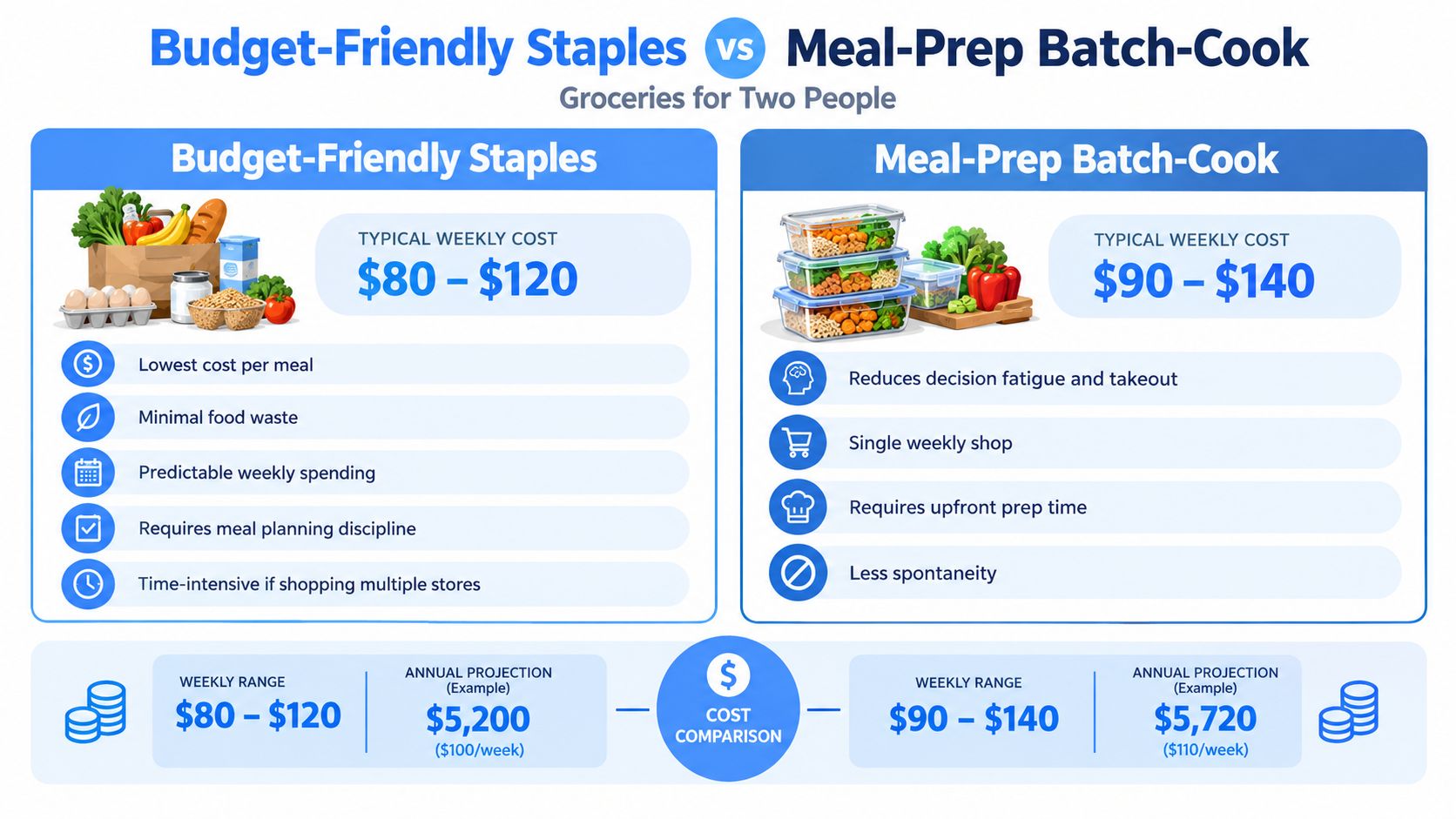
At $100 per week, the sample plan projects $400 per month and $5,200 per year, calculated as $100 multiplied by 52 weeks. The decision is simple: can you explicitly reserve that yearly amount, or will you reduce the weekly shop?
Practical rule: Store brands and bulk purchases only help when you already know how you'll use them.
Log the regular grocery day in FloosYo's guide to grocery shopping on a budget as a recurring transaction. Use voice entry for top-ups, such as “groceries, milk and bread, five dollars,” then review the monthly and yearly projection before the next trip.
2. Meal-Prep and Batch-Cook List for Two
A couple with changing weeknight schedules can spend Sunday preparing grains, beans, chicken or another preferred protein, sauces, and vegetables. The useful shopping list also includes onions, garlic, pasta, yogurt, fruit, and freezer-safe containers. Choose ingredients that can serve several meals, then assign each portion a planned use before buying more.
Worked scenario: A $110 weekly prep shop reaches $440 per month on a four-week planning view and $5,720 per year across 52 weeks. That annual limit forces one decision: will the household protect a regular cooking session, or pay for more convenience when plans change?
The trade-off is time against food waste. A batch that becomes three dinners can replace repeated preparation and reduce unplanned takeout. A batch that remains untouched ties up money and freezer space. Freeze portions with dates, leave one flexible meal night, and use top-up trips only for missing staples.
Keep prepared-food purchases separate from groceries. That comparison shows whether the prep routine changes total food spending, rather than merely producing a controlled supermarket bill. The household spending figures in the household spending report cover all household sizes, so they should not be read as a direct benchmark for a two-person plan. Restaurant meals, delivery, and takeout belong in the separate prepared-food category.
Record the main shop in FloosYo's grocery budget worksheet, then compare it with those convenience transactions. A recurring Sunday entry establishes the baseline. FloosYo's skip function can model a week without the prep run, while voice capture records small additions before they disappear from the total.
Review what the couple ate before repeating the list. The freezer should support the plan, not become storage for meals no one wants.
3. Plant-Forward Grocery List for Two
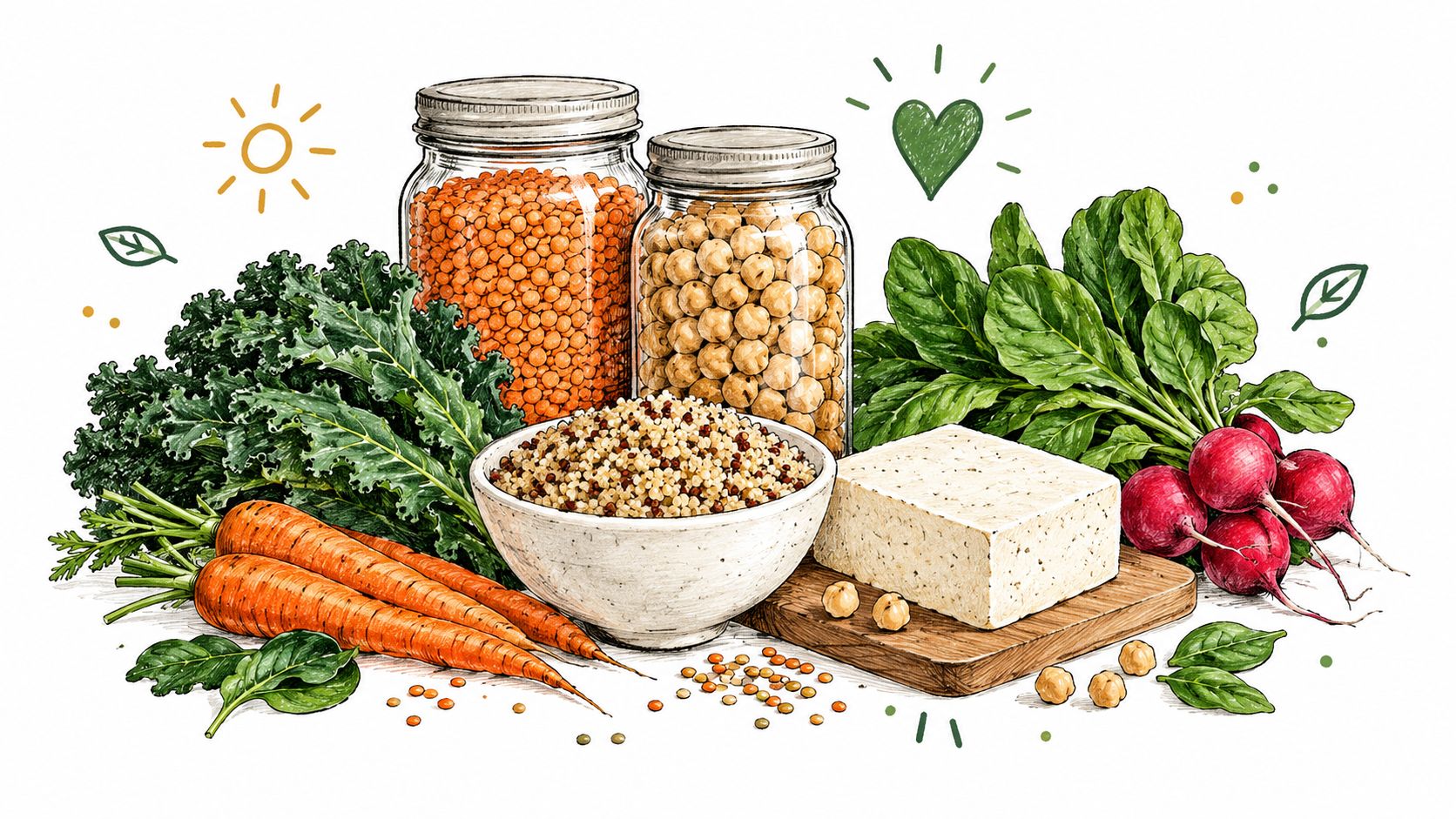
A plant-forward basket centers on lentils, chickpeas, beans, rice, oats, pasta, tofu, seasonal vegetables, frozen produce, fruit, bread, and dairy or non-dairy alternatives that the household actually uses. It can lower the cost of a weekly shop, but only if inexpensive staples replace premium substitutes rather than sitting beside them.
At $80 per week, the example projects $320 per month on a four-week view and $4,160 per year. That figure is a planning scenario, not a universal plant-based benchmark. Dried goods may be inexpensive per unit, while specialty products, out-of-season produce, and frequent farmers-market trips can push the total higher.
The best test is to separate the base basket from discretionary additions. Log bulk legumes, grains, and ordinary produce under “Groceries.” Use a separate category for specialty ingredients or occasional produce runs. That distinction shows whether the plan is affordable because of its core ingredients or because some purchases aren't being counted.
Plant-forward shopping reduces the price of a meal only when the household cooks and eats the ingredients before they spoil.
A couple can use FloosYo's voice entry for a market visit, such as “groceries, farmers market, twelve dollars,” then compare the addition with the recurring base. The single decision is whether premium ingredients improve the household's meals enough to deserve a fixed place in the yearly limit.
Try a short substitution cycle:
- Keep the base: Lentils, rice, chickpeas, oats, beans, and frozen vegetables.
- Rotate the produce: Buy whichever suitable vegetables are available at a reasonable price.
- Separate preferences: If one person eats animal products, track those purchases separately instead of hiding them inside the shared total.
A planned reduction in the recurring amount can be modeled before changing the shop. FloosYo's projected savings view turns “we should spend less” into a specific choice about premium foods, specialty items, or extra trips.
4. Convenience and Pre-Prepared Foods List for Two
Convenience groceries are not automatically wasteful. Rotisserie chicken, prepared salads, frozen meals, pre-cut vegetables, deli items, and ready-to-heat dishes can be a rational purchase when cooking time is scarce. The mistake is treating the convenience premium as invisible.
A $150 weekly shop projects $600 per month on a four-week view and $7,800 per year. A household paying $200 per week for takeout would project $10,400 per year, so the convenience grocery plan could still reduce total prepared-food outflow in this example. Those figures are scenarios for comparison, not claims about your local prices.
Build the list around the meals that would otherwise trigger an unplanned order:
- Fast proteins: Rotisserie chicken, eggs, tofu, or frozen fish.
- Ready vegetables: Prepared salads, frozen vegetables, and pre-cut produce.
- Emergency meals: Frozen dishes, soup, bread, yogurt, and fruit.
- Controlled extras: One or two convenience items, not an open-ended basket.
The decision is whether the time saved is worth the added grocery cost. Track convenience groceries separately from takeout and restaurants in FloosYo. If the prepared grocery shop replaces more expensive outside meals, keep it. If it becomes an extra layer on top of normal groceries, reduce it.
A hybrid approach often works better than a complete switch. Cut the convenience shop by 25% in your own plan, prepare one simple component in advance, and compare the result over a month. Don't assume the saving is real until the bank transactions support it.
Use voice entry for impulse purchases, such as “groceries, pre-made salads, eight dollars.” A recurring weekly entry handles the planned shop, while individual additions reveal whether convenience is concentrated in the main basket or leaking through repeated top-ups.
FloosYo's skip feature can model skipping one planned shop, but the result should be judged against replacement spending. Skipping groceries only saves money if the household doesn't replace them with delivery or restaurant charges.
5. Bulk and Warehouse Club List for Two
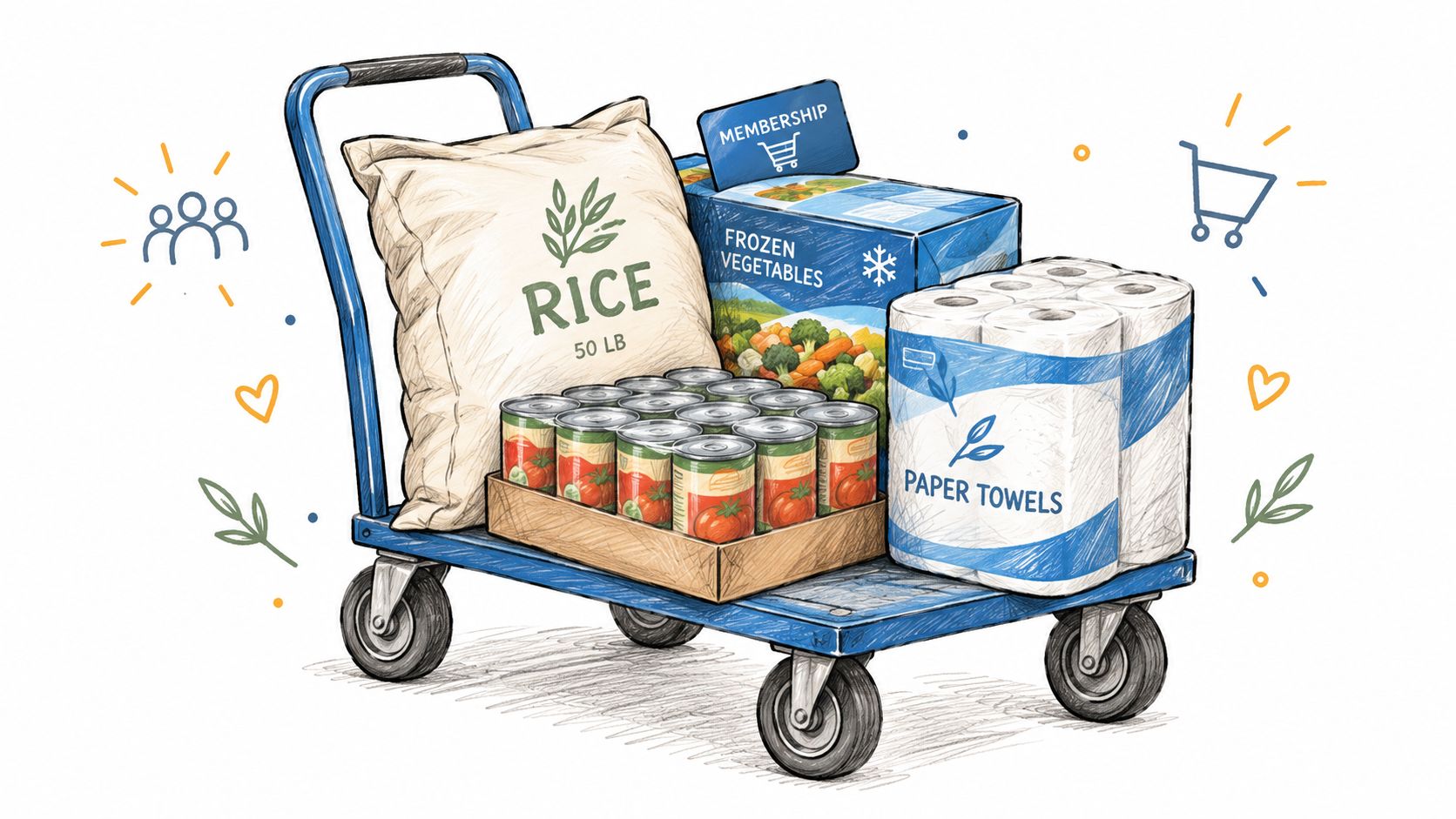
Warehouse shopping suits two people when the household has storage space, predictable consumption, and enough discipline to avoid buying because an item appears inexpensive. A useful list includes rice, oats, canned vegetables, frozen produce, shelf-stable beans, selected proteins, toiletries, and cleaning products. Keep fresh items and fragile specialty foods out of the bulk basket unless you already have a clear use for them.
Suppose a couple spends $180 every five weeks on warehouse groceries. That projects $1,872 per year, calculated from 52 weeks divided by five and multiplied by $180. Add a $120 annual membership, and the all-in example becomes $1,992 per year, or approximately $166 per month across twelve months. This is a planning scenario, not a promise that warehouse shopping will cost less in every household.
The membership must be treated as part of the grocery strategy. Log it as a separate annual recurring charge in FloosYo, then add traditional-store top-ups separately. A low warehouse total can be misleading if the household still makes frequent regular-store trips.
The warehouse test: Buy bulk only when the household can finish the package before quality drops or the product becomes forgotten inventory.
Use a five-week recurring entry for the main trip and voice-capture additions, such as “groceries, regular store, thirty dollars.” Then review the combined projection before renewing the membership.
The single decision is whether the lower unit cost beats the cost of storage, waste, and supplemental shopping. If the warehouse trip is large but predictable, set aside the amount before the charge arrives. If it creates repeated top-ups, the strategy isn't doing the job.
Roommates can also use separate categories for shared food, individual food, and household supplies. FloosYo's customizable categories help keep reimbursements and personal outflows distinct without losing sight of the total household spend.
6. Mixed Diet with Flexitarian Grocery List for Two
A flexible mixed diet combines grains, vegetables, beans, dairy, eggs, and selected animal proteins without making any one category the center of every meal. A representative basket might include rice, pasta, potatoes, lentils, chicken, eggs, yogurt, cheese, frozen vegetables, fresh produce, bread, and fruit.
At $120 per week, the sample projects $480 per month on a four-week planning view and $6,240 per year. The useful control is not banning a food. It's noticing which purchase changes the weekly total. A plant-focused week can use less of the protein budget, while a meat-heavy week may require a deliberate trade-off elsewhere.
Separate protein purchases in FloosYo whenever possible. “Groceries, chicken, ten dollars” and “groceries, lentils bulk, five dollars” provide more useful information than one undifferentiated grocery total. Voice capture is especially practical when an unplanned purchase happens in the store.
Review the basket by role:
- Base meals: Grains, beans, vegetables, fruit, and dairy.
- Planned proteins: The quantity needed for meals already on the calendar.
- Flexible proteins: Items bought only when the price and schedule support them.
- Impulse additions: Purchases that weren't part of the planned shop.
The single decision is whether variety requires the current protein mix or whether one category can alternate with another. Use FloosYo's skip or scenario tools to model a heavier plant-focused week before making the change permanent.
A recurring baseline should describe the normal shop, not an unusually frugal week. Then compare actual transactions against that baseline. If repeated impulse additions are driving the difference, set a household limit for unexpected items and review it monthly.
This strategy works when both people agree on the trade-off. One person shouldn't absorb the cost of the other's preferred protein while the household judges itself against a lower shared target.
7. Fresh, Local, and Seasonal Grocery List for Two
A local and seasonal plan prioritizes farmers-market produce, community-supported agriculture, nearby farms, and smaller vendors. The list changes with availability, so it might include vegetables, fruit, eggs, grains, legumes, bread, and selected proteins rather than a fixed set of ingredients.
The sample range is $100 to $160 per week, which projects $400 to $640 per month on a four-week view and $5,200 to $8,320 per year using 52 weeks. These are planning boundaries from the strategy, not a verified national price range. Seasonal variation, vendor choice, and how much the household supplements at a conventional store will determine the actual total.
The single decision is whether the quality, locality, and shopping experience justify the premium and variability. Track market purchases individually in FloosYo with voice entries such as “farmers market, mixed produce, thirty dollars” and “farmers market, local eggs, eight dollars.” That record shows which vendors and categories account for the annual cost.
A seasonal plan needs a fallback. Use affordable pantry staples when produce prices rise, and avoid buying a large amount just because it looks attractive at the market. Plan meals around what can be used quickly, especially leafy greens, herbs, soft fruit, and other short-life items.
Buy the amount your household can eat, not the amount that makes the market trip feel successful.
If you use a CSA, record its charge as a seasonal recurring expense rather than burying it in a single grocery month. Before renewing, compare the CSA cost with the produce actually used. A share that creates repeated supplementation or waste may need a smaller format or a different schedule.
Skipping one off-season market trip can be modeled in FloosYo, but count the replacement shop too. The aim isn't to eliminate local food automatically. It's to make the yearly trade-off visible before the next commitment.
8. Household Staples Plus Subscriptions Approach for Two
A subscription-based food plan combines ordinary groceries with a meal-kit or delivery service. The basket might include pantry staples, milk, fruit, vegetables, breakfast items, and household essentials, while the subscription supplies selected dinners. This can create structure, but it can also leave two people paying for ingredients and meals that compete with each other.
Consider a scenario with $90 per week in groceries and an $80 per week meal-kit subscription. Together, the recurring food outflow projects to $680 per month on a four-week view and $8,840 per year using 52 weeks. FloosYo should record the grocery shop and subscription separately so you can see whether the kit replaces shopping or merely adds to it.
The single decision is whether the subscription is being used often enough to justify its recurring charge. Review the last shipment before the next renewal. If meals remain unused, pause the service rather than allowing the charge to continue by default.
Track the plan in three layers:
- Household staples: Grocery transactions for food used outside the kit.
- Subscription cost: The meal-kit or delivery membership as its own recurring category.
- Replacement spending: Extra groceries or prepared food bought because the subscription didn't fit the schedule.
Use FloosYo's pre-charge reminders to create a decision point before renewal. Its skip function can model pausing the service for a month, while voice entry captures a quick top-up such as “groceries, quick top-up, twenty dollars.” This A/B comparison is more useful than judging the subscription by its advertised per-meal price.
The FloosYo grocery budget tracker can help keep subscription charges separate from ordinary groceries. A delivery service may be worthwhile for especially difficult weeks, but a permanent membership deserves an annual review. Cancel, downgrade, or skip cycles when actual use doesn't support the recurring cost.
Groceries for Two: 8-Option Comparison
| Strategy | Complexity (🔄) | Resources & Cost (⚡) | Expected Outcomes / Impact (📊 ⭐) | Ideal Use Cases (💡) | Key Advantages (⭐) |
|---|---|---|---|---|---|
| Budget-Friendly Staples List for Two | 🔄🔄, needs weekly planning, discipline | ⚡⚡, $80–$120 / week; pantry space; bulk buys | 📊 Predictable weekly/annual spend (e.g., $5,200/yr at $100/wk); ⭐⭐ low cost per meal | 💡 Cost-conscious couples or roommates tracking recurring spend | ⭐ Lowest cost per meal; low waste; easy to annualize |
| Meal-Prep and Batch-Cook List for Two | 🔄🔄🔄, upfront prep day(s) required | ⚡⚡⚡, $90–$140 / week; containers, freezer space | 📊 Reduces weekday takeout; clear annual baseline ($5,720/yr at $110/wk); ⭐⭐⭐ improved portion control | 💡 Busy people who can allocate prep time weekly to avoid takeout | ⭐ Cuts decision fatigue; one weekly shop; predictable savings vs takeout |
| Plant-Forward Grocery List for Two | 🔄🔄, needs balanced meal planning | ⚡⚡, $70–$110 / week; dried legumes, seasonal produce | 📊 Often the lowest annual cost (e.g., $4,160/yr at $80/wk); ⭐⭐–⭐⭐⭐ health & sustainability benefits | 💡 Households prioritizing health, sustainability, or lower costs | ⭐ Low per-meal cost; shelf-stable staples; environmental benefits |
| Convenience & Pre-Prepared Foods List for Two | 🔄, minimal cooking skill/time required | ⚡⚡, $120–$180 / week; premium per-item; more packaging | 📊 Significant time saved; higher annual cost (e.g., $7,800/yr at $150/wk); ⭐ for convenience | 💡 Very busy couples or those with limited cooking confidence | ⭐ Saves time and mental load; may reduce restaurant orders |
| Bulk & Warehouse Club List for Two | 🔄🔄, planning for infrequent large trips | ⚡⚡, $150–250 per trip every 4–6 weeks; membership fee $40–130/yr | 📊 Lowest per-unit prices; irregular spend but annual savings if storage available | 💡 Couples with freezer/storage space and steady staple needs | ⭐ Lowest unit cost; fewer shopping trips; membership ROI |
| Mixed Diet / Flexitarian Grocery List for Two | 🔄🔄, flexible planning, occasional adjustments | ⚡⚡, $100–140 / week; variable by meat-heavy weeks | 📊 Balanced nutrition and adjustable cost; ⭐ adaptable budget (e.g., average $120/wk) | 💡 Households wanting variety and cost flexibility between meat & plant weeks | ⭐ Flexible cost modulation; suits mixed preferences |
| Fresh, Local & Seasonal Grocery List for Two | 🔄🔄🔄, variable inventory & planning by season | ⚡⚡, $100–160 / week; 10–30% premium; farmers-market visits | 📊 Peak flavor/quality; seasonal spending swings; ⭐ for quality & values | 💡 Values-driven households prioritizing flavor, community, sustainability | ⭐ Superior seasonal quality; supports local producers; encourages variety |
| Household Staples + Subscriptions Approach for Two | 🔄🔄, subscription management + ad-hoc shopping | ⚡⚡, $80–120 groceries + $60–100 subscription/week (variable) | 📊 Predictable recurring cost for subscription portion; combined annual view reveals true cost | 💡 Busy couples wanting recipe structure with top-ups and predictable bills | ⭐ Predictability + convenience; skip/pause options make cost testable |
Choose One Strategy and Set Its Yearly Limit
The best plan is the one your household can follow without repeatedly buying a second plan on top of it. A staples basket fails when it leads to takeout. A meal-prep routine fails when the freezer fills with forgotten portions. A warehouse membership fails when bulk purchases create waste and regular-store top-ups. A subscription fails when it adds meals instead of replacing them.
Start with the decision that matters most:
- Choose staples if both people accept repetition and want a predictable base.
- Choose batch cooking if one scheduled cooking session can replace weekday convenience.
- Choose plant-forward shopping if legumes, grains, and vegetables already fit your meals.
- Choose convenience groceries if they replace more expensive prepared food.
- Choose warehouse buying if you can finish bulk packages and limit top-ups.
- Choose a mixed diet if protein variety matters and you can alternate higher-cost weeks.
- Choose local and seasonal food if values and quality justify variable spending.
- Choose subscriptions only if the recurring service replaces, rather than adds to, ordinary shopping.
Then set one yearly ceiling. Don't rely only on a weekly intention, because a small extra trip can disappear inside a busy month. The BLS reported that food-at-home expenditures increased 2.8% in 2024, so a grocery budget can rise even when purchasing patterns remain broadly similar, as shown in the BLS consumer expenditures report. Your ceiling should therefore be reviewed, not treated as permanent.
Log the main grocery pattern in FloosYo as a recurring transaction. Add voice entries for charges the bank may not classify correctly, including market visits, shared purchases, and small top-ups. Check the monthly and yearly projections before the next charge, then choose one action: keep the plan, reduce the amount, skip a trip, or cancel a related subscription.
Track food waste separately when possible. A peer-reviewed study found that participants estimated approximately 22% of purchased groceries would go uneaten, and its sample averaged $109.14 in weekly grocery expenditure, as reported in the study on grocery-shopping frequency and food waste. For a household spending that weekly amount, applying the 22% estimate produces roughly $24 per week, or about $1,250 per year, in potentially avoidable purchased food. That is an estimate, not a measured saving, but it gives you a reason to record spoiled produce, forgotten leftovers, oversized packages, and meals replaced by takeout.
Finally, send skipped spending to a defined savings goal before it gets absorbed elsewhere. FloosYo connects recurring expense decisions with savings tracking, so a skipped charge can become a visible contribution instead of an intention. Review the projection each month and change the strategy when your schedule, diet, or household priorities change.
FloosYo connects to your bank, identifies recurring spending, and shows what groceries, subscriptions, bills, and daily habits cost over a month and a year. Use voice entry for unplanned grocery runs, renewal reminders for food subscriptions, and skip or cancel decisions to turn this month's grocery plan into a clear yearly limit. Visit FloosYo to see how the iOS app can help you track the next charge before it lands.