
You walk into the grocery store for “a few things” for two people and leave with a receipt that feels larger than the cart. The weekly trip may include produce, protein, milk, pantry refills, snacks, and one convenience purchase that wasn't on the list. None looks dramatic alone. Together, they create a recurring outflow that can be surprisingly large over a full year.
The national reference points are broad. The Bureau of Labor Statistics reports that U.S. households spent an average of $6,224 on food prepared at home in 2024, or approximately $519 per month. FRED's two-person consumer-unit series puts food-at-home spending at $6,088 in 2024, about $507 per month or $117 per week. Those figures aren't a fixed target for every couple. Location, diet, cooking habits, waste, and shopping frequency all change the result.
A useful average grocery list for 2 is therefore more than a monthly dollar figure. The categories below turn common purchases into sample weekly, monthly, and annual budgets, then attach one decision to each: skip, downgrade, consolidate, or cancel. FloosYo helps by capturing bank transactions automatically, accepting voice entries for purchases your bank can't classify, and showing what each habit costs before the next charge arrives.
Table of Contents
- 1. Fresh Produce
- 2. Protein
- 3. Dairy and Alternatives
- 4. Pantry Staples
- 5. Frozen Foods and Convenience Items
- 6. Beverages
- 7. Snacks and Treats
- 8. Store Brand Versus Name Brand
- 9. Bulk Buying and Warehouse Club Memberships
- 10. Specialty Diets and Dietary Restrictions
- Comparison of 10 Grocery Lists for Two
- Turn Your Grocery List Into a Yearly Number
1. Fresh Produce
Fresh produce forms the backbone of many two-person grocery lists. Carrots, broccoli, apples, bananas, spinach, and seasonal vegetables can support breakfasts, packed lunches, salads, bowls, and dinners. The problem isn't usually one expensive item. It's buying more perishables than two people can use before they soften, wilt, or spoil.
A couple spending $30 per week on farmers market produce would spend $1,560 per year. That's a sample household budget, not a national benchmark, but annualizing it changes the decision. If grocery-store seasonal produce and frozen vegetables reduce that pattern by $10 per week, the sample saving would be $520 per year.
The decision is often consolidation
Use FloosYo's voice entry for purchases that don't appear cleanly in bank data, such as “farmers market every Saturday, $35.” A recurring $35 weekly pattern projects to $1,820 per year, which makes it easier to compare one market trip with smaller in-store purchases.
Practical rule: Buy fresh quantities for the meals you have scheduled, then keep frozen vegetables or fruit as a backup instead of buying duplicate fresh items.
A Thursday produce delivery at $15 per week would represent $780 per year. Log it as a recurring entry, set a reminder before delivery, and decide whether to skip a cycle when the refrigerator is already full. The best choice may not be abandoning fresh produce. It may be reducing delivery frequency and using frozen alternatives during months when favorite produce costs more.
2. Protein
Protein usually deserves the closest scrutiny because the same category can contain eggs, dried beans, lentils, chicken, ground beef, fish, and premium cuts. A two-person household can keep costs controlled by rotating sources, but a freezer full of premium poultry or warehouse-club meat can hide a recurring pattern.
Suppose a couple spends $120 per month on premium chicken. That becomes $1,440 per year. Switching to a $70 monthly budget-poultry pattern would reduce the sample outflow to $840 per year, a difference of $600. The practical trade-off is quality, convenience, and preference. Eggs and legumes may lower the bill, but they won't replace every meal for every household.
A warehouse-club pattern can also mislead. A $120 annual membership plus $80 per month in protein purchases equals $1,080 per year. Grocery-store shopping at $100 per month equals $1,200 per year, so the club pattern appears cheaper in this example, but only if the household uses what it buys and the membership serves other purchases too.
Track the freezer, not just the receipt
Log the membership separately from “Costco chicken run, $40 every other week.” FloosYo's annualized projection then shows the fee and shopping rhythm together without pretending they're one purchase. Before another protein trip, set a skip reminder and check the freezer.
For meal planning ideas that connect daily food spending with household budgeting, use this guide to food spending per day. The strongest list isn't the one with the cheapest protein. It's the one that prevents duplicate buying and uses the portions already paid for.
3. Dairy and Alternatives
Milk, yogurt, and cheese are predictable purchases, which makes them easy to overlook. A couple buying these items weekly might spend $20 to $50 per week as a sample range, or approximately $80 to $200 per month and $960 to $2,400 per year. The exact amount depends on brands, package sizes, dietary needs, and how often food is wasted.
A recurring dairy entry such as “milk, yogurt, cheese weekly, $35” projects to $1,820 per year. That number may feel high because dairy purchases are spread across many ordinary trips. FloosYo makes the repetition visible so you can test a downgrade rather than guessing.
Consider yogurt alone. A $12 weekly premium Greek-yogurt habit equals $624 per year. Switching to a budget brand at $6.23 per week would be approximately $324 per year, a sample saving of about $300. You can keep premium cheese or a preferred milk while changing the item that produces the largest recurring difference.
Don't let convenience create spoilage
Milk subscriptions can look efficient, but the delivery price and unused product matter. A subscription at $6 per gallon for approximately 20 gallons would total $120 per year. Switching to a budget store brand at a sample annual cost of $80 would reduce that outflow by $40.
Set a pre-charge or shopping reminder for weeks when you already have enough dairy. The right decision is often skip, not cancel. This preserves convenience while preventing a second purchase from becoming wasted food.
4. Pantry Staples
Rice, pasta, bread, cooking oil, condiments, and spices rarely dominate one receipt. They appear as small additions, often between $2 and $8 in a sample purchase, then accumulate across the year. A two-person household spending $30 to $60 per month on pantry staples would spend $360 to $720 annually.
Irregular timing makes this category difficult to manage from memory. One month may include oil and spices, while the next includes rice, pasta, sauce, and bread. FloosYo's voice entry can capture “restocking pantry, $25, monthly” or “Costco staples, $40, every 6 weeks,” then project the pattern without requiring a detailed spreadsheet.
Consolidate only the items you can store
A household making five pantry-restocking trips at $30 each spends $150 in that sample pattern. Centralizing purchases into one quarterly warehouse trip costing $90 would reduce the sample total by $60, provided the products remain usable and the trip doesn't trigger extra purchases.
Use the grocery budget tracker guide as a companion to a category-based review. Then audit cupboards before shopping. Bulk rice, pasta, and sealed spices may work well. Buying multiple short-life bakery items or sauces you rarely use doesn't.
5. Frozen Foods and Convenience Items
Convenience purchases solve a real problem: two people may be tired, working late, or unable to cook from scratch. They become expensive when the household pays for convenience repeatedly without checking whether the food gets eaten.
A couple spending $40 per week on frozen dinners would spend $2,080 per year. If meal preparation reduced that pattern to $25 per week, the annual food cost would be $1,300, creating a sample difference of $780. The trade-off is time. If preparing ingredients takes more effort than the household can sustain, an unrealistically strict plan may cause more takeout or wasted groceries.
Meal kits deserve the same test. A $70 weekly subscription projects to $3,640 per year. If only half the delivered meals are eaten, canceling may be more effective than trying to optimize the recipes. FloosYo can record the subscription, show its yearly projection, and set a reminder before renewal.
Match the purchase to actual use
Track whether prepared meals are eaten, frozen, or discarded. When the freezer is full, use the app's skip decision before another delivery. A skipped cycle only saves money if you actually use the food you already bought.
A convenience budget should buy time you use, not food you forget.
Compare raw-ingredient meal preparation with frozen meals at the category level. The goal isn't to eliminate convenience. It's to reserve it for the evenings when it prevents a more expensive decision.
6. Beverages
Beverages are daily habits disguised as groceries. Coffee beans, tea, juice, bottled drinks, and soft drinks can appear in small purchases, while coffee delivery or a café routine creates a separate recurring pattern.
A premium coffee subscription at $60 per month costs $720 per year. Switching to grocery-store beans at $20 per month reduces the sample cost to $240 per year, a difference of $480. This is a clear downgrade decision if the household prefers the cheaper beans enough to use them.
A daily coffee purchased for $3.50, five days each week, would total $910 per year in the sample pattern. Home-brewed coffee at $10 per month would cost $120 per year, creating an approximate difference of $790, not $850. The exact result depends on how often the purchase occurs, so log the actual rhythm rather than relying on a rough memory.
Capture habits your bank can't explain
Use voice entry for “coffee shop, around $3.50, five days a week.” Log a juice or coffee subscription separately, then set a reminder before the next charge. FloosYo's annual view turns a drink bought today into a decision about the year's outflow.
If the household still values café coffee, don't pretend a total ban will last. Set a planned frequency, skip the subscription, or downgrade the beans. A sustainable reduction beats a rule that produces rebound spending.
7. Snacks and Treats
Snacks often escape the grocery list because they come from convenience stores, checkout displays, or quick stops after work. A two-person household spending $15 per week on snacks would spend $780 per year. At $25 per week, the sample annual cost rises to $1,300.
The issue isn't that every treat is irresponsible. It's that “occasional” purchases become difficult to evaluate when no one groups them together. FloosYo's categorized transaction view can reveal whether the pattern is one planned snack purchase or several unplanned stops.
A household spending $15 weekly at convenience stores could switch to a $30 monthly bulk-snack budget. The sample cost would fall from $780 per year to $360 per year, a difference of $420. That approach works only if the household doesn't eat the bulk supply faster because it is always available.
Choose one shopping window
Review snack purchases once each week and consolidate them into the ordinary grocery trip. A couple spending $25 per week could reduce the pattern to $10 per week, saving $780 per year in this example.
Use voice entry for “warehouse snacks, $30, monthly,” then set a skip reminder when the cupboard is full. The decision is usually consolidate, with a follow-up check for waste and overconsumption.
8. Store Brand Versus Name Brand
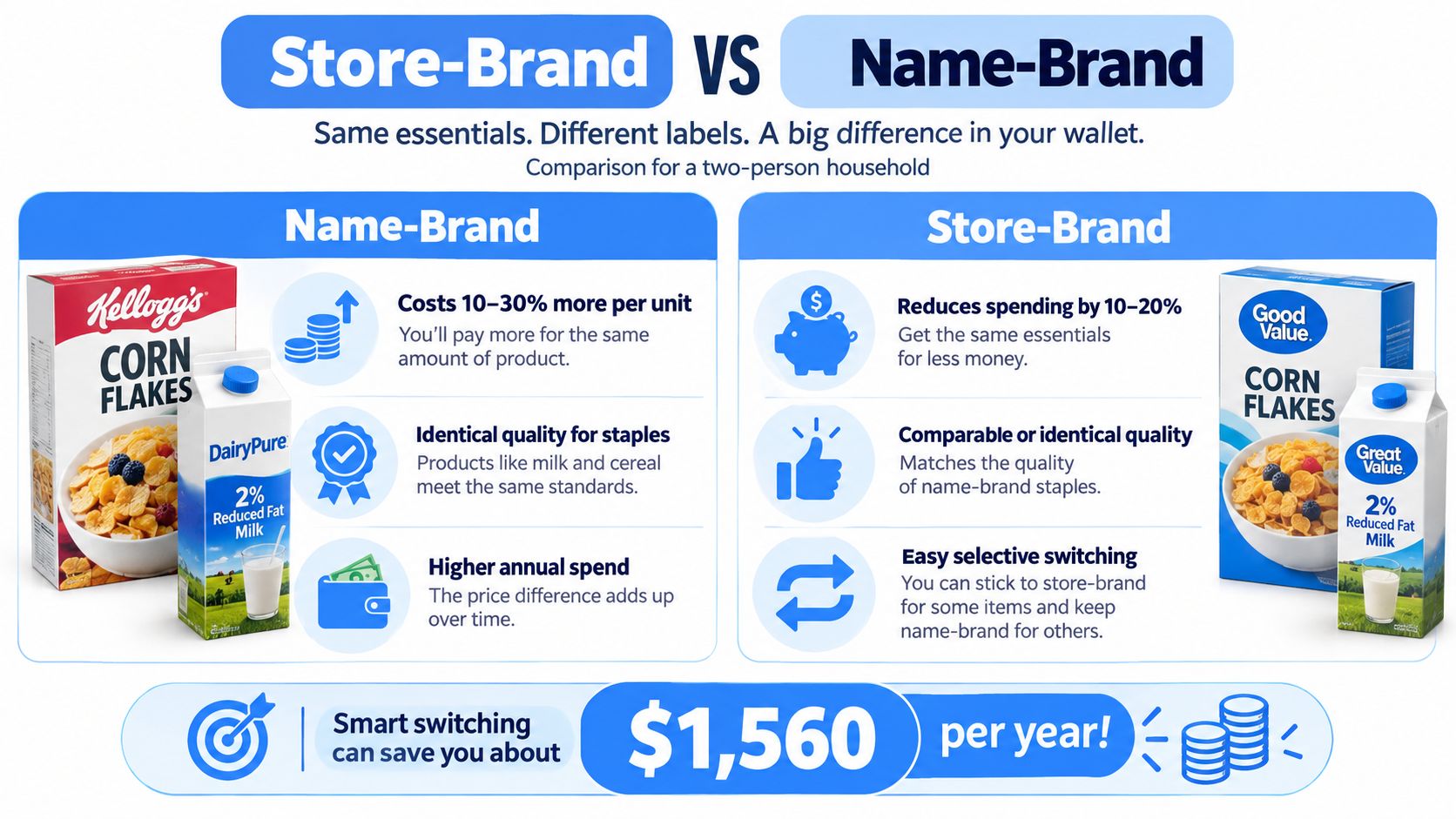
Brand decisions can affect many lines at once. Milk, eggs, bread, cereal, snacks, and pantry staples are frequent purchases, so a small difference repeats more often than a one-time premium item.
Suppose a household spends $150 per week on name-brand products across its grocery list. A store-brand version of the same broad basket at $120 per week would reduce the sample annual cost from $7,800 to $6,240, a difference of $1,560. These are example figures, not a universal price gap, and quality can vary by product.
Start with items where the household has no strong preference. Milk, basic cereal, bread, and pantry staples are easier tests than a specialty product everyone enjoys. Keep the premium item when it delivers value, then remove the premium from the products that don't justify it.
Test one downgrade at a time
FloosYo's merchant and category views help identify where name-brand spending repeats. Use the skip or monitor decision for one shopping cycle, then compare the result. The point isn't to make every item cheaper. It's to see which swaps survive real use.
A grocery budget worksheet can help document the comparison, while FloosYo's projection shows the annual effect. One successful downgrade repeated weekly can matter more than searching for a rare discount.
9. Bulk Buying and Warehouse Club Memberships
Bulk buying works when the product is used, stored safely, and cheaper after accounting for the membership. It fails when a two-person household buys family-size perishables because the unit price looks attractive.
A $120 annual membership paired with sample bulk savings of $800 per year would produce a net saving of $680. The membership breaks even once the household's cumulative savings cover the fee. By contrast, saving $100 per year while paying a $120 membership doesn't cover the membership cost.
Log the membership as its own recurring expense. Then record warehouse trips separately, such as “warehouse grocery run, $150 monthly.” This distinguishes the fee from the purchases and lets you compare the total with an ordinary supermarket pattern.
Reduce frequency when stockpiling causes waste
A couple buying frozen meat in bulk may find that products expire before use. Reducing purchase frequency by half can preserve the useful price advantage while preventing the freezer from becoming an expensive storage problem.
Set a reminder before each warehouse trip. Check protein, dairy, pantry stock, and freezer capacity first. The practical decision may be consolidate certain staples at the club while buying fresh produce and short-life items elsewhere.
10. Specialty Diets and Dietary Restrictions
Organic, gluten-free, vegan, keto, and allergy-friendly products can change the structure of an average grocery list for 2. Some substitutions are essential because of allergies or health needs. Others reflect preferences that can be applied selectively.
A household spending $180 per month on exclusively gluten-free products would spend $2,160 per year in the sample pattern. A comparable non-restricted sample budget of $100 per month would total $1,200, a difference of $960. That gap isn't automatically avoidable. Safety and essential dietary requirements come before a cheaper substitute.
A vegan household paying an extra $50 per month for plant-based alternatives would face a sample premium of $600 per year. Reducing that premium to $20 per month would make the annual difference $240, but only if the household replaces expensive specialty products with affordable foods it actually wants to eat.
Separate essential compliance from premium preference
Create a custom FloosYo category such as “Gluten-Free” or “Organic.” Log “organic produce, $40 weekly” as a recurring pattern, then distinguish required products from aspirational upgrades.
Keep the restriction, question the premium.
A hybrid approach may preserve the household's priorities while controlling the rest of the basket. For example, a household might keep specialty products where safety or core values require them, then choose standard staples where the difference doesn't affect use.
Comparison of 10 Grocery Lists for Two
| Item | 🔄 Implementation Complexity | ⚡ Resource Requirements | 📊 Expected Outcomes | Ideal Use Cases | ⭐ Key Advantages & 💡 Tips |
|---|---|---|---|---|---|
| Fresh Produce (Seasonal Vegetables & Fruits) | Medium, seasonal variability & perishability | Low–Medium, weekly spend, fridge/freezer space | Moderate savings when seasonal; waste risk if mismanaged | Weekly meal-planning, farmers-market shoppers | ⭐⭐⭐ Essential nutrition; flexible cost-savings. 💡 Log as recurring; use annualized view; switch to frozen off‑season. |
| Protein (Meat, Fish, Eggs, Legumes) | Medium–High, quality tiers, bulk patterns | Medium–High, higher spend, freezer space, possible memberships | Large budget impact; big savings with bulk or plant alternatives | Households prioritizing protein or using warehouse clubs | ⭐⭐⭐⭐ Core macronutrient; bulk discounts reduce unit cost. 💡 Log membership separately; voice-log bulk buys; compare annualized cost. |
| Dairy & Alternatives (Milk, Yogurt, Cheese) | Low, consistent weekly pattern | Low, steady moderate spend; subscription-friendly | Predictable recurring cost; easy to optimize brands | Subscription users or predictable weekly shoppers | ⭐⭐⭐ Stable, easy-to-track recurring spend. 💡 Log as single recurring entry; compare subscription vs in-store. |
| Pantry Staples (Grains, Oils, Condiments, Spices) | Medium, many small intermittent purchases | Low, low per-item cost; storage for bulk | Small per-transaction but meaningful annual total | Periodic restocking, bulk-buying households | ⭐⭐ Long shelf life; bulk savings possible. 💡 Group items into monthly entries; audit stock before restocking. |
| Frozen Foods & Convenience Items | Low, regular buys or subscriptions; higher per-serving cost | Medium, higher per-serving spend; freezer space | High annual cost if frequent; saves prep time | Busy professionals or those valuing time savings | ⭐⭐⭐ Saves time; reduces spoilage risk. 💡 Log subscriptions; set skip reminders; compare with meal-prep costs. |
| Beverages (Coffee, Tea, Juice, Soft Drinks) | High, mixes daily purchases and subscriptions | Low–Medium, frequent small spends or subscription fees | Can compound into sizable annual spend | Daily coffee/juice drinkers or subscription users | ⭐⭐ Offers quality/consistency via subscriptions. 💡 Voice-log daily habits; annualize subscriptions; consider home-brew. |
| Snacks & Treats (Nuts, Biscuits, Sweets, Chips) | High, many impulse small transactions | Low, small per-item cost but frequent purchases | Noticeable annual spend; easy to reduce | Those seeking quick savings with minimal lifestyle change | ⭐⭐ Easy to cut and realize savings. 💡 Review weekly; consolidate buys; log bulk purchases. |
| Store-Brand vs Name-Brand Decisions | Low, simple swap decisions | Low, immediate per-item savings | 10–20% reduction in grocery spend when broadly applied | Budget-conscious shoppers wanting quick wins | ⭐⭐⭐ High ROI for minimal change. 💡 Use transaction view to spot name-brand purchases; test swaps. |
| Bulk Buying & Warehouse Club Memberships | Medium, requires planning to justify fee | Medium, membership fee + upfront bulk spend; storage | Large per-unit savings if breakeven met; waste risk if misused | High-volume staple buyers or planned batch cookers | ⭐⭐⭐ Significant unit savings when used properly. 💡 Log membership as recurring; calculate breakeven; audit stock before trips. |
| Specialty Diets & Dietary Restrictions (Organic, GF, Vegan) | Medium–High, spans merchants/categories | High, higher per-unit costs; may need specialty sourcing | Significant annual premium; necessary for health/values | Allergies, medical needs, ethical dietary choices | ⭐⭐ Necessary for health/values; trackable in FloosYo. 💡 Create custom category; annualize costs; prioritize non-negotiables. |
Turn Your Grocery List Into a Yearly Number
A monthly grocery budget becomes useful when each category has a rhythm. Convert weekly spending by multiplying it across the year, monthly spending by the number of months, and irregular purchases by the number of times they occur. FloosYo handles those recurring projections automatically, while voice entry fills in cash purchases, market trips, and habits that don't appear in bank records.
Start with the two national reference points, but don't treat either as a prescription. The BLS household average for food at home was $6,224 in 2024, approximately $519 per month, while the FRED two-person consumer-unit series recorded $6,088, approximately $507 per month. FRED's historical series records $5,745 in 2023, $5,635 in 2022, $5,145 in 2021, and $4,791 in 2020, showing why an average grocery list for 2 should be reviewed over time rather than treated as permanent. The FRED series measures spending, not the exact quantities of produce, meat, dairy, and grains in a basket.
The USDA-based 2026 benchmarks offer a wider planning range for two adults aged 19 to 50. The estimated monthly figures are approximately $630 on a Thrifty plan, $653 on a Low-Cost plan, $809 on a Moderate plan, and $1,009 on a Liberal plan, or roughly $145 to $233 per week. The Moderate benchmark is approximately $186 per week, or $404 per person per month, according to the published benchmark summary. These are food-at-home planning models, not itemized shopping carts, so your list still needs quantities and meal frequency.
Make one decision this month
Choose the category with the clearest repeated pattern. Skip a produce delivery cycle, downgrade one premium dairy item, consolidate a pantry or warehouse trip, or cancel a convenience subscription that the household isn't using. Don't change ten categories at once. One measurable decision gives you a cleaner comparison and makes it easier to see whether the saving survived real life.
Food waste deserves its own measurement. The FDA states that 30% to 40% of food in the United States goes uneaten, with an estimate of up to 20 pounds per person per month and approximately $165 billion in discarded food annually. For two people, the upper estimate would represent as much as 40 pounds per month, although that national estimate doesn't predict every household. The FDA's food-waste guidance supports a list built around portions, planned leftovers, and perishables you can use.
This week, check the freezer, refrigerator, and pantry before shopping. Write seven days of meals for two, add a “use first” section, and log the planned grocery trip in FloosYo. At the end of the week, review grocery spend per trip, unplanned items, and food purchased but discarded. A declining unplanned-item rate with stable meal coverage tells you more than a single unusually low receipt.
FloosYo connects to your bank, finds recurring grocery and household outflows, and projects each pattern monthly and yearly. Use voice entry for market purchases, set renewal reminders, and choose whether to skip, downgrade, consolidate, or cancel before the next charge by visiting FloosYo.