
You check your bank statement and see the same familiar charges: a streaming service, a gym membership, cloud storage, a phone plan, and a food delivery subscription. None looks alarming alone. Then an annual renewal appears that you forgot about, and several small daily purchases have easily taken more room than expected. You didn't fail to create a budget. You failed to get a decision in front of the charge.
That distinction matters. A traditional budget tells you what left your account. A useful recurring-spending system asks what will leave your account next, when it will happen, what it costs over a year, and whether you still want it. The right time to manage a recurring expense is before renewal, not after the statement arrives.
Table of Contents
- The Charge You Stop Noticing
- What It Means When You Need a Budget
- Why Inattention Costs More Than Overspending
- Comparing Three Budgeting Methods
- How to Build a Recurring-First Workflow
- What a Realistic Year of Savings Looks Like
- Why Renewal Reminders Need to Be Decision Prompts
- A Simple Weekly Habit That Holds It Together
The Charge You Stop Noticing
Many people already have a category for subscriptions. They may label it entertainment, household services, personal spending, or bills. The category isn't the problem. The problem is that a category can make an unwanted charge look normal.
A monthly statement review often turns into a quick scan. You recognise the merchant, remember that you once wanted the service, and move on. An annual charge is easier to miss because it doesn't appear every month. By the time you notice it in January, the payment has already happened and the cancellation decision has arrived too late.
Practical rule: Never review a recurring charge only as a historical transaction. Review it as an upcoming decision.
Start with the next seven days, not the previous month. Look for every charge scheduled to arrive soon, then record four details:
- Renewal date: When will the next payment be taken?
- Amount: What will leave the account?
- Yearly cost: What does this habit or service consume over a full year?
- Action: Will you keep, skip, cancel, downgrade, or monitor it?
This changes the question from “What did I spend on subscriptions?” to “What am I about to approve?” That shift is especially useful for charges that are affordable but easy to forget. A service can fit inside your monthly limit and still fail the more important test, whether it remains worth its annual cost.
The same logic applies to habits that aren't technically subscriptions. A repeated food delivery order, ride-hailing pattern, or small app purchase may not have a fixed renewal date, but it still creates a predictable outflow. Record the frequency, project the yearly total, and choose whether the habit deserves another cycle.
A budget category describes the past. A pre-charge decision protects the future. You need both, but if your main frustration is surprise renewals, start with timing.
What It Means When You Need a Budget
“You Need a Budget” refers to a specific company, and to a habit that matters far beyond one app. YNAB started with Jesse and Julie Mecham, a newly married college couple trying to free up $350 per month for rent. Jesse built their system in Excel, then launched it through youneedabudget.com in September 2004, according to YNAB's own timeline.
The first version was a downloadable Windows spreadsheet. Reported profit rose from $38.10 to $1,540.15 as the method caught on, and YNAB later introduced YNAB Pro with a starting price of $39.95, after which it reported that sales quadrupled. The company later added an iPhone app and launched its next-generation product on December 30, 2015, shifting from software licensing to a subscription model. Those details come from the company's published history.
The method itself is simple. Give every available dollar a job before you spend it. That puts YNAB in the envelope-budgeting and zero-based camp. Independent coverage also traces YNAB's path from spreadsheet to subscription app, notes that it reached hundreds of thousands of users before growing to millions, and reports that the company had 115 employees working remotely in 2020. It also summarizes YNAB's own claim that new users save an average of $600 during their first two months and more than $6,000 during their first year. Read the overview of YNAB's history and method with the right lens. The company-reported savings figures are marketing claims, not an independent population study.
The useful meaning of needing a budget
For ordinary households, needing a budget means needing a plan for the money that is about to leave your account. Income, fixed bills, groceries, irregular costs, and savings goals all belong in that plan. So do the charges that look harmless each month and expensive across a year.
Many budgets stay too shallow here.
A category files the payment. A decision system questions whether it deserves another renewal. If you only record that streaming, software, deliveries, or memberships belong under the right label, you miss the more important call, whether you still want the next charge to happen.
That is the practical meaning of “you need a budget.” You need a way to decide before autopay runs, not after the statement closes. Anchor recurring expenses to the next renewal date and the yearly cost. Then make the call clearly: keep it, downgrade it, pause it, or cancel it.
Traditional budgeting still matters because it controls cash flow. But ordinary categories often miss the quiet leaks, charges that fit the month and fail the year. A useful budget catches both. It assigns money on purpose and forces a pre-charge decision before recurring spending renews itself.
Why Inattention Costs More Than Overspending
A forgotten renewal doesn't require reckless spending. It requires only a payment method that keeps working after your attention has moved elsewhere.
A natural-experiment study examined millions of payment-card records across ten subscription services. When consumers replaced a card and had to re-enter payment details, monthly cancellations rose to approximately 8%, compared with roughly 2% in an ordinary month. The researchers estimated that consumer inattention increased provider revenue by 14% to more than 200%, depending on the service, as reported in coverage of the subscription-payment study.
The important point isn't that replacing a card is a budgeting strategy. It isn't. The finding isolates the behaviour that automatic renewal hides: when payment details stop working, consumers must make an active decision. Some decide the service isn't worth restoring.
Friction protects decisions
Autopay is convenient, but convenience removes the moment when value gets reassessed. A cancellation page, a forgotten trial, or a renewal email may be the only point at which a customer asks whether the service still earns its place in the budget. If that point never arrives, the charge continues by default.
That makes inattention different from overspending. Overspending happens when you choose an expense that exceeds your plan. Inattention happens when you stop choosing at all.
A recurring-first budget restores the choice without forcing you to abandon automatic payments. It identifies a merchant and amount pattern, estimates the next charge, shows the monthly and yearly cost, and asks you to decide before billing. The workflow should make “keep” an active choice, not the silent default.
This approach also avoids blaming people for every unused service. Income pressure, irregular pay, and essential bills can leave little room for broad cuts. The practical target is more precise: find repeated outflows that no longer match current priorities, then redirect the amount you recover.
Comparing Three Budgeting Methods
Envelope budgeting, zero-based budgeting, and recurring-first tracking solve different problems. The first two help allocate money. The third adds a decision before automatic money leaves.
Envelope budgeting assigns available money to defined purposes before spending. It creates strong limits for flexible categories, but it can require regular manual upkeep. This guide to envelope budgeting explains the underlying idea in more detail.
Zero-based budgeting gives every dollar a job during the planning period. It works well when income is predictable and you want a complete allocation, but a monthly plan doesn't automatically intercept a subscription that renews on an unusual date.
Recurring-first tracking starts with the transactions that already repeat. It keeps the useful allocation discipline of envelopes while adding a separate renewal review.
Three Budgeting Methods Compared
| Method | When it assigns money | Manual effort | How it treats renewals |
|---|---|---|---|
| Envelope budgeting | Before spending, by category or purpose | Medium to high, depending on how often categories change | Usually treats the charge as part of an existing envelope |
| Zero-based budgeting | During each planning period, until all income has a job | Medium, with updates when income or expenses change | Usually records the renewal in its assigned category |
| Pre-charge recurring tracking | Before each detected or recorded renewal | Lower when transactions are detected automatically, with manual entries for cash spending | Surfaces the date and cost, then asks for keep, skip, cancel, or monitor |
The choice depends on your actual pain point. If flexible spending regularly runs away, envelopes may give you the control you need. If you want a complete allocation for a stable paycheck, zero-based budgeting is a sound foundation. If your statement contains charges you no longer remember approving, add recurring-first tracking.
Don't force one method to do every job. A category budget can tell you whether a streaming service fits. A pre-charge review tells you whether you want to pay for it again.
How to Build a Recurring-First Workflow
A recurring-first workflow should remove memory from the detection stage and reserve your attention for the decision. You can build it in a spreadsheet, but an app can reduce the data entry.
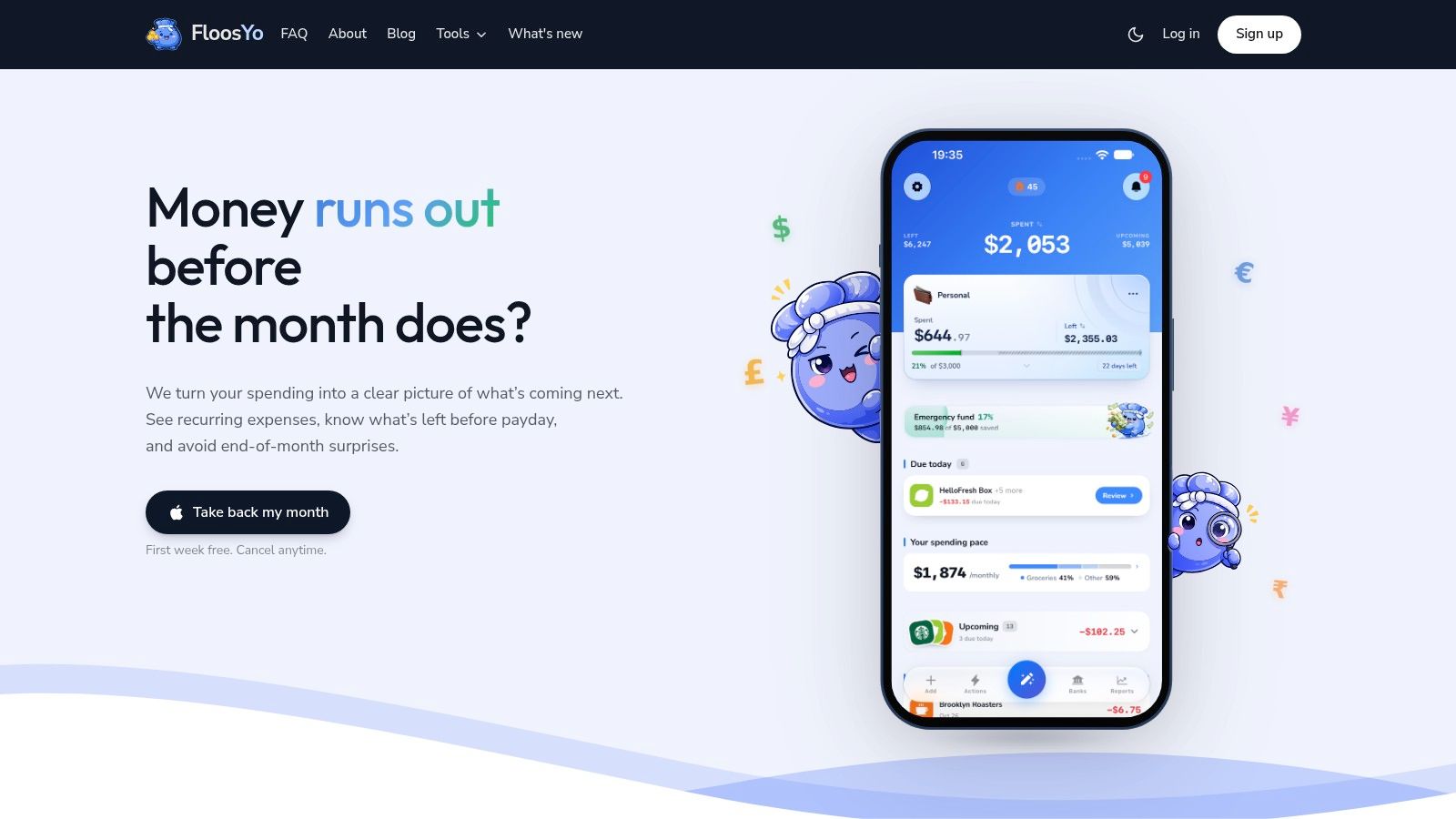
FloosYo connects to bank accounts through Plaid across 12,000 financial institutions in 20 countries, detects recurring transactions, and displays merchant logos from a library of 298 brands. It also allows voice or text entries for spending that a bank can't see, parsing natural phrases into amount, category, and frequency. Those are practical mechanics, not a reason to stop reviewing the underlying transactions.
Detect what memory misses
Connect the account or review several months of transactions manually. Mark repeated merchant, amount, and interval patterns. Include phone plans, cloud storage, streaming, gym memberships, software, delivery services, and annual memberships.
Then add what the bank can't see. A cash purchase, person-to-person payment, or work expense can still repeat even when no subscription record exists. Voice or text capture is useful here because “cloud storage, twelve dollars monthly” is faster than building a full transaction form. The goal is completeness, not perfect categorisation.
Translate each charge into a yearly decision
Monthly amounts hide the opportunity cost. A $12 monthly charge becomes $144 per year. The annual figure gives you a better comparison with a savings goal, a planned purchase, or the value you receive from the service.
Create a record with the next date, amount, frequency, monthly projection, yearly projection, and current action. FloosYo projects monthly and annual totals for expenses, while a spreadsheet can use the same columns. For irregular charges, record the actual expected renewal amount rather than forcing everything into a monthly subscription pattern.
Use this practical guide to managing subscriptions to review cancellation timing, usage, and the difference between stopping a renewal and losing access immediately.
Decide before the money leaves
Set the reminder before the charge, not on the billing date. When it arrives, choose one action:
- Keep: The service earns its projected cost and remains useful.
- Skip: You don't need this cycle, so the amount becomes available for another purpose.
- Cancel: The recurring arrangement no longer deserves a place in the plan.
- Monitor: You need more information, such as usage or cancellation terms, before committing.
A skipped charge should create a visible result. Route the estimated saved amount into one active savings goal and record the decision. FloosYo supports pre-charge notifications, consolidated digests, skip and cancel actions, savings goals, and automatic funding when a bill is skipped. It also offers read-only bank access, so the app reads transactions but can't move money from your account.
A short video can help visualise how a recurring-first budget fits together:
The system works because it connects detection, annual framing, a timed decision, and a recorded outcome. Without the final step, cancellation feels like deprivation. With it, the saved amount becomes visible progress.
What a Realistic Year of Savings Looks Like
A realistic target starts with forgotten services, not extreme austerity. A 2025 CNET and YouGov survey of 2,440 U.S. adults found that subscribers spent about $1,080 per year on subscriptions, with nearly $200 going to unused services. The same survey reported that 74% found recurring charges easy to forget and 42% had continued paying after stopping use. Read the CNET and YouGov subscription survey for the survey context.
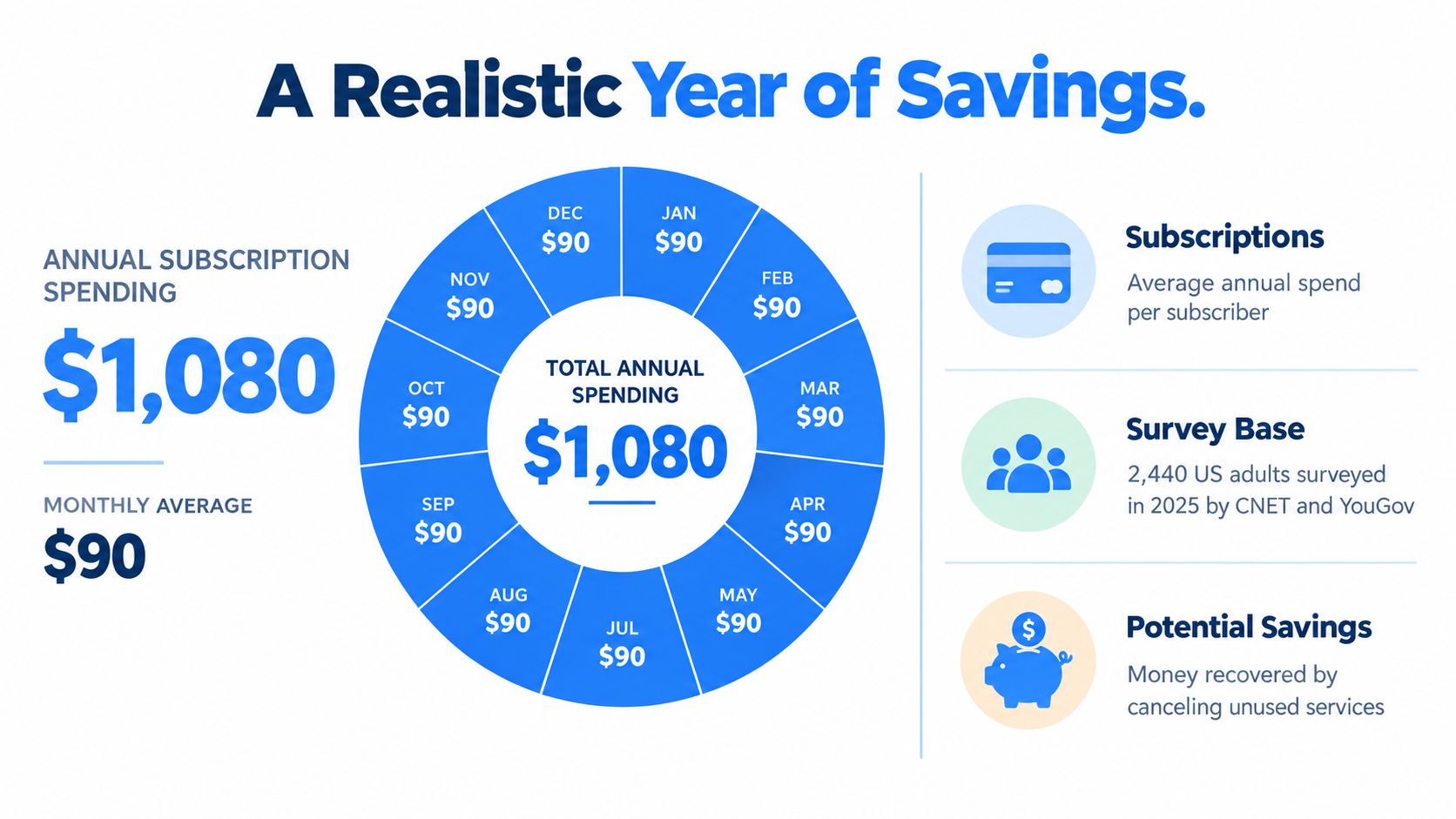
That doesn't mean every reader will recover the same amount. It does provide a sensible benchmark for the kind of waste a renewal review can uncover. Three forgotten annual charges, one unused service, or several skipped cycles may produce meaningful savings without cutting something you actively value.
Protect cash flow when income changes
Irregular income makes monthly budgeting harder because the timing of money and the timing of charges don't always match. Students, freelancers, creators, and gig workers may also combine bank-visible payments with cash purchases, reimbursed costs, and informal recurring commitments.
An affordability study covering 14,139 consumers across Belgium, Spain, Italy, and Portugal found continuing pressure around essentials including food, energy, housing, transportation, health, and leisure, as reported in the 2025 affordability barometer. That context makes “cut everything discretionary” poor advice. A better approach protects necessary services while exposing repeated outflows that no longer justify their timing or price.
Consider this simple example. A $12 monthly service projects to $144 per year. If you skip one cycle, direct $12 to the active savings goal and record the remaining projected annual opportunity separately. If you cancel the service, the full yearly projection becomes a candidate for future goal funding, subject to the actual cancellation date and terms.
The useful number is the amount you decide not to pay, not an imaginary total based on cancelling every convenience. Keep what you use. Challenge what you forget. Measure the result after each decision.
Why Renewal Reminders Need to Be Decision Prompts
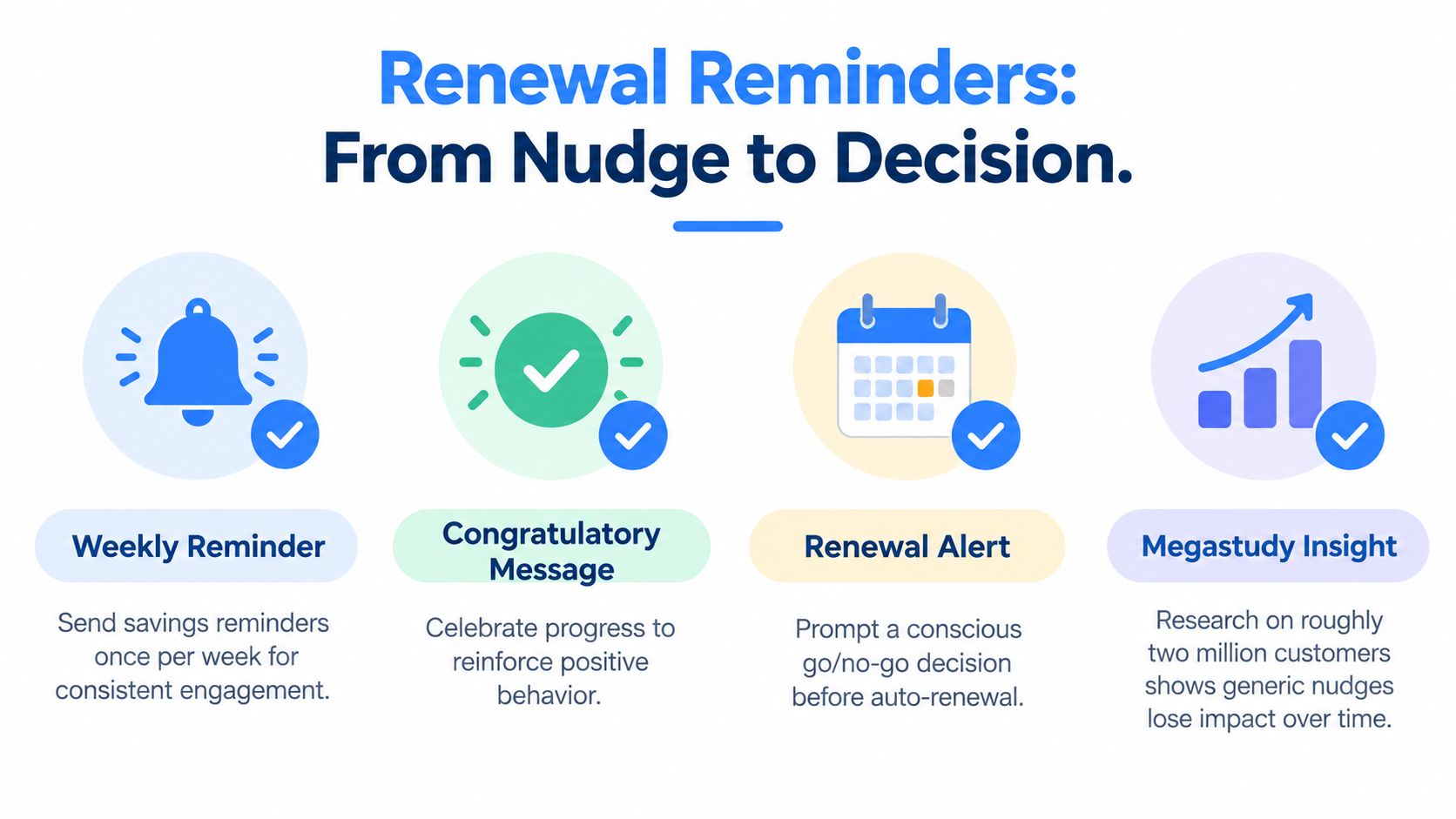
A generic reminder rarely changes behaviour by itself. A 2025 megastudy involving roughly two million customers found that weekly savings reminders for customers who hadn't deposited during the prior week, or congratulatory messages to recent depositors, increased the likelihood of a one-time monthly savings deposit by 0.13 percentage points, equivalent to a 1.32% relative increase. The PNAS Nexus study shows the effect was measurable but modest.
The lesson is straightforward. A prompt helps bring an intended action into working memory, but it can't create affordability. Timing matters more than volume. A renewal alert should arrive when the consumer can still choose, with enough information to make the choice useful.
Build the prompt around the decision
A useful notification should show:
- The merchant and amount: Identify what will be charged.
- The renewal date: Give the user time to act.
- The monthly and yearly view: Make the opportunity cost visible.
- The action buttons: Offer keep, skip, cancel, or monitor.
- The goal result: Show where the skipped amount will go.
The U.S. Federal Trade Commission's Negative Option Rule addresses recurring-payment arrangements where consumers are charged unless they cancel. The rule is intended to help consumers avoid unwanted payments and cancel without unwarranted obstacles.
The FTC describes three protections: sellers must disclose material terms before collecting billing information and charging the consumer, obtain unambiguous affirmative consent to the negative-option feature, and provide simple cancellation measures. Its commission order on the rule supports the same practical design principle, make the amount, timing, and choice clear.
Cancellation should also be at least as easy as sign-up. The FTC's rule text explains that cancellation applies to the negative-option portion, while other contract terms may continue until the agreement expires. In practice, check whether cancelling stops future renewals only or ends access immediately.
A decision prompt doesn't need to nag. It needs to arrive once, show the facts, and make the next action obvious. Consolidated reminders can group several upcoming charges without turning every day into a notification day.
A Simple Weekly Habit That Holds It Together
Choose one day each week to scan the next seven days of recurring charges. For every item, choose keep, skip, or cancel, then check whether the saved amount has reached your single active savings goal.
A pre-charge digest can make this review quick, while read-only bank access and encrypted data stored at rest can keep the setup focused on visibility rather than money movement. The habit matters more than a perfect budget. This guide to sticking to a budget is useful if you need help making the review routine.
Start this week with the next renewal you can see. Write down its date, monthly cost, yearly cost, and decision. The aim is fewer surprises on the statement and more money visible in the goal before the charge lands.
FloosYo connects to your bank, detects recurring charges, adds voice or text entries for spending the bank misses, and shows monthly and yearly projections before renewals. Visit FloosYo to review upcoming charges, make keep, skip, or cancel decisions, and track the amount you recover.