
Subscription management is the system for tracking, controlling, and deciding on recurring charges before they bill. For personal finance, it means seeing every subscription as a monthly and yearly total with a clear keep, skip, or cancel choice.
You may know the feeling. A streaming service renews while you're busy, a cloud-storage plan charges again, and a small daily purchase has become part of your routine before you've noticed. None of these payments feels dramatic on its own, but together they can make your monthly cash flow harder to read.
The practical question isn't only, “How many subscriptions do I have?” It's “What will these recurring choices cost me over the next year, and do I still want each one before it bills?”
Table of Contents
- Introduction to Subscription Management That Actually Saves You Money
- What Subscription Management Means in Plain Terms
- Key Features That Make Subscription Management Work
- Why Unified Control Matters More Than Tracking Alone
- How to Audit Recurring Spend and Cut Waste Without Guesswork
- How FloosYo Puts Subscription Management Into Practice
- Take Control of Recurring Costs Starting Today
Introduction to Subscription Management That Actually Saves You Money
Subscription management is often described as software that helps businesses bill customers. That definition is accurate, but it misses the personal-finance problem many face. For an individual, subscription management is a way to find recurring charges, understand their real cost, and make a decision before the next payment leaves the account.
Start with a simple example. A service costing $12 each month may feel minor when it appears among ordinary transactions. Viewed annually, the same charge represents $144 in recurring spending, calculated as $12 multiplied by 12 months. The arithmetic is simple. The useful change is psychological: a yearly projection makes a quiet repeat easier to compare with something else you may value more.
The same idea applies to bills and habits that aren't technically subscriptions. A phone plan, gym membership, food delivery routine, software renewal, or recurring household service all deserves the same question: What does this cost monthly, what does it cost yearly, and what action should I take?
Practical rule: Don't wait until after a renewal to decide whether you wanted it. Decide while the charge is still pending.
A useful system combines three jobs:
- Find recurring outflows: Identify repeating merchants across bank and card activity.
- Make the cost tangible: Show monthly and yearly projections, including plans billed less often than monthly.
- Prompt a decision: Give you time to keep, skip, downgrade, or cancel before the charge lands.
Payment inertia is easy to mistake for continued value. A service can remain active because cancelling it requires attention, not because you still use it. A trustworthy approach doesn't tell you every recurring expense is wasteful. It helps you distinguish useful commitments from charges you've stopped noticing.
Subscription billing has become a major software category because recurring revenue now supports digital businesses and many consumer services. The global subscription billing management market was estimated at USD 7.15 billion in 2024 and projected to reach USD 17.95 billion by 2030, with a projected 16.9% CAGR from 2025 to 2030, according to Grand View Research's subscription billing management market analysis. That business growth has a personal consequence: recurring charges are now common enough that memory alone is a poor control system.
What Subscription Management Means in Plain Terms
Think of one recurring payment as a single tap from a leaky faucet. You might notice the first drip, especially when you sign up. After a while, the sound blends into the background. Add several services, bills, and habits, and the problem isn't one large burst. It's a steady collection of small outflows that rarely receive a fresh decision.
Subscription management turns those drips into a visible system.
From one payment to a full picture
Begin with a single service. Record its merchant, amount, billing frequency, next billing date, and recent use. Then ask whether the amount should be treated as a monthly expense, even if the merchant bills quarterly or annually.
A quarterly plan should be divided into its monthly equivalent so you can compare it fairly with monthly charges. An annual plan belongs in the same view. Otherwise, a large renewal may look like an unusual expense instead of a recurring commitment you chose earlier.
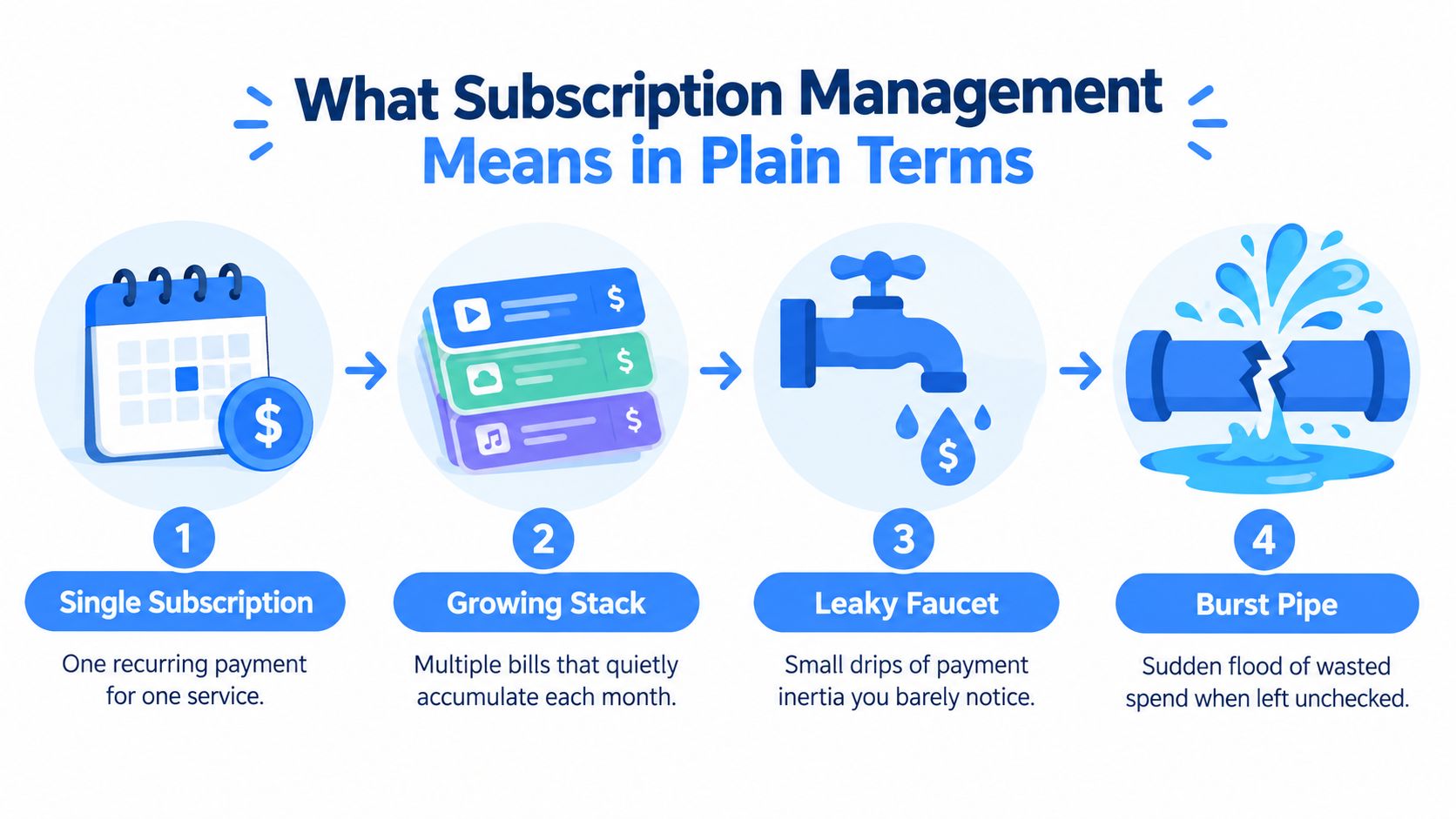
Next, group your repeating payments. Streaming, fitness, phone, cloud storage, software, transport, and household services can sit in one consolidated view instead of being checked separately inside multiple merchant apps.
Why annual totals change behavior
Monthly prices are convenient for sellers and easy for buyers to underestimate. A recurring charge can feel harmless because it arrives in small pieces. A yearly projection gives the payment a longer time horizon.
Suppose a daily habit costs $3 on the days you make the purchase. The important question isn't only whether today's purchase fits. It's how often it repeats and what the projected yearly total would be if the pattern continues. You don't need a complicated budget model to make that visible. You need the amount, the frequency, and a realistic projection.
Subscription management also differs from a basic list. A list tells you what exists. A calendar tells you when something may happen. An effective system adds context and a next action.
- Detection: Find repeats you may not remember.
- Projection: Convert different billing frequencies into comparable totals.
- Timing: Alert you before the payment event.
- Decision: Make keep, skip, downgrade, or cancel the available outcomes.
That's why personal subscription management should be event-driven rather than passive. The useful moment is not when you discover a charge in an old statement. It's when you receive enough notice to decide before the next charge.
Key Features That Make Subscription Management Work
A passive tracker records history. An active subscription-management system helps you act on what's about to happen. The difference comes down to whether the tool stops at visibility or connects visibility to a practical decision.
Automatic detection and clear identity
The first layer is finding repeating charges from bank or card activity. Manual entry can miss merchants whose billing names differ from their familiar brand names, or payments that occur less often than monthly. Automatic detection reduces the need to remember every recurring payment yourself.
Merchant identity also matters. A recognizable logo and a clear category make a transaction easier to understand than an unfamiliar payment descriptor. Pre-categorization helps you review a consolidated list without opening each merchant's app.
Monthly and yearly projections
A useful projection answers two questions at once:
- What will this expense do to my regular monthly outflow?
- What commitment am I making if I allow the pattern to continue?
Monthly projections help with near-term cash flow. Yearly projections expose the long-term cost of small repeats. Together, they make it easier to compare a service with a savings goal or another household priority without relying on vague feelings about whether the expense is “small.”
Renewal reminders before the charge
A reminder that arrives after a renewal is merely a receipt. A reminder before the billing date creates a decision window.
Microsoft's subscription billing documentation describes operational features such as automated billing periods, upcoming-invoice previews, notice-period calculations, grouped contracts for consolidated billing, and deferral-based posting for income and expenses in Business Central subscription billing documentation. These are merchant-side functions, but the underlying principle also helps consumers: dates, billing rules, and financial timing should be explicit rather than hidden.
Actions that estimate the consequence
The useful options are specific:
- Keep: Confirm the service still earns its place.
- Skip: Avoid a cycle when the service supports that option.
- Downgrade: Move to a cheaper tier when the full plan isn't necessary.
- Cancel: Stop a payment that no longer provides enough value.
- Monitor: Keep an item temporarily while watching usage and renewal timing.
A savings estimate makes the choice more concrete. If you skip a charge, the system should show what that decision could leave available for another purpose. FloosYo's subscription management app follows this decision-oriented approach by combining recurring-expense visibility with projections, reminders, and skip or cancel choices.
Visibility must lead to a decision. Otherwise, a beautifully organized list can still leave every unwanted charge active.
Why Unified Control Matters More Than Tracking Alone
Merchant-side billing and consumer-side control solve different problems.
A business needs systems that create invoices, process recurring payments, calculate proration, recover failed payments, manage renewals, and record revenue at the appropriate time. Subscription management software has expanded into this wider revenue-operations role because recurring billing depends on more than sending the same invoice repeatedly.
A consumer needs the reverse perspective. You want to know which merchants are charging you, when they'll charge again, whether the service still fits your life, and how to stop or pause the outflow without searching through separate accounts.
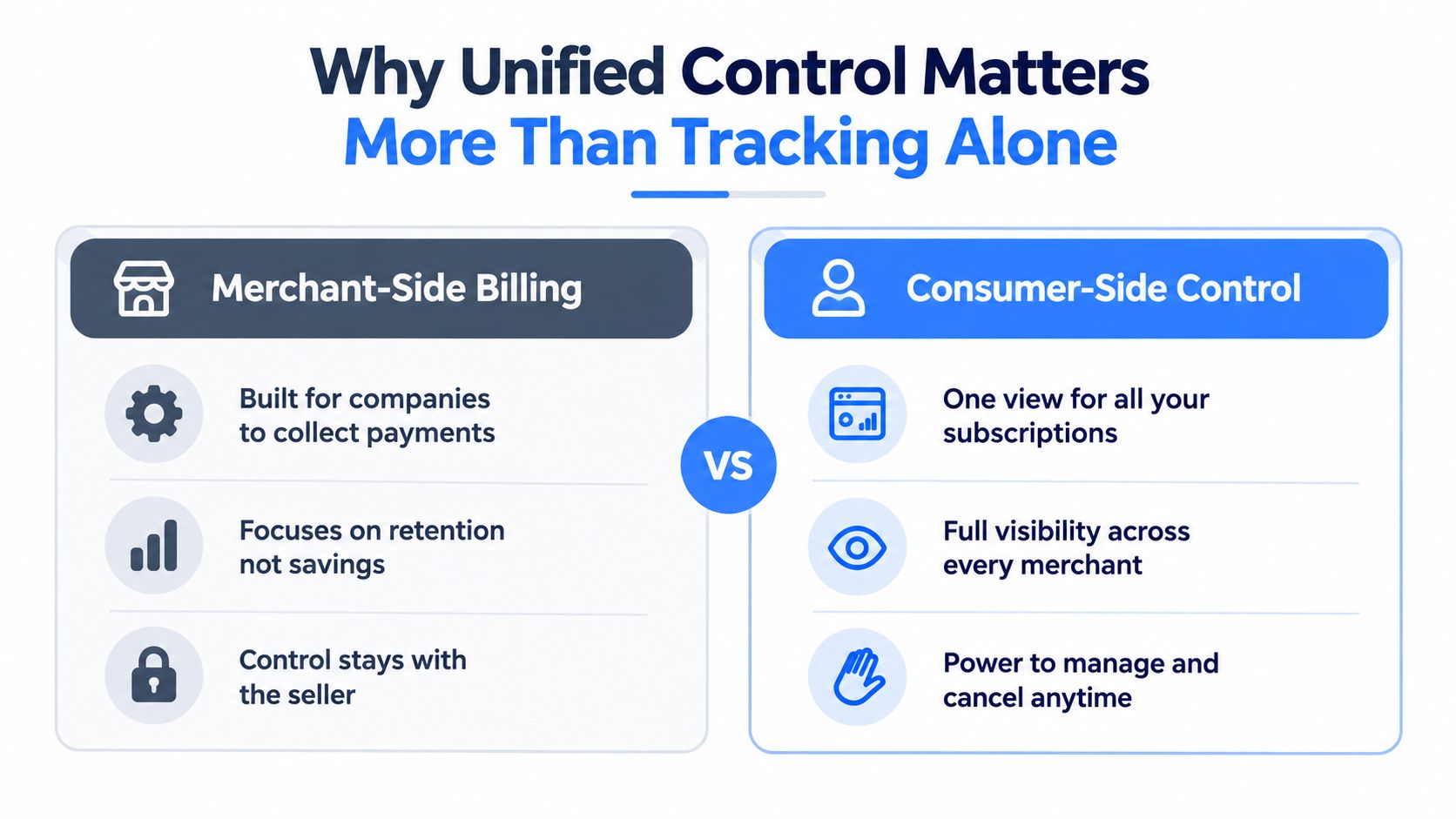
Two systems, two definitions of success
| Merchant-side billing | Consumer-side control |
|---|---|
| Collects payments according to plan rules | Shows every recurring outflow in one place |
| Focuses on renewals, retention, and payment recovery | Focuses on use, value, and avoiding unwanted charges |
| Handles invoices, proration, and accounting workflows | Provides projections, reminders, and clear actions |
| Keeps control with the seller's billing system | Gives the user a consolidated view of commitments |
The distinction explains why many articles about what is subscription management feel irrelevant to someone trying to reduce spending. They describe how a company manages customer accounts, but not how a household manages its own cash flow.
Consumer expectations are moving toward unified control. Mastercard reports that 77% of consumers globally want to see and manage all subscriptions in their banking app, while 39% would consider switching banks for that capability, according to its subscription-management findings reported by Recurly. The demand is not limited to seeing a list. It includes control over cancellation, pausing, renewal timing, and billing flexibility.
Trust is part of the feature
A merchant may view a flexible pause option as a retention tool. The customer may view it as evidence that the service respects changing circumstances. Transparent renewal terms and a straightforward cancellation path reduce the feeling that a subscription continues because stopping it is inconvenient.
That changes the role of management. It isn't only a savings tactic. It's a way to restore control to the person whose account is being charged, preferably in the place where that person already reviews money.
How to Audit Recurring Spend and Cut Waste Without Guesswork
You don't need to remember every service you've ever tried. Start with the records that show what left your accounts.
Pull the evidence first
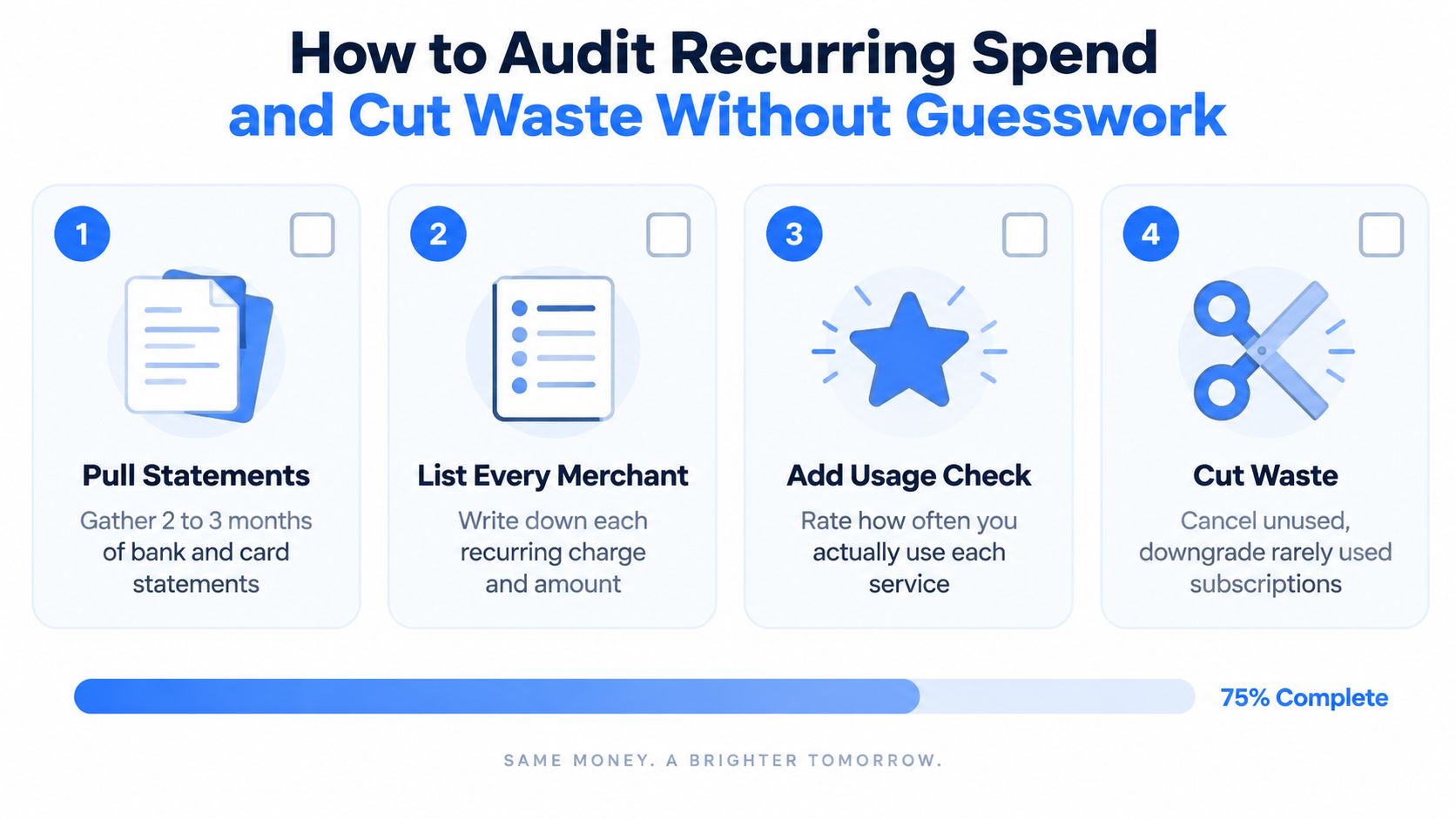
Gather the last 2 to 3 months of bank or card statements, as recommended by Financial Aha's recurring-expense tracking guide. Look for merchants that repeat, charges with similar descriptions, and payments that occur on a less obvious schedule.
Create a simple working list with these columns:
| Merchant | Amount | Frequency | Monthly equivalent | Next date | Recent use | Decision |
|---|---|---|---|---|---|---|
| Cloud storage | $X | Monthly | $X | Date | Frequent | Keep |
| Fitness service | $X | Quarterly | Amount divided by three | Date | Occasional | Downgrade or skip |
| Software plan | $X | Annual | Amount divided by 12 | Date | Rare | Cancel or review |
Use the actual amounts from your statements. The monthly-equivalent column prevents annual and quarterly payments from disappearing outside your normal monthly view.
Check use before judging value
A subscription isn't wasteful merely because you didn't use it yesterday. Review recent behavior and the reason you originally signed up. A service may support a genuine need even if usage comes in bursts.
Use this decision checklist:
- Keep: You use it regularly, need it for work or home, and would replace it if it disappeared.
- Downgrade: You use the service, but the current tier includes features or capacity you don't need.
- Skip: The service allows a pause, and you expect a temporary period of low use.
- Cancel: You don't use it, don't expect to use it soon, or no longer recognize why it remains active.
- Verify: You think you cancelled, but the statements still show charges. Check the merchant confirmation and the next statement.
A 2025 CNET-reported survey found that the average U.S. household spends about $1,080 per year on subscriptions, including roughly $205 per year on unused subscriptions, or about $17 per month on rarely or never used services, as summarized by Frisbii's subscription trends coverage. The behavioral lesson is more useful than the totals: payment inertia can preserve a service after its value has faded.
Ask one direct question for every repeat: “Would I choose this payment again today?”
Use a regular review rhythm. Some consumer-finance guidance recommends quarterly audits and separate checks for annual renewals twice a year, according to SpendTrak's subscription-stacking guidance. A recurring review catches changes before they become a long-running drain.
For a visual walkthrough of the statement-review process, watch the guide below.
You can also use this guide to checking subscriptions when you want a structured way to compare transactions, billing dates, and recent use.
How FloosYo Puts Subscription Management Into Practice
FloosYo applies subscription management as personal cash-flow control, from finding recurring charges to deciding what happens before the next payment. It connects through Plaid to 12,000 financial institutions across 20 countries, while bank sign-in happens on the bank's own screen. The app receives read-only access, so it can read transactions without moving money.
FloosYo detects repeating charges and records each one as a recurring expense with its amount and billing rhythm. Transactions arrive pre-categorized, and merchant logos from a library of 298 brands can make the consolidated list easier to scan than raw statement descriptions.
From bank activity to an upcoming decision
FloosYo displays monthly and yearly projections for subscriptions, bills, and other recurring expenses. A small monthly charge can look much larger when viewed across a year, giving you a clearer basis for deciding whether to keep it. Pre-charge notifications and consolidated digests place several upcoming expenses in one review moment, before they leave the account.
Connected bank data cannot capture every habit. Cash spending and purchases made outside linked accounts may remain invisible, so voice or text capture lets you add them manually. The app parses a natural-language entry into its amount, category, and frequency, then shows it beside bank-detected repeats instead of leaving it on a separate mental list.
The action layer focuses on practical choices. For an eligible recurring item, you can review skip or cancel options and compare estimated savings scenarios. If you skip a bill, the saved amount can move automatically into one focused savings goal. That keeps the result visible, much like putting the money in a labeled envelope instead of letting it blend into everyday spending.
Security and everyday usability
FloosYo encrypts bank access tokens, account names, account masks, and institution names at rest, and redacts them from logs and error output. Plaid messages are signature-verified, checked against replay timing, and hash-matched to their payload before processing. Accounts support TOTP two-factor authentication, and financial data is not sold to advertisers.
The product is built for iOS and distributed through the App Store. Its five home-screen widgets show items such as what is due today, goal progress, and budget standing. The actions hub keeps budget creation, income planning, category editing, and goals within one sheet, so reviewing a recurring charge can lead directly to a clear next action.
Take Control of Recurring Costs Starting Today
Subscription management works when it changes the timing of your decisions. Instead of discovering a charge after it posts, you identify the pattern, calculate the monthly and yearly effect, and decide before the renewal.
Run your first review with a short checklist:
- Pull your statements: Review the last 2 to 3 months of bank and card activity.
- List every repeat: Include monthly, quarterly, annual, bill-based, and habitual outflows.
- Normalize the cost: Add a monthly-equivalent amount for plans that don't bill monthly.
- Check actual use: Look at what you've used recently, not what you hoped to use.
- Choose an action: Keep, downgrade, skip, cancel, or verify.
- Set the next review: Use quarterly reviews and check annual renewals twice a year.
- Track one result: Record what a skip, downgrade, or cancellation makes available for a focused goal.
A yearly view won't make every subscription unnecessary. It will make the tradeoff visible. That's enough to challenge payment inertia, especially when small recurring choices continue without a fresh decision.
The strongest habit is simple: review before the charge, not after it. One cancellation may help once, but regular pre-charge decisions keep your recurring outflows aligned with how you live.
FloosYo connects recurring spending to monthly and yearly projections, pre-charge reminders, voice entry, and clear skip or cancel decisions. Visit FloosYo to review your recurring costs and start turning overlooked charges into visible savings choices.