
You're checking your account at month end, not hunting for a problem. A streaming charge landed. Cloud storage renewed. A food delivery credit rolled over. None of them looks reckless on its own, and you don't remember approving a bigger monthly total. That's exactly how recurring spending wins. Smart cash back starts before the next charge, not after it. Don't chase a slightly better reward on money you didn't mean to spend. Reclaim the outflow first, record what you stopped, and let that amount do visible work in your budget.
Table of Contents
- The Hidden Cost of Charges You Stopped Noticing
- What Smart Cash Back Actually Means
- Smart Cash Back vs Traditional Cash Back
- The Four Numbers That Make a Charge Decidable
- Why the Yearly View Changes Every Decision
- Three Real Scenarios You Can Run This Week
- A Weekly and Monthly Ritual That Compounds
- What Smart Cash Back Looks Like in Practice
The Hidden Cost of Charges You Stopped Noticing
You open your bank feed thinking the month was fairly controlled. Then the small lines stack up. A streaming bundle you kept for one show. Extra cloud storage you added during a phone upgrade. A gym add-on, a food delivery pass, a trial that converted. You didn't make one bad decision. You made no decision at all, and autopay filled the gap.
That's the pattern I see most often when reviewing subscription lists with people. The surprise isn't a luxury purchase. It's the distance between what they think they pay and what repeats without their attention. A 2025 CNET survey on subscription spending reported U.S. adults spent an average of $1,080 per year on subscriptions and approximately $204 per year on subscriptions they considered unused.
Why small charges survive
Small charges survive because they don't trigger the same scrutiny as a rent payment or a phone bill. You see the monthly figure, shrug, and move on. By the time you've repeated that shrug across several services, you're funding a second, invisible bill.
- Autopay removes the decision point: The charge lands whether you used the service or not.
- Trials convert automatically: A free period ends and paid billing begins without a fresh yes from you.
- Bundles hide the unused part: You keep the whole package for one feature you still value.
Start by learning what counts as a recurring expense in your own account, because bills, subscriptions, and daily habits all behave the same way when they repeat. If it charges on a rhythm, it deserves a decision on that rhythm.
Practical rule: If you can't name the last time you used a service, don't let it renew by default.
The biggest cash back opportunity in most households isn't a higher rate somewhere else. It's the charge you no longer use, the plan you meant to downgrade, and the renewal you would've stopped if you'd seen it three days earlier. Money you don't send out is money you keep in full. No redemption step, no waiting period, and no fine print stands between you and that saving.
What Smart Cash Back Actually Means
Smart cash back isn't a headline percentage. It's a test you apply before money leaves. You see every recurring charge clearly, you decide on it before it bills, and you measure what keeping, skipping, or canceling it does over a month and a year. If one of those three pieces is missing, you're guessing.
Traditional rewards work after spending has already happened, and the value often sits untouched. CFPB data summarized by NerdWallet on cardholder rewards showed cardholders earned $41.1 billion in total rewards in 2022, including $15.2 billion in cash back, and the average rewards account ended the year with $156 in unspent rewards. Earned isn't the same as used. That gap is the whole lesson.
The diagram below maps the three parts that make the idea work in practice.
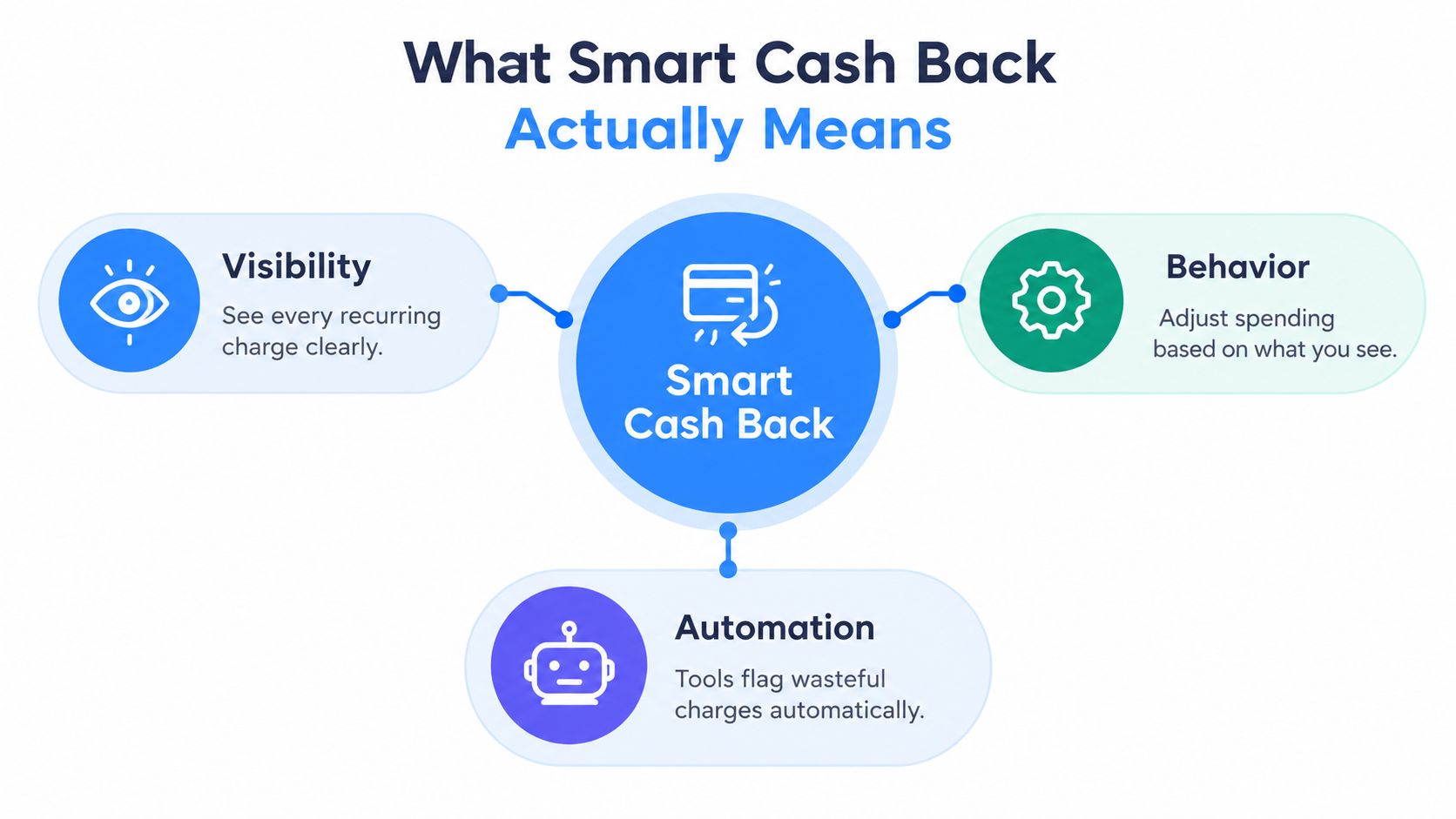
The three-part test
Visibility means the charge appears in one place, with the merchant, amount, and next date attached. You don't rely on memory or a buried email receipt. If you have to go hunting for it, you'll review it too late.
Behavior is where most people stall. Seeing a charge doesn't save anything. You still have to keep it, skip a cycle, downgrade it, or cancel it. Don't treat awareness as the win. The win is the changed instruction before billing day.
Automation should support that decision, not replace your judgment. A reminder before renewal, a projection in yearly terms, and a record of what you saved make the next review faster. The tool flags the charge. You make the call.
Ask three questions about any recurring expense. Do I see it? Will I decide before it bills? Have I measured its yearly cost? If the answer to any question is no, fix that first. Chasing a better return on spending you haven't reviewed puts the effort in the wrong place. Visibility plus a timely decision beats a reward you forget to use, every time.
Smart Cash Back vs Traditional Cash Back
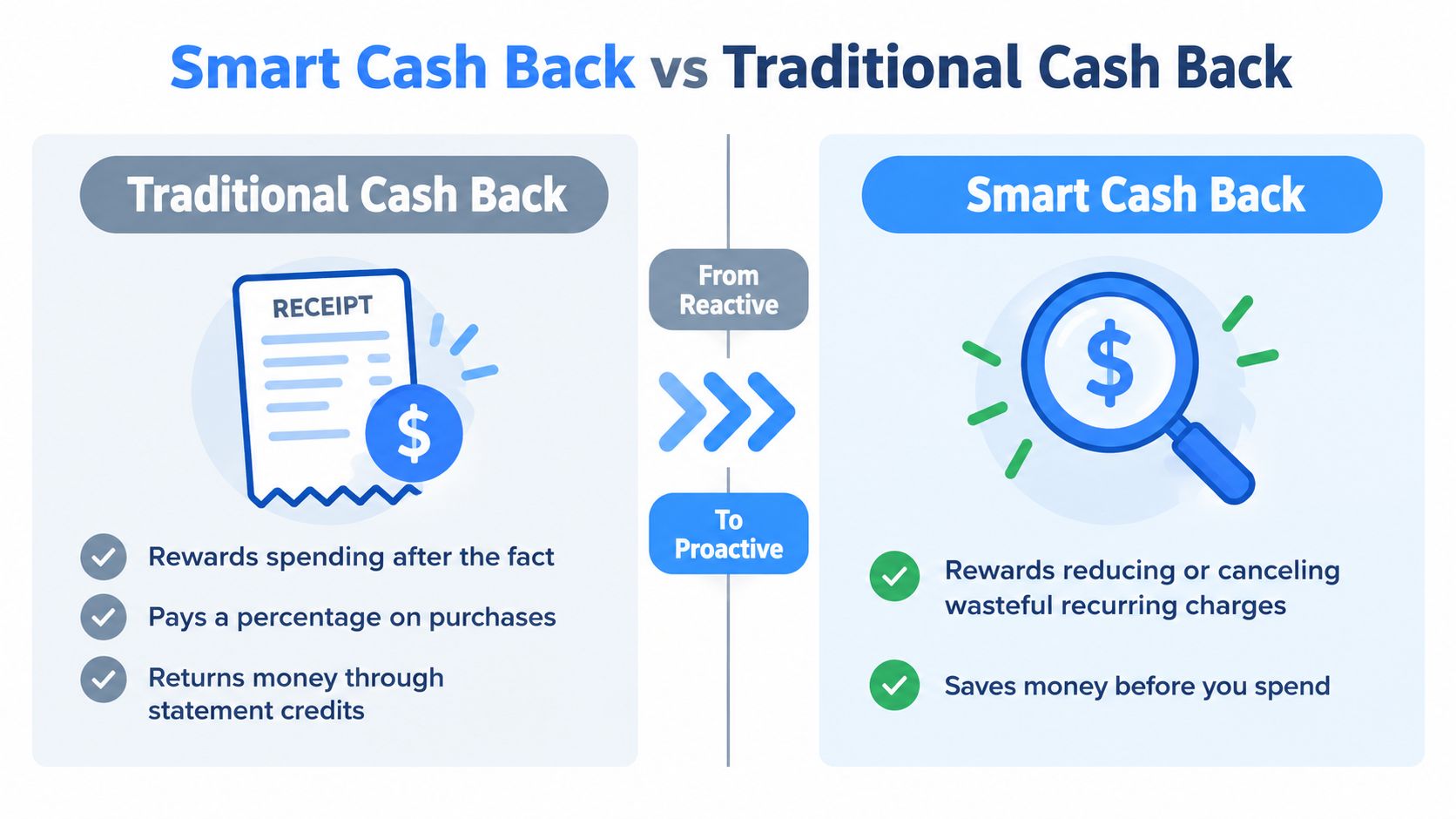
Traditional cash back pays you a percentage after you've spent. Smart cash back asks whether the spending should happen at all. Both can put money back in your pocket, but they operate at different points in the timeline, and that timing changes everything about reliability.
The comparison below shows the shift from reacting after a purchase to deciding before a charge.
Cash back cards are widely held, which makes the comparison worth doing. A 2019 survey on credit card rewards habits reported 49% of U.S. adults had at least one cash-back credit card, making cash back the most widely held major rewards category, while 23% of rewards-card holders had not redeemed any rewards during the previous year. Broad participation doesn't guarantee realized value.
Compare them on what matters
- Who pays: Traditional cash back comes from the card program after a purchase. Smart cash back comes from you not releasing the money in the first place.
- When value arrives: A reward may sit as a statement credit or balance until you redeem it. A canceled charge never leaves your account.
- What triggers it: Traditional rewards require spending. Smart cash back requires a decision, and often requires less spending.
- How easily it's lost: Unredeemed rewards can sit unused or be forfeited under program rules. A stopped renewal can't be forgotten in an account you never check.
- What can erase it: Fees, extra spending to chase a reward, and charges you didn't need can wipe out a reward's value. Don't spend more to earn a fraction back.
This short video walks through the reactive versus proactive distinction in everyday terms.
My recommendation is plain. Audit recurring outflow first. Canceling one forgotten annual plan returns the full amount, while a reward returns only a slice of what you spent. If you already use a simple cash back card for planned purchases, keep the habit simple and redeem what you've earned. Don't build a complicated system around categories and deadlines if a straightforward review of your subscriptions would save more with less effort. Simplicity you use beats a higher nominal rate you don't.
The Four Numbers That Make a Charge Decidable
A charge becomes decidable when you can see four numbers without digging. Until then, you're reacting to a notification, not managing an expense. In a survey on recurring charges and autopay habits, 74% of respondents said recurring charges were easy to forget, 72% had placed all subscription payments on autopay, and 42% said they had stopped using a service but continued paying for it. Forgetting isn't a character flaw. It's what happens when the numbers aren't in front of you.
The checklist below names the four data points to capture for every recurring charge.
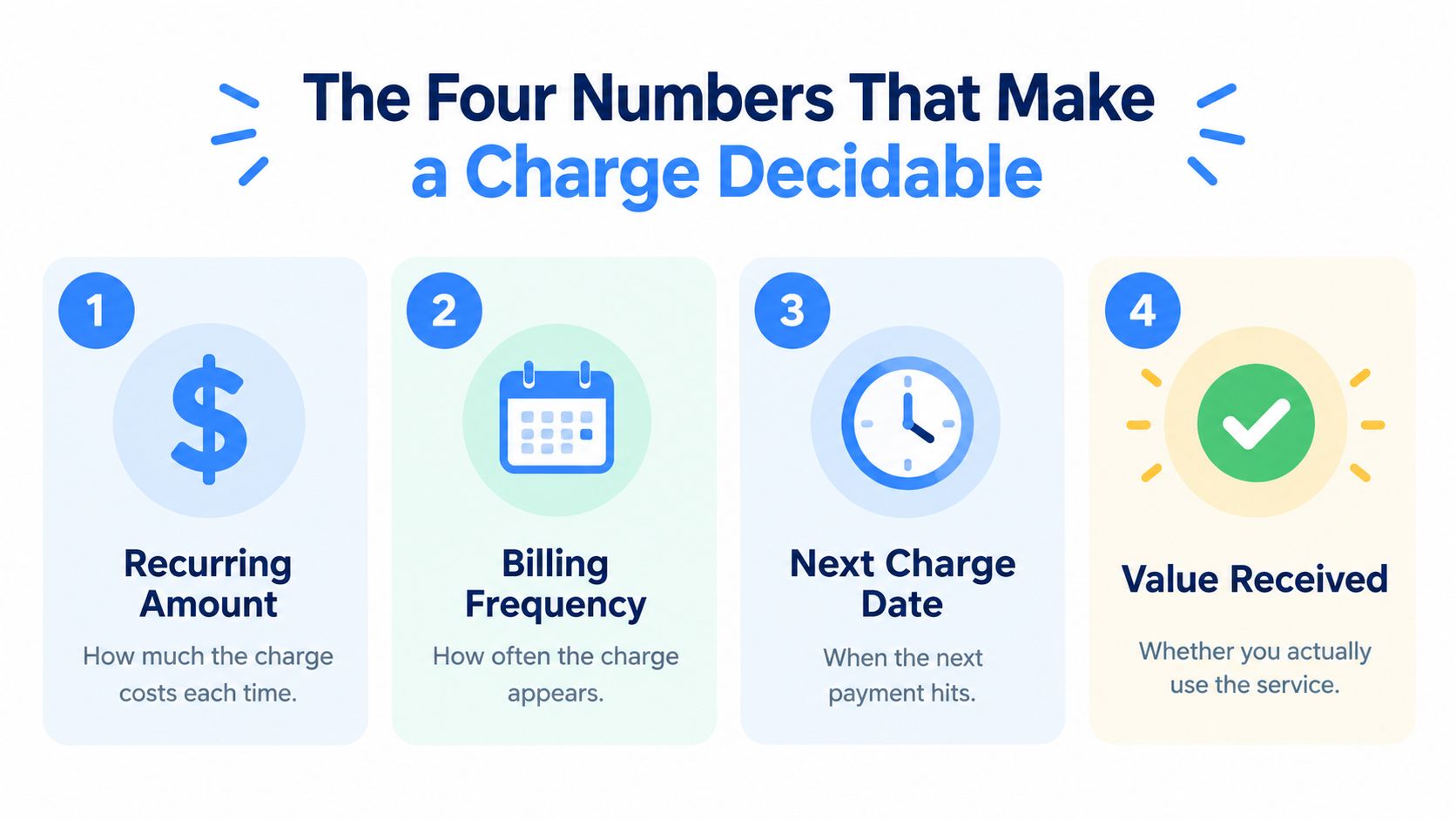
Capture these before the next billing date
- Recurring amount: Write down exactly what leaves your account each cycle, including the price after a trial or promotion ends.
- Billing frequency: Mark whether it's weekly, monthly, quarterly, or annual, because frequency changes how fast a small amount grows.
- Next charge date: Record the actual date and the last day you can act before it bills. Those aren't always the same day.
- Projected yearly cost: Convert the charge into annual terms so you can compare it fairly against other uses for that money.
Once those numbers are visible, the action is mechanical. Keep the charge if the value is clear and current. Skip a cycle if the service allows it and you want a break. Cancel if it's unused. Monitor it if your household is in transition and you'll know more next month.
Use a clear needs versus wants check for recurring bills when you're torn, but don't let classification become delay. A want you use weekly can stay. A need at the wrong tier should be downgraded.
Also record how to cancel while you're calm, not on billing day. Note the exact screen, phone number, or account page involved. People miss deadlines because they start searching for the cancellation route after the reminder arrives. Find the exit when you sign up, save it next to the charge, and you'll never lose a decision to friction.
Why the Yearly View Changes Every Decision
Monthly pricing is designed to feel small. That's why it works. You approve the monthly figure in your head, but you live with the yearly total in your account. Annualizing a charge isn't a scare tactic. It's the honest unit for a decision that repeats.
Take the unused subscription amount noted earlier. A modest monthly charge becomes $204 over twelve months, and a slightly larger one reaches $276. You wouldn't hand over that full amount in one payment for a service you barely open. Don't let twelve smaller payments sneak past a standard you'd apply to one.
Monthly charge translated to yearly cost
| Monthly charge | Yearly cost | Skip one cycle | Cancel for a year |
|---|---|---|---|
| $17 | $204 | $17 kept this month | $204 kept over the year |
| $23 | $276 | $23 kept this month | $276 kept over the year |
The table uses simple multiplication, and that's the point. You don't need a forecast to see the trade-off. You need the yearly figure on the same screen as the keep or cancel button.
Read the annual total cost view for recurring expenses before your next review and apply it to everything, including charges that feel too small to matter. A daily habit, a streaming add-on, and a cloud storage tier all deserve the same arithmetic.
Any recurring expense that wants another month from you should first justify its full year.
The yearly view also puts rewards in perspective without any complicated math. A small percentage back on spending can't compete with the full value of a charge you stop entirely. You'd have to spend a great deal through a rewards program to offset one forgotten subscription running all year. Stop the leak first. Then judge any reward on the spending that remains, because that spending has already passed your test. Annualize first, decide second, and keep only what survives both steps.
Three Real Scenarios You Can Run This Week
Frameworks don't save money. Repeated decisions do. Run these three common situations through the four numbers, name the yearly cost, pick an action, and record the saving. You'll learn the pattern faster by doing it once than by reading about it again.
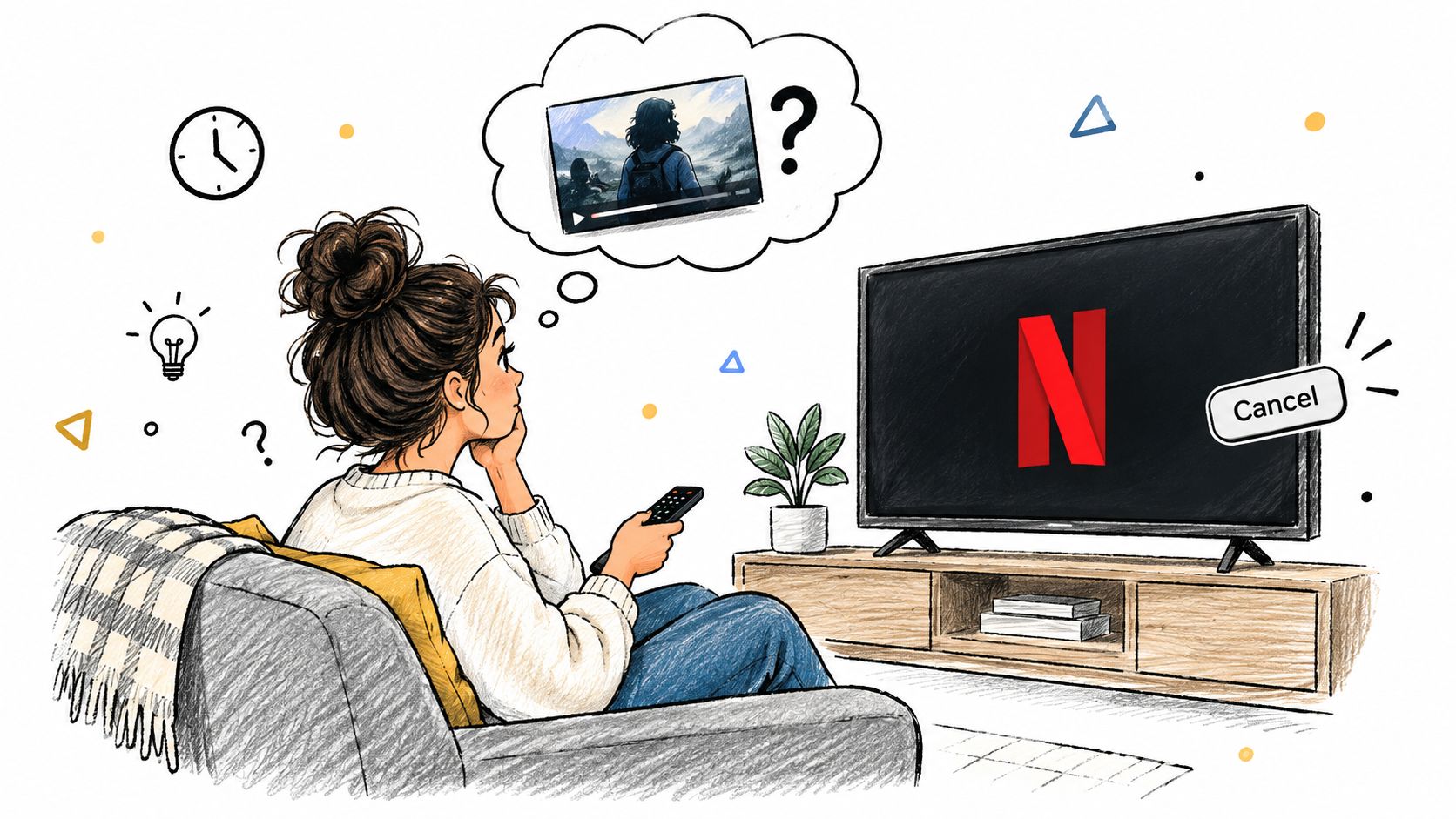
The photo below captures the most familiar version of the first scenario.
A streaming bundle kept for a finished show
You subscribed for a series everyone in the house watched. The series ended, the app still opens out of habit, and nobody can name what they'd watch next. Surface the amount, frequency, next date, and yearly total. If there's no current show justifying it, cancel before renewal. You can resubscribe when something specific pulls you back. Cancel for the gap, not forever. Record the monthly amount as saved and move on.
A phone plan that no longer fits the household
A family member moved to their own plan, or your data use dropped after a job change, but the old tier kept billing. This one usually needs a downgrade, not a cancellation. Check your actual usage, compare it with the tier you're funding, and call before the next cycle. Ask directly what changes today and when the lower price starts. Write down the new amount and the date it takes effect, then monitor the first bill to confirm it landed.
A food delivery pass that renews on its own
You signed up during a busy month when ordering in made sense. Life calmed down, you're cooking again, and the pass now subsidizes a habit you're trying to reduce. Skip a cycle if the service allows it, or cancel and pay per order for a while. That test tells you the truth quickly. If you barely notice its absence, you have your answer.
Notice what all three scenarios share. None requires a new financial product. Each one surfaces four numbers, forces one decision before billing, and records the result. That's smart cash back as a household habit. Run one scenario today, even if the saving looks modest. The first recorded saving changes how you see every charge after it.
A Weekly and Monthly Ritual That Compounds
A one-time cleanup feels great and fades fast. A short ritual keeps working because it meets each charge before billing day. You don't need an hour. You need a fixed moment, a complete list, and a rule that every flagged charge gets a decision.
Timing matters more than intensity. California automatic-renewal reminder requirements generally require reminders 15 to 45 days before an annual subscription renewal and 3 to 21 days before a promotional trial ends. Those windows tell you how early your own alerts should fire. A reminder on billing day is an apology, not a tool.
Your weekly check
- Scan what's due next: Look at charges landing in the coming days and flag anything you don't recognize or no longer use.
- Act on one charge: Skip, cancel, downgrade, or consciously keep it. Don't close the review with a charge left in limbo.
- Capture what the bank misses: Log cash habits and informal recurring costs by voice or quick text while they're fresh, so your list stays complete.
Your monthly review
Once a month, read the yearly projection for your full recurring list, not just the new additions. Sort by annual cost and work from the top. The largest yearly figures deserve the hardest questions, even when the monthly amount feels familiar.
Then do the step many people skip. Move what you saved. When you skip or cancel a bill, send that amount to a named savings goal right away, or set it aside for a specific upcoming expense. One goal at a time keeps the progress legible. Watching a single goal grow by each stopped charge teaches you faster than any chart that the ritual is working.
Keep your setup safe and low-friction while you do this. Use read-only bank access where available, so a tool can surface transactions without moving money. Turn on two-factor authentication for your accounts. Check a home-screen widget for what's due today instead of opening a full app every time. The easier the weekly glance is, the longer the ritual survives, and surviving is what makes it compound.
What Smart Cash Back Looks Like in Practice
In practice, smart cash back doesn't look like a rewards dashboard. It looks like a calm moment before a renewal, where you already know the amount, the date, the yearly cost, and your decision. No scramble, no surprise, and no charge renewed because you were busy that week.
It also looks unspectacular from the outside. You downgrade a phone plan after a household change. You skip a food delivery pass for a month and barely notice. You cancel a streaming bundle between shows and resubscribe only when there's something specific to watch. Each move is small. Together they change what your account keeps.
Your checklist for the next billing cycle
- List every recurring charge: Include subscriptions, bills, memberships, and daily habits that repeat.
- Attach the four numbers: Amount, frequency, next charge date, and projected yearly cost for each one.
- Save the cancellation route: Record how to stop each service before you need to.
- Decide before billing: Keep, skip, downgrade, cancel, or monitor. Pick one, in writing.
- Record the saving: Move each stopped amount into one named goal so the result stays visible.
Be honest about the trade-off. A higher promotional rate on spending still loses to a forgotten charge running all year, because the reward returns a fraction while cancellation returns everything. Don't optimize the fraction while the full amount walks out monthly. Review first, keep what earns its place, and let any rewards apply only to spending you've deliberately approved.
The smartest cash back for most households is the expense they keep meaning to cancel, finally canceled.
Start this week with the charge you already have doubts about. Pull up its four numbers tonight, set a reminder ahead of its next billing date, and decide while you still have room to act. Then watch that first saving land somewhere you chose. That visible result, repeated monthly, is the entire strategy. It's not flashy, and it doesn't need to be. It works because you keep the full amount, you see it accumulate, and you trust the next decision a little more than the last one.
Ready to see every recurring charge in monthly and yearly terms before it bills, with renewal reminders and a clear skip or cancel decision on each one? FloosYo connects to your bank, surfaces the subscriptions and bills you've stopped noticing, captures cash habits by voice, and moves what you save into a goal automatically. Start your free week, run your first review tonight, and keep the full amount of the next charge you no longer need.