
A meaningful savings percentage of income often starts around 10%, but the best way to reach it is to identify one or two recurring expenses you can skip each month instead of forcing a fixed amount from every paycheck. A small monthly cancellation can become a measurable annual improvement without requiring a complicated budget or investment system.
You may already know the feeling. A renewal notification arrives for a service you barely use, a phone bill includes an add-on you forgot about, and several small purchases have steadily become a large yearly outflow. You work, pay the bills, and intend to save, yet the balance barely moves.
The problem often isn't discipline. It's visibility. Recurring charges and habitual spending can consume disposable income before you make a deliberate decision about where that money should go. The practical answer is to make each repeating expense visible, express it in monthly and yearly terms, and decide whether it deserves another payment.
Table of Contents
- Why Your Savings Percentage Feels Out of Reach
- Understanding the Math Behind Your Savings Rate
- How Income Levels Change Your Saving Strategy
- Why a Fixed Percentage Is Not Always the Best Target
- Setting Up Automated Savings Without Hassle
- Building a Sustainable Financial Routine
Why Your Savings Percentage Feels Out of Reach
A renewal charge can expose the gap between intention and action in seconds. You open your banking app expecting an ordinary month and see a subscription renewed, a cloud-storage plan increased, or a gym payment processed after weeks without use. Each charge looks manageable alone. Together, they reduce the money available for saving.
Many households lose progress through automatic outflows that continue after the original need has disappeared. A streaming service kept for one show, a premium phone feature used once, or food delivery ordered after a long workday can remain active because cancellation requires a deliberate choice. Without that choice, the payment repeats.

The hidden difference between monthly and yearly cost
Judge recurring spending by its annual effect, not by one transaction. The personal saving rate measures the share of disposable income left after taxes and spending. Every avoidable recurring charge lowers the amount that can remain available for saving.
A service costing $15 per month creates $180 over a year, as illustrated in the FRED personal saving rate series. Cancel the service and avoid replacing it with another purchase, and your annual savings can rise by that same amount. The percentage improves because your actual outflow falls.
Practical rule: Review recurring expenses before cutting every category. One decision can stop the same payment from returning each month.
Small reductions are often easier to maintain than a strict savings target. Cancel one unused service, remove one forgotten add-on, or pause one habit that no longer earns its place in your spending. Repeat the review whenever a new renewal appears.
Start with a decision, not a spreadsheet
A full budget can help, but the first useful change does not require one. Begin with automatic charges and ask:
- Do I still use it? Separate current use from the fact that you once wanted it.
- Would I buy it again today? This identifies services maintained by inertia.
- Can I skip one cycle? A temporary pause may be more realistic than permanent cancellation.
Use a monthly budget planner to organize the remaining expenses if you need a broader view. First, turn an unnoticed payment into a conscious decision. Record the amount you avoid and direct it toward a specific reserve or goal. Your savings percentage then rises through changed behavior, not a more ambitious intention.
Understanding the Math Behind Your Savings Rate
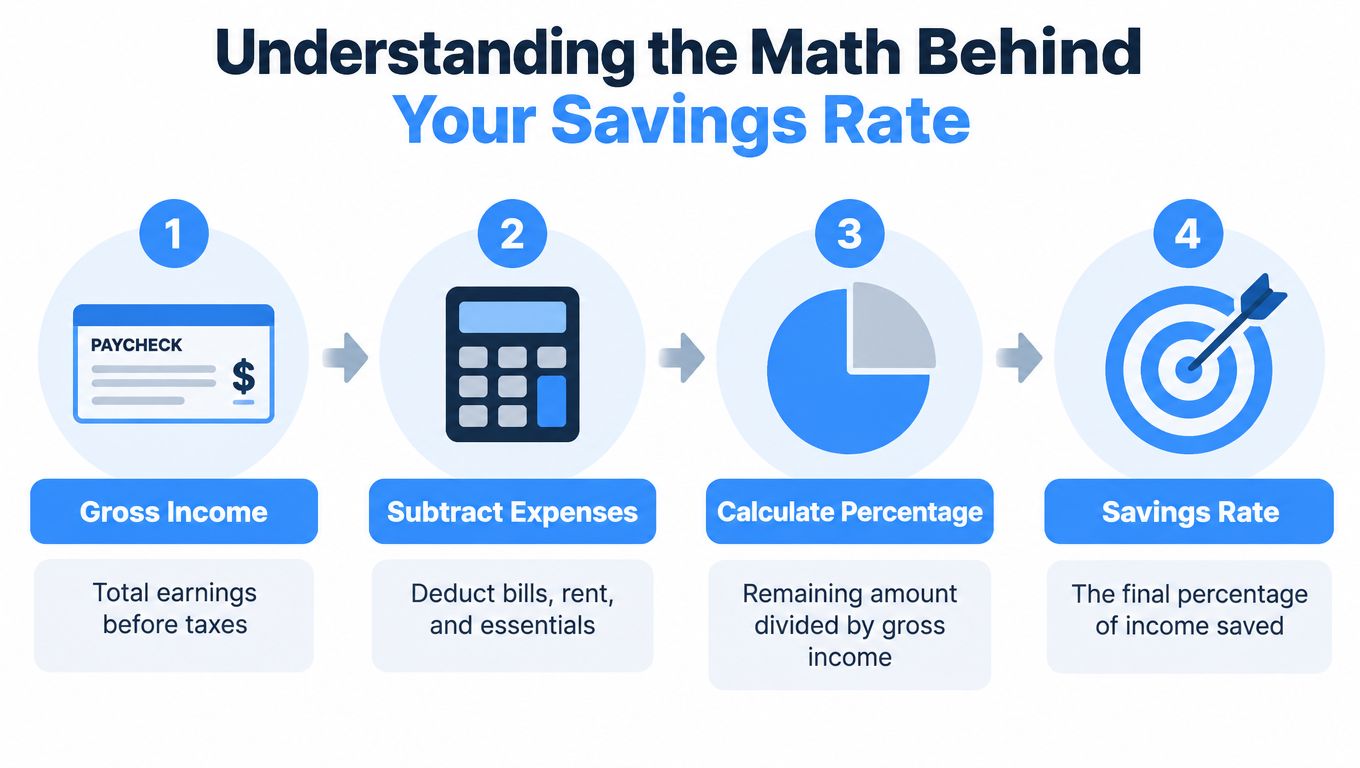
Your savings percentage of income is a ratio, not a judgment about your discipline. Calculate it with:
Savings rate = (net disposable income − consumption) ÷ net disposable income × 100
The OECD household savings definition treats saving as the share of net disposable income that remains after consumption, with adjustments for changes in household pension entitlements. For personal planning, use take-home income and define your method clearly. Decide whether automatic retirement contributions, debt principal payments, taxes, or transfers count as saving, then apply that choice consistently.
Use disposable income as the denominator
Gross salary can hide the amount available for real household decisions. If $4,000 remains after taxes and spending leaves $200, your savings rate is 5%, consistent with the BEA explanation of personal saving. Use disposable income, not the salary printed on an employment contract.
National-account measures and household budgets serve different purposes. Official statistics can include aggregate categories or mandatory pension saving that does not feel accessible as cash. Your personal calculation should state its denominator and included items plainly. Review it each month using the same method, so a change reflects behavior rather than a changed formula.
Convert recurring reductions into percentage points
A recurring expense changes your rate through its annual cost:
Annual avoided cost ÷ annual net income × 100 = savings-rate improvement
Eliminating a $15 monthly charge avoids $180 per year. Against $48,000 of annual disposable income, that raises the savings rate by 0.375%, using the calculation illustrated by the BEA historical series example. The increase is modest, but it comes from one repeatable decision instead of restricting every purchase.
Several small cuts can matter more than one ambitious target. Ten monthly expenses of $15 each consume 5% of $3,000 monthly income, equal to half of a 10% savings target. The Congressional Research Service discussion of saving rates provides broader context for comparing savings rates. Annualize recurring outflows before the next payment arrives, then remove the charges that provide the least value.
Track the rate and the balance
The rate measures how much income you retain. The balance measures whether that money is still available for an unexpected bill or another defined goal. Record both, because a higher percentage does not prove that a usable reserve has grown.
Federal Reserve survey results illustrate the difference. In 2024, 55% of U.S. adults reported emergency savings covering at least three months of expenses, while 63% said they could cover a hypothetical $400 emergency with cash, savings, or a credit card paid off at the next statement, according to the Federal Reserve household well-being report. Track the percentage improvement from avoided spending and the dollars accumulated from it.
How Income Levels Change Your Saving Strategy
A 10% savings target can feel manageable for one household and restrictive for another. In 2022, 30.9% of families in the bottom 20% of the U.S. income distribution reported saving some income, compared with 83.7% of families in the top 10%, according to Congressional Research Service analysis of Federal Reserve data. The same ratio can therefore require a very different sacrifice at different income levels.
| Monthly disposable income | Monthly saving at 10% | Annual saving at 10% |
|---|---|---|
| $3,000 | $300 | $3,600 |
| $6,000 | $600 | $7,200 |
Both households save the same share, but the lower-income household has less room for rent, food, transport, medical costs, and irregular bills. A fixed percentage may be mathematically equal while producing unequal pressure.
Match the target to essential outflows
List required payments before setting a savings target. If essential costs consume most disposable income, begin by removing recurring charges that deliver little value and stabilizing cash flow. That approach can raise the actual savings percentage without requiring a complex budget or investment system.
A student with variable work hours may need a small contribution that continues through ordinary months. A professional with predictable income may cancel several discretionary services and redirect the released money automatically. Choose the method that fits the household's cash flow. The measure of success is consistent retention of more income without creating a new shortfall.
Small recurring reductions deserve priority because they repeat every month. Canceling unused services, reducing delivery orders, or renegotiating a regular bill can increase savings with less friction than pursuing one aggressive target. Direct each freed amount into savings as soon as the charge disappears.
Use a percentage as a diagnostic
The U.S. personal saving rate has shifted with economic conditions. The FRED historical series shows rates generally between 10% and 15% during much of the 1950s through the 1980s, falling to approximately 3% to 4% around the 2007 to 2009 financial crisis and later stabilizing near 7% before the COVID-19 pandemic. The Congressional Research Service calculated an average rate of 5.9% from January 2005 through December 2024, while the December 2024 rate was 3.8%.
Use these figures for context, not as a personal quota. Compare your current rate with your previous baseline and track the effect of each canceled expense. A household saving 10% accumulates twice as much annually as one saving 5%, before investment returns, because the saved share is twice as large. Set the percentage, then improve it through repeatable expense reductions.
Why a Fixed Percentage Is Not Always the Best Target
A freelancer may earn well in one month and face a thin cash-flow month soon after. A gig worker, seasonal earner, or commission-based employee can face the same pattern. For these households, forcing the same transfer every month can create a shortfall and lead to withdrawals later. A fixed percentage looks tidy, but it can work against actual financial stability.
Income uncertainty is often linked with higher saving rates, particularly among lower-income households, as people build precautionary cash when they fear losing income. This pattern appears in Bank of Italy research on household saving and uncertainty. The practical priority is clear: consistency and liquidity can matter more than hitting an identical monthly ratio.

Build a floor and a surplus rule
Use two layers instead of one rigid target:
- Set a minimum floor. Choose an amount that remains affordable during a weak month. The floor should preserve liquidity rather than force a transfer you will later reverse.
- Save a variable share of surplus. When income rises above its normal baseline and essential obligations are covered, direct part of the extra money toward the same goal.
- Pause intelligently during lean periods. Lower contributions are appropriate when upcoming bills or irregular income make cash more valuable.
- Review the annual result. Track total saved, recurring costs removed, and available cash. One difficult month should not define the plan.
Small recurring reductions make this rule easier to maintain. Cancel an unused service, reduce delivery orders, or renegotiate a regular bill, then redirect the released amount to savings. Repeating a modest reduction each month can raise the actual savings percentage of income without a complex budget or investment system.
Prioritize resilience over a flattering ratio
A rate alone can conceal financial fragility. Federal Reserve findings show a strong relationship between having money left at month-end and holding emergency savings. Use that principle in practice: create recurring room in the monthly cash flow, then direct verified avoided spending toward a liquid reserve or a defined near-term need.
A lower rate that remains intact is more useful than a higher rate that forces you to withdraw the money later. Judge the plan by retained cash and reduced outflows, not by whether one month matches a popular rule.
Setting Up Automated Savings Without Hassle
Automation works best after you decide what should stop. It shouldn't hide spending or move money blindly. Set up a routine that identifies a recurring charge, gives you time to skip or cancel it, and routes the verified avoided amount toward one clearly named goal.

Create the system in a deliberate order
- Connect the accounts you regularly use. Read-only bank access can provide a clearer record of recurring bills and subscriptions than memory. Check the connection and confirm that incoming transactions match your account history.
- Review detected repetition. Group charges by merchant, amount, and rhythm. Separate genuine recurring obligations from occasional purchases that only look similar.
- Add missing expenses manually. Bank records may not capture cash spending or planned charges. Voice or text entry can record an amount, category, and frequency without requiring a long form.
- Set renewal reminders. Put notifications before the charge date, not after it. The useful moment for a decision is before a renewal becomes an outflow.
- Choose skip, cancel, or monitor. Don't treat every recurring expense as bad. Keep what supports your priorities and challenge what no longer earns its place.
- Send the avoided amount to one goal. A single destination makes the result easy to verify. Split goals later if your cash flow can support it.
An app's read-only connection should remain read-only. The system can show a projected saving and track progress, but you should retain control over transfers and account permissions.
Make projections do the work
Monthly totals help you manage the next payment. Yearly totals help you judge whether the payment deserves to continue. A service that costs little today can compete with a meaningful savings target once you view its annual projection alongside other recurring expenses.
Use clear savings goals with a defined purpose, such as an emergency reserve, an upcoming predictable bill, or a necessary replacement purchase. Avoid vague labels like “future money.” The more concrete the goal, the easier it is to connect a skipped charge with a visible result.
The system should also capture income. The savings percentage uses disposable income as its denominator, so an accurate paycheck record matters. If income changes, the target should change with it rather than pretending that last month's amount remains available.
Automation should remove repetition, not judgment. You still decide which costs belong in your life. The tool makes the next charge, annual cost, and possible saving visible early enough to act.
Building a Sustainable Financial Routine
A durable savings routine has three parts: visibility, a timely decision, and a recorded result. Visibility means knowing which charges repeat and what they cost over a year. The decision is whether to keep, downgrade, skip, or cancel. The result is the amount that remains available for a goal.
Review recurring expenses on a regular schedule, especially before renewals. Don't wait for a large financial reset. One phone feature, streaming plan, cloud service, gym membership, or delivery habit can provide the next useful decision.
Save the amount you can prove you avoided, not the amount you hoped you would spend.
Check both metrics after each review: your savings percentage of income and your accumulated cash balance. The first shows the share of disposable income retained. The second shows whether that improvement is becoming usable resilience. If your income is irregular, compare a broader period rather than judging one unusually weak or strong month.
Use how much to save as a starting point for your thinking, not as a substitute for your actual cash flow. A realistic floor, variable contributions during stronger months, and fewer unwanted recurring charges will outperform a rigid rule that repeatedly fails.
FloosYo connects to your bank, finds recurring subscriptions and bills, projects their monthly and yearly cost, and reminds you before renewals. Use voice entry for expenses your bank doesn't capture, then skip or stop charges and track the avoided amount toward one savings goal. Visit FloosYo to turn recurring spending decisions into measurable progress.