
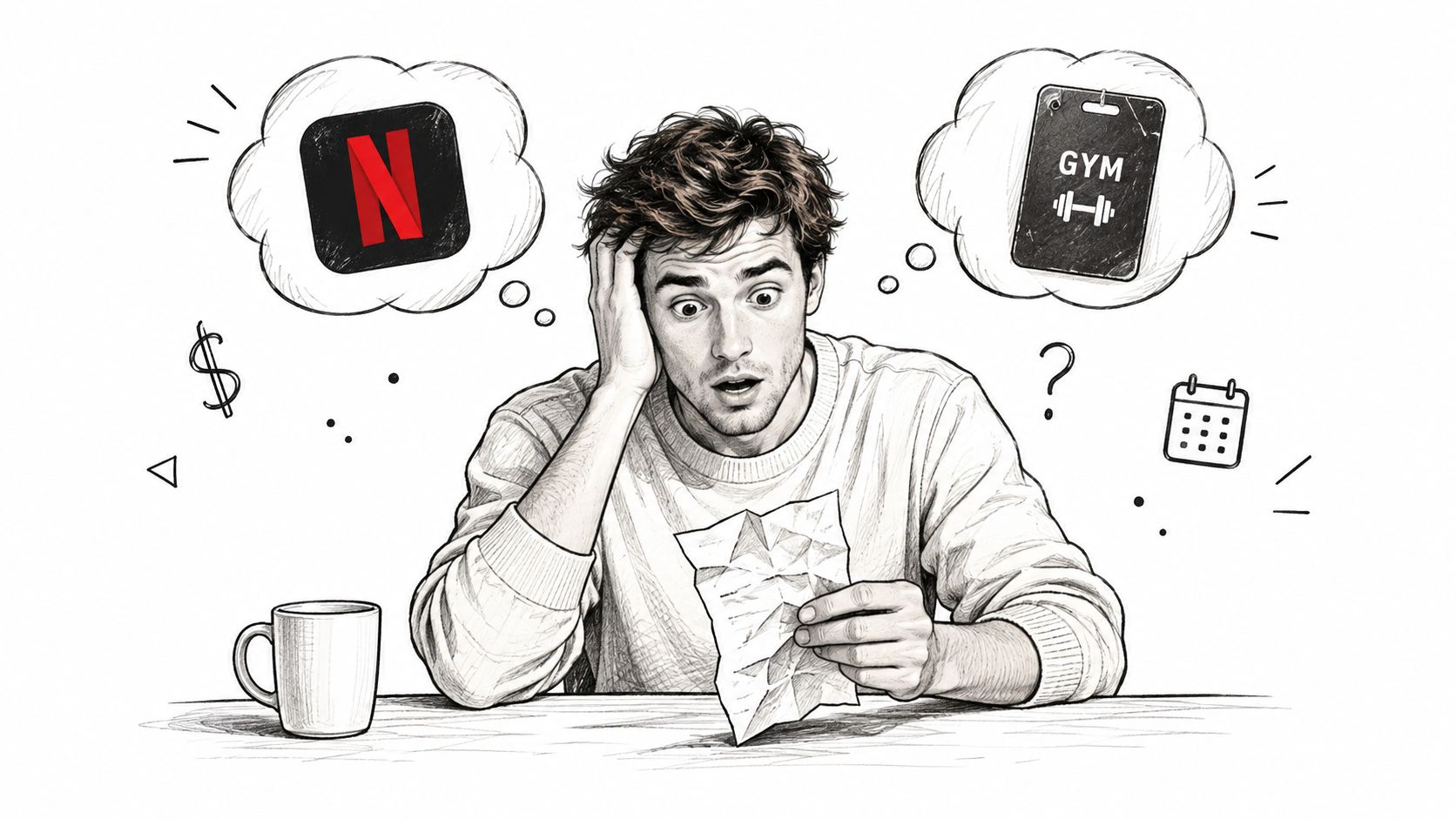
You check your bank account and find a charge you barely recognize. It might be a streaming plan you stopped watching, a gym membership you haven't used since January, or cloud storage that renewed while you were focused on rent and groceries. The amount doesn't look alarming on its own, so you let it pass. Then another renewal appears.
That pattern is one of the least dramatic ways money leaves your life. It doesn't arrive as a financial emergency. It slips out through recurring bills, forgotten trials, app fees, delivery habits, and automatic renewals. If you're learning how to leave the rat race, the first move isn't necessarily changing careers or starting a business. It's finding the money that's already disappearing and deciding whether each charge deserves another year.
Table of Contents
- The Moment You Realize Money Is Leaving Automatically
- Understanding the Hidden Cost of Recurring Charges
- Auditing Your Recurring Spending Step by Step
- Why Annual Projections Change How You Save
- Building a Savings Goal and Tracking Progress
- Your Practical Exit Strategy Starting Today
The Moment You Realize Money Is Leaving Automatically
The uncomfortable moment usually arrives during an ordinary transaction review. You recognize the merchant name, remember intending to try the service, and realize you've paid for it repeatedly without making an active decision. The charge may be small enough to ignore, but the repetition is what matters.
Recurring spending is easy to miss because your attention follows large bills. Rent, utilities, transportation, and groceries feel important because you actively deal with them. Smaller payments blend into the background, especially when they're processed on different dates and appear under unfamiliar billing names.
A useful audit starts with a simple question: what left my account automatically during the last year? Memory won't answer that reliably. Transaction records will.
Independent consumer research found that Americans often estimate their monthly subscription spending at about $86, while itemized records average about $219, creating a $133 monthly blind spot that can become roughly $1,596 over a year (subscription spending research). That gap isn't proof that every charge is wasteful. It shows why guessing produces a weak exit plan.
Find the charge before judging it
Look through bank transactions, card statements, and app-store billing records. Search for repeating merchant names, similar amounts, and charges that occur monthly, quarterly, or annually. A free trial that converted into a paid plan belongs in the same review as a phone bill or a software subscription.
The aim isn't to eliminate every convenience. A service you use consistently may earn its place. The important distinction is between intentional recurring spending and charges that continue only because cancellation requires attention.
Practical rule: Don't ask whether a charge feels small. Ask whether you'd knowingly authorize the next twelve payments today.
That question changes the conversation. It turns passive spending into a decision, which is the foundation of reducing paycheck dependence without relying on motivation alone.
Understanding the Hidden Cost of Recurring Charges
A $9.99 charge looks minor on a statement. Annualized, it becomes nearly $120 before tax, renewal increases, or additional services enter the picture. That calculation exposes the commitment attached to entertainment plans, storage upgrades, and app fees. It also gives an automated detector a useful target: repeated merchant names, predictable intervals, and small charges that rarely receive manual review.
A related 2026 consumer survey found that U.S. adults who subscribed during the previous year spent an average of $111 per month, or $1,332 annually. About $21 per month went toward unused subscriptions, equal to $252 per year. Subscription spending increased 7.7% year over year in July 2026, while entertainment and retail subscriptions represented about 43% of total subscription spending. Growth was faster among younger groups, with Gen Z spending up about 14%, younger Millennials around 10%, and older Millennials nearly 8% over the prior twelve months (Bank of America Institute analysis).
The practical lesson is to detect recurring charges before deciding whether they deserve cancellation. Unused services create a measurable outflow without delivering a matching benefit, but a frequently used subscription may still justify its annual cost.
Think in obligations, not isolated payments
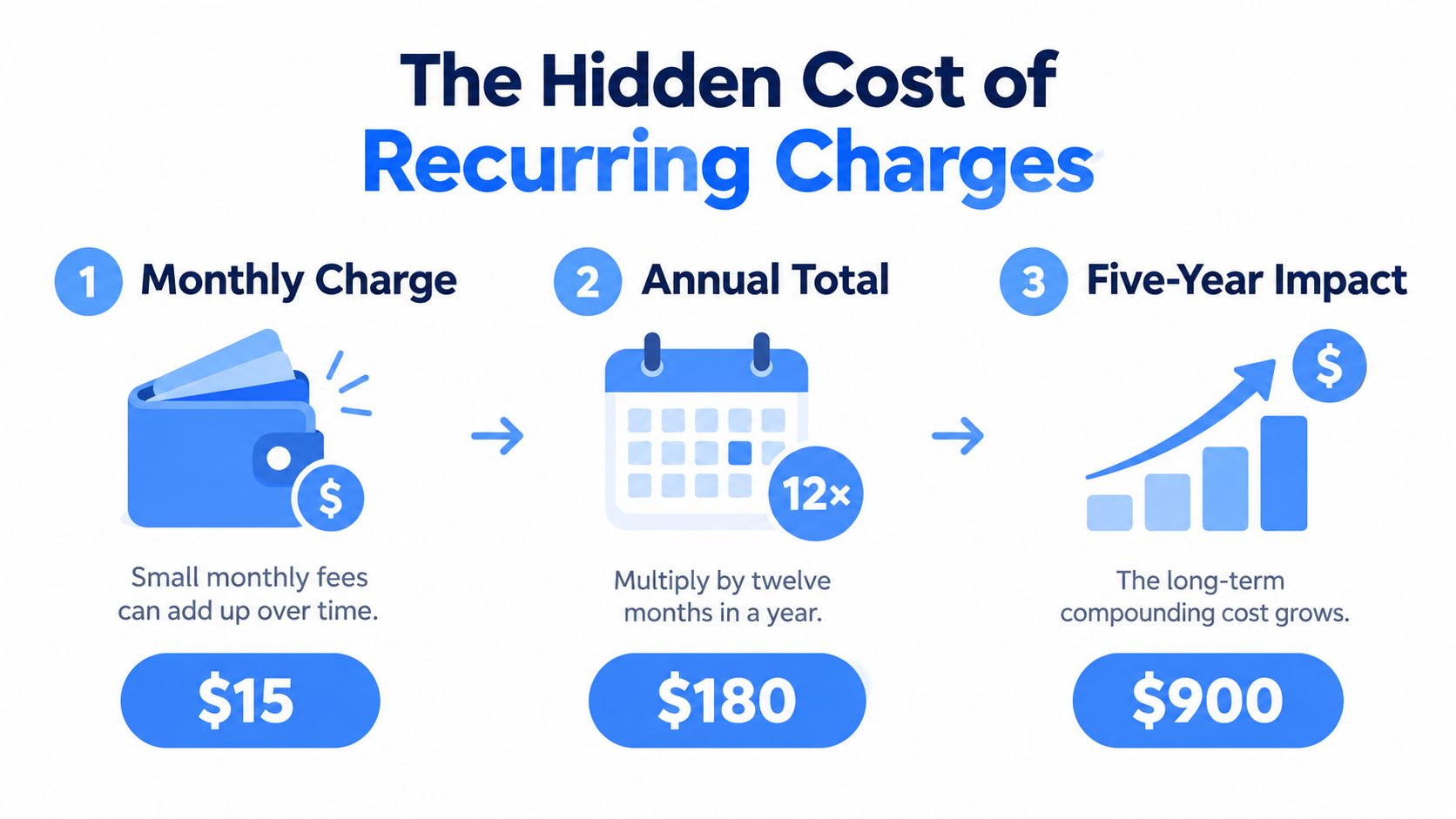
Evaluate each charge at three levels:
- Monthly view: What leaves the account now?
- Annual view: What will the same choice cost over twelve months?
- Exit-plan view: What could that amount support if it stopped recurring?
Annualization does not make a purchase wasteful by itself. It creates a fair comparison between convenience and opportunity cost. Consumer Reports lists its Digital plan at $39 per year, displayed as $3.25 per month, and its All Access plan at $64 per year, displayed as $5.34 per month when billed annually (Consumer Reports membership pricing). Calculating in both directions prevents a low monthly price from hiding a larger yearly obligation.
Recurring costs also affect financial-independence planning. Research found that the average American defines financial independence as earning about $94,000 per year, while 60% said they felt optimistic about reaching it (Empower financial independence research). Lowering fixed outflows can improve that position without requiring an immediate income transformation. A yearly projection shows which cancellations produce meaningful room in the budget and which changes are too small to matter.
Auditing Your Recurring Spending Step by Step
Start with transaction data, not a memory exercise. Connect the accounts where recurring charges appear, then review enough history to capture monthly, quarterly, and annual renewals. A bank record can expose three music services running at once, a forgotten gym payment, or a trial that automatically became a standard plan.
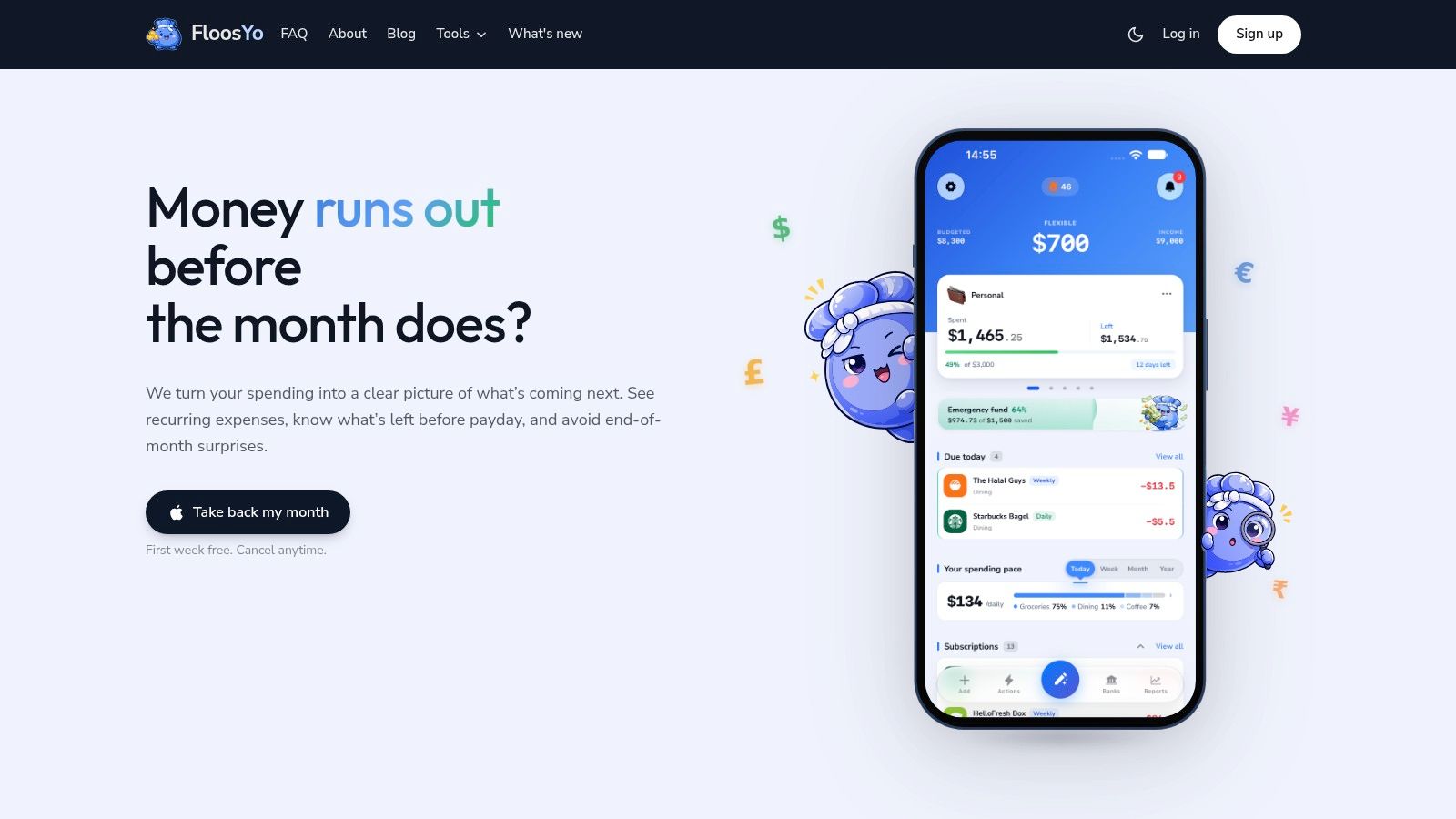
FloosYo is one option for this workflow. It connects to banks through Plaid, detects repeating transactions, projects monthly and yearly totals, and lets you record items the bank can't see through voice or text entry. You can also review the app's approach to tracking spending from transaction data before choosing a method.
Use a decision category for every charge
Assign each recurring expense to one of three groups:
- Essential: Keep it, but check whether a lower tier or different billing schedule meets the same need.
- Useful but replaceable: Compare alternatives, shared plans, library access, free tools, or a less expensive service.
- Unnecessary: Cancel it, or stop the renewal before the next billing event.
Don't treat “I might use it later” as a decision. If you need the service again, you can reassess when the need returns. A subscription that remains active only because cancellation feels inconvenient is already costing you attention as well as money.
Set a reminder before renewal when cancellation isn't immediate. Read the service's terms and save the confirmation. In the United States, automatic-renewal rules generally require clear disclosure of material terms, express informed consent, and a simple cancellation method, while some states add reminder and cancellation-parity requirements (U.S. subscription rights overview). California requires certain reminder notices 15 to 45 days before longer renewals, while Delaware uses a 30 to 60 day notice window for specified renewals extending beyond an initial one-year term (state automatic-renewal obligations).
A practical audit sheet can contain only these fields:
| Charge | Billing rhythm | Annualized cost | Decision | Renewal date |
|---|---|---|---|---|
| Cloud storage | Monthly | Monthly amount × 12 | Keep, downgrade, or cancel | Date |
| Gym | Monthly | Monthly amount × 12 | Cancel or keep | Date |
| Streaming service | Annual | Listed annual price | Keep or cancel | Date |
Use reminders and projected totals to act before the payment, not after the surprise charge.
Why Annual Projections Change How You Save
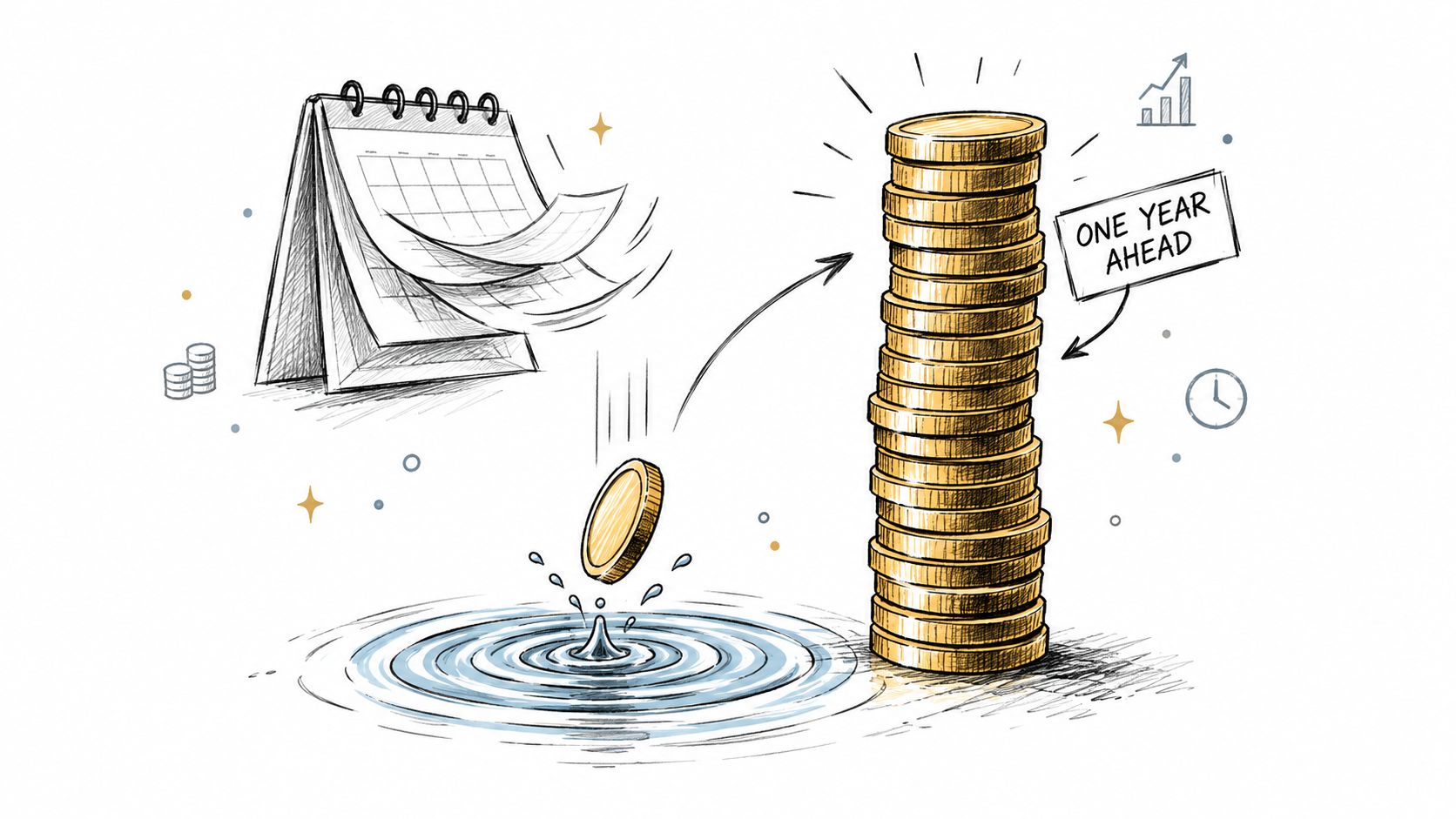
A monthly charge can feel harmless because it asks for attention only once at a time. The annual projection removes that disguise. If a service costs $12 per month, the yearly outflow is $144, assuming the charge continues for twelve months. That isn't a prediction of what every reader will save. It's a clearer description of the commitment being accepted.
The most useful question after finding a recurring expense is not, “Can I afford this month?” It's, “Do I want to spend the annual amount on this?” That question works for subscriptions, delivery habits, app upgrades, and recurring fees.
A projected total also helps you choose between cutting a large bill and removing several smaller ones. One cancellation may not change your lifestyle, but a group of low-friction decisions can create a noticeable reduction in fixed obligations. The money then needs a destination, or it may flow into another category.
See how annual total cost changes spending decisions and apply the same calculation to every repeating expense.
Turn one skipped payment into a visible result
Suppose you skip a service for one cycle. Record the avoided amount and move it into a separate goal account or designated savings envelope. Don't leave the saving undefined. “I'll spend less” is vague. “This avoided charge goes toward my emergency cushion” gives the decision a job.
This approach is more reliable than reconstructing costs from memory. Automated recurring-charge detection identifies patterns that you may overlook, while annual projections show whether a decision is strategically meaningful. Visibility doesn't eliminate trade-offs, but it helps you make them deliberately.
Building a Savings Goal and Tracking Progress
A canceled charge matters only when the avoided money reaches a defined purpose. Choose one target first, such as an emergency cushion, a period of essential expenses, or a planned major payment. Several competing goals can make each skipped bill feel too small to notice.
Write the goal in operational terms, following the structure in our guide to setting savings goals:
- Name: Emergency cushion or runway account.
- Funding source: Canceled, downgraded, or skipped recurring expenses.
- Tracking method: Record each avoided payment.
- Review rhythm: Check the balance and upcoming renewals weekly.
The amount can be modest and still change your position. Assign it before it blends into general spending. If a canceled service would have charged on a known date, transfer or set aside the avoided amount on that date. Matching the transfer to the original billing date keeps the spending decision visible and makes progress easier to verify.
FloosYo supports a savings-goal workflow where skipping a bill can automatically assign the saved amount to a selected goal. The home screen displays cumulative progress, so you can review the result without maintaining a separate spreadsheet. FloosYo has read-only bank access. It reads transactions but cannot move money from your bank account.
Keep the system easy to maintain
Income tracking shows what remains after recurring obligations. Log a paycheck or let the bank supply the income transaction, then compare that amount with projected expenses. Voice or text capture can record cash purchases and other spending that does not appear in the connected account.
A widget can shorten the path from awareness to action. A home-screen view of upcoming charges, goal progress, or budget standing can prompt a review before a renewal arrives. Custom categories also improve readability when household members use different names for similar costs.
The system does not require perfect behavior. It needs to record the decision, capture the avoided amount, and keep the goal visible. Review progress weekly without turning every review into a full financial overhaul. A brief check of upcoming renewals and recent recurring charges is enough to keep the process active.
Your Practical Exit Strategy Starting Today
Leaving the rat race usually starts smaller than people expect. Connect the accounts where recurring charges appear, identify every repeating payment, annualize each cost, and decide whether to keep, downgrade, skip, or cancel it.
Set aside the avoided amount for one defined goal. Review upcoming renewals weekly, and use reminders where cancellation requires advance notice. If financial independence feels distant, this process still improves your position because it reduces obligations you don't need to carry.
The broader challenge is real. Pew found that only 45% of U.S. adults ages 18 to 34 reported being completely financially independent from their parents in 2024, while 44% had received financial help from them during the previous year (Pew financial independence findings). A systematic reduction in recurring outflows won't solve housing or income pressures by itself, but it gives you clearer control over the money already passing through your account.
Start with the next transaction review, not a distant fantasy of freedom. The exit plan becomes credible when you can name the charges you removed, the annual cost you avoided, and the goal now receiving that money.
FloosYo connects to your bank, detects recurring spending, shows monthly and yearly projections, and provides renewal reminders plus skip or cancel decisions. Use FloosYo to audit the charges you've stopped noticing and turn each avoided payment into visible savings progress.