
A 2025 CNET/YouGov survey found that U.S. adults estimated subscription spending at $86 a month, while their reported actual spending averaged $219. That's more than 2.5 times higher, and 42% said they'd stopped using a service but kept paying for it, according to the survey findings on unused subscriptions.
So if you're asking, "How much do you save by cutting recurring charges?" don't start with an ideal monthly target. Start by finding what's already leaving your account. The most useful savings number isn't a guess about what you could cut. It's the amount you confirm, decide to stop paying, and keep.
Table of Contents
- Why Savers Underestimate What They Save
- Building Your Real Recurring Spending List
- Turning Recurring Charges Into Annual Numbers
- Choosing Skip, Cancel, or Negotiate for Each Charge
- Routing Saved Cash Into a Real Savings Goal
- A Realistic Quarter of Avoiding Recurring Charges
- Your Next Statement and the One Number Worth Tracking
Why Savers Underestimate What They Save
A $133 monthly miss becomes $1,596 over a year. That is the subscription gap annualized, and it is large enough to rival a major household bill rather than a rounding error.
Choosing a savings target first, then hoping willpower protects it, overlooks a basic problem: you cannot make a reliable decision about recurring spending if you do not know what is recurring.
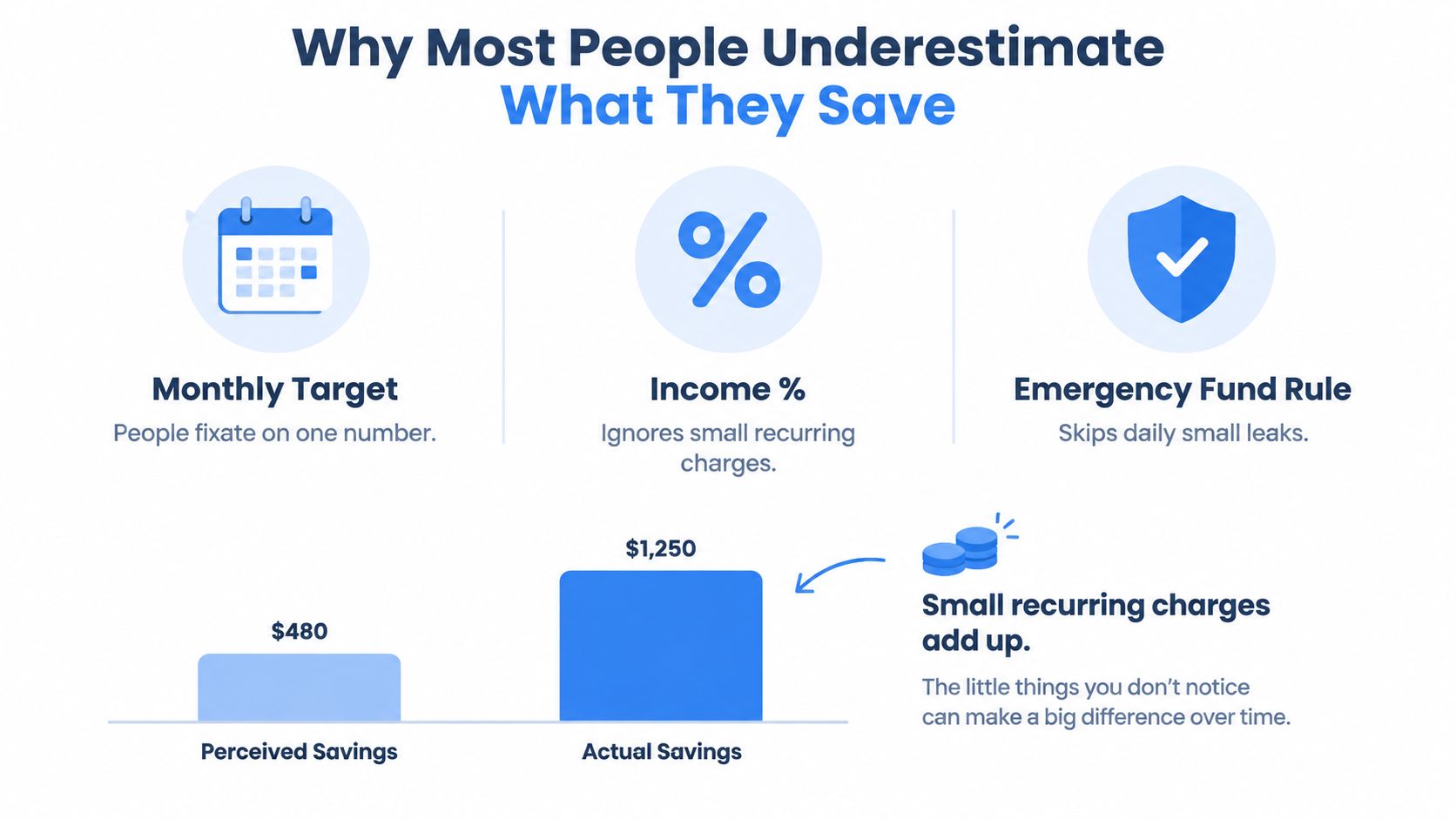
That is why I treat saving as a measurement problem before a motivation problem. A target can look disciplined while forgotten renewals, annual fees, and small app charges keep draining the account. Visibility gives you something specific to act on: a merchant, a next billing date, and the yearly cost of leaving it alone.
The practical shift: Don't ask only how much you should save. Find out what you're paying for without noticing.
Willpower budgeting asks you to resist the same outflow every cycle. Visibility budgeting lets you skip a month, cancel a duplicate, or negotiate a rate before the next charge lands. One decision can protect cash for twelve billing cycles.
Keep every recurring cost that still earns its place. Judge it with the actual amount and frequency in front of you, then route the confirmed savings somewhere you can count.
Building Your Real Recurring Spending List
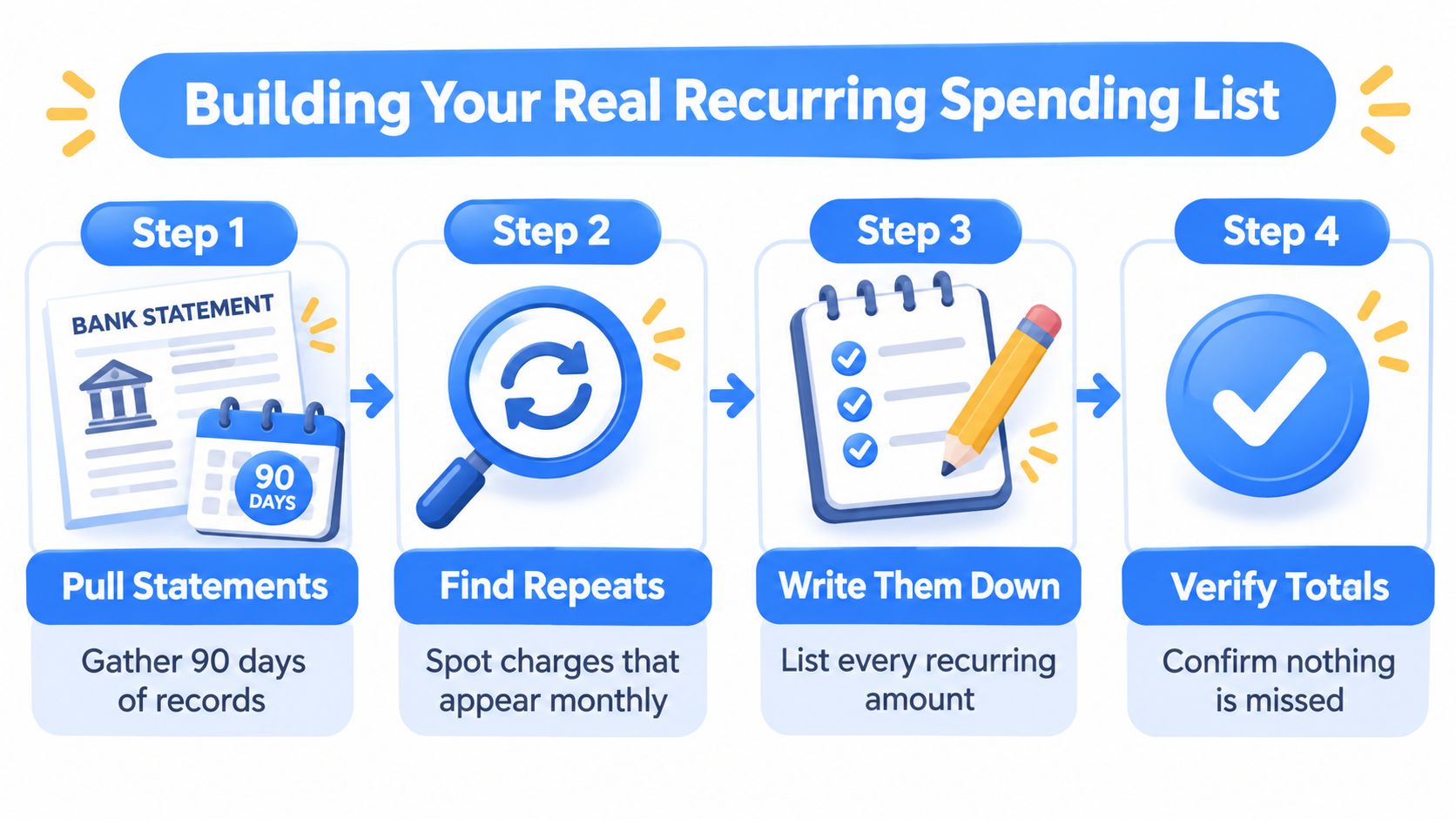
Memory isn't a spending record. Pull three to six months of bank and card transactions and let the transactions, not your best guess, show you what repeats. If you want a practical guide to recording and sorting purchases, use this approach to tracking spending.
Start by grouping transactions by merchant. Banks may display the same business under slightly different names, so standardize those labels before deciding how many services you pay for. Then group each merchant's charges by billing interval and mark each as monthly, weekly, quarterly, or annual.
Check for repeats and missed renewals
Look for charges that appear more than once in a billing period, especially when a free trial became paid or a plan changed. Also check for overlapping services. Two music apps may both be active because you switched services but never canceled the first.
For each line, write down the merchant, amount, billing rhythm, next expected charge, and whether you still use it. That last detail matters. A charge isn't automatically waste just because it repeats. Mark whether you use it, share it, or keep it for a specific need.
One survey reported perceived subscription spending of $86 per month versus $219 identified from actual charges, a $133 monthly gap that works out to $1,596 annually, according to the survey report on subscription spending. A list built from transactions is more useful than a mental inventory precisely because it can surface costs you wouldn't think to include.
Your finished list doesn't need to be elaborate. It needs to be complete enough that each recurring charge has an amount, a frequency, and a confirmed use status. Once you have that, you can make choices based on what you pay.
Turning Recurring Charges Into Annual Numbers
A recurring charge can look trivial when you see it once. Put the same charge beside its yearly cost, and you can judge it more clearly. The arithmetic is simple: multiply monthly costs by twelve, and multiply weekly costs by fifty-two.
Consider a streaming plan at $24.99 a month. Its annual cost is $299.88. A $6 weekday coffee habit comes to $30 per week, or $1,560 over fifty-two weeks. An annual antivirus plan billed once a year may look like a larger one-time payment, but its monthly equivalent is the yearly charge divided by twelve.
| Charge type | Per period | Annual cost | What it really buys |
|---|---|---|---|
| Streaming plan | $24.99 per month | $299.88 | A year of access |
| Weekday coffee habit | $30 per week | $1,560 over fifty-two weeks | Repeated purchases across the year |
| Annual antivirus plan | One yearly payment | The yearly charge | Protection averaged across twelve months |
A $10 monthly charge is $120 over twelve months. That's a clear reason to compare small outflows, not proof that every one should be cut. The Bureau of Labor Statistics reported that average annual consumer expenditures reached $78,535 in 2024, which provides context for why a yearly view can make recurring costs easier to assess (2024 consumer expenditure data).
For a closer look at turning repeated costs into yearly totals, see this guide to calculating the annual total cost.
Don't confuse a projection with cash saved. Annualizing a charge shows its potential cost over a year. It doesn't mean you'll recover that full amount if you cancel today, especially when a renewal is close or a service is still useful.
Build a one-page summary with each charge's monthly equivalent, annual cost, next billing date, and likely action. Then distinguish gross potential savings, the total of charges you might change, from realistic savings, the amount you can avoid without replacing the service or giving up something you need.
Choosing Skip, Cancel, or Negotiate for Each Charge
A list of annual costs gives you a starting point, not a savings result. For every line, choose the action that fits the charge: skip, cancel, or negotiate.
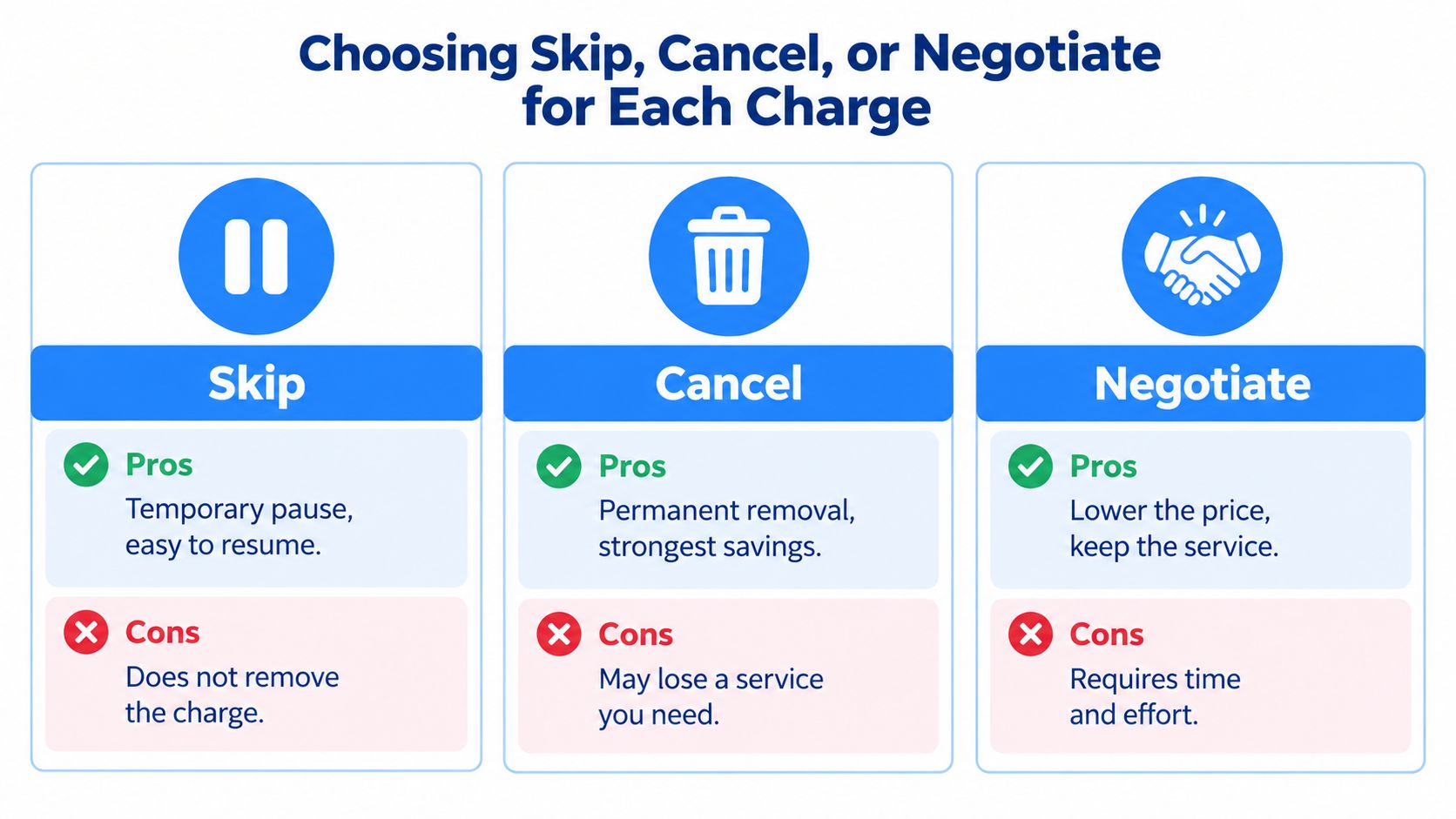
Skip works for a service or habit you want to keep available but don't need this cycle. Check the plan's terms and act before renewal. A skipped cycle only counts as a saving if the charge is prevented.
Cancel fits a duplicate, unused, or low-value subscription. Confirm whether canceling stops future renewals, when access ends, and whether the merchant requires a specific cancellation process. Keep a record of your confirmation.
Negotiate is for a bill you still need but suspect costs more than it should. Ask the provider to review the current plan and available lower-cost options before renewal. Don't treat a discount as real savings until you know the new price, terms, and start date.
The FTC's Negative Option Rule sets out safeguards for automatically renewing subscriptions: sellers must disclose material terms before collecting payment information, get unambiguous affirmative consent to the recurring charge, and provide a simple way to cancel future recurring charges, according to the FTC's rule materials. Review the actual terms of your subscription before the renewal date; a reminder is only useful if it gives you time to act.
Use these questions to decide:
- Do I use this or need it? If not, consider canceling.
- Can I pause it without losing something important? If so, skip the next cycle.
- Do I need the service but not this price or plan? Ask the provider about a lower-cost option.
- Will the next charge really be avoided? Verify the effective date and check the following statement.
That last check is essential. A cancellation attempt, chat, or click isn't money saved. Count it only after the charge you meant to prevent doesn't happen.
Routing Saved Cash Into a Real Savings Goal
Stopping a payment and keeping the money are separate jobs. If the avoided amount blends back into everyday spending, you may not see any lasting progress. Give each confirmed saving a destination, such as an emergency buffer, a planned repair, or a predictable annual bill.
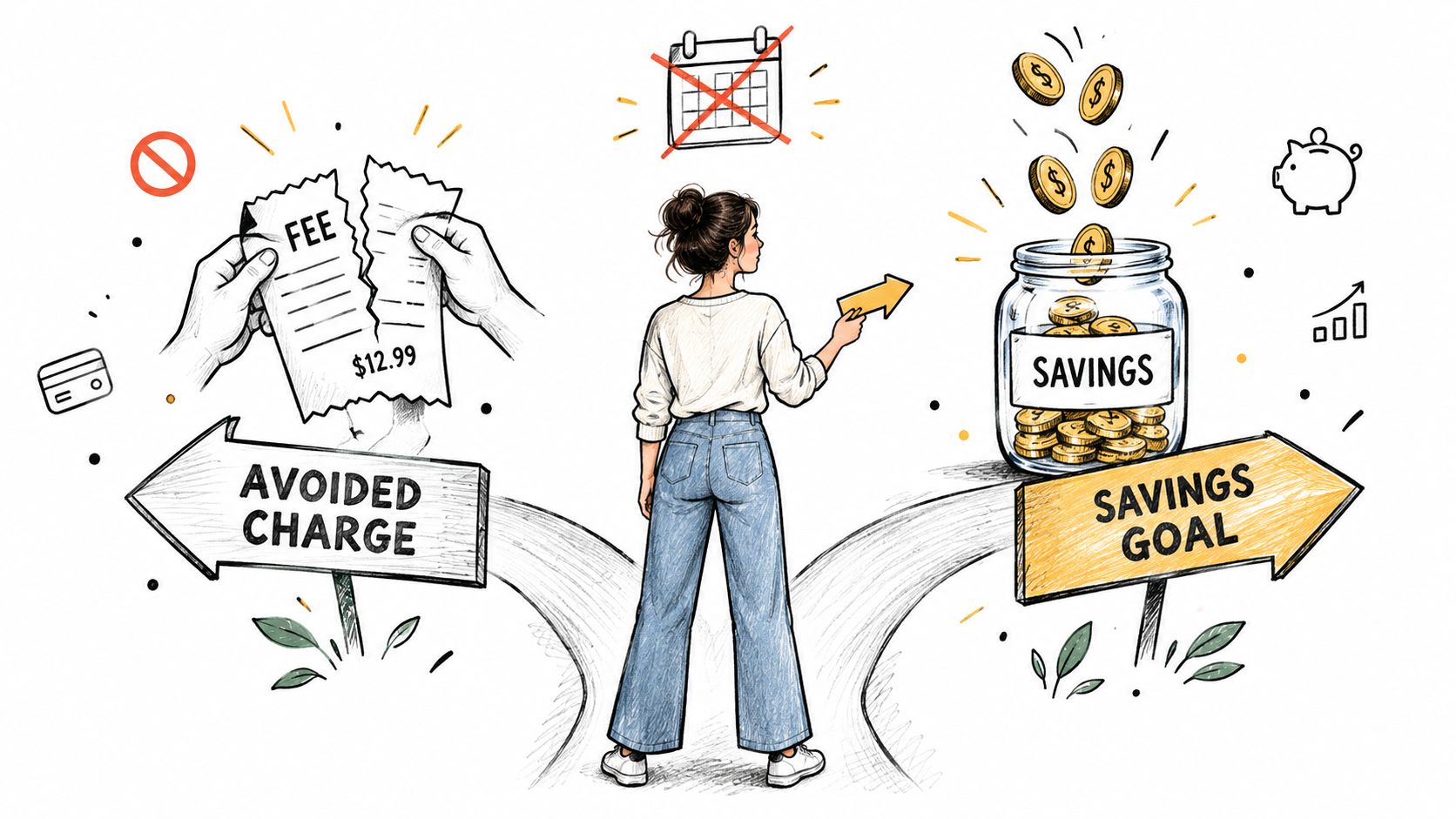
Choose one goal to start. A single, named purpose makes it easier to see what each skipped or canceled charge is helping you fund, instead of dividing small amounts across competing targets. If your income varies, keep essential obligations covered and preserve a cash buffer before treating a possible saving as available. A predictable annual bill also deserves its own consideration; money set aside for it isn't the same as money available for an unexpected expense.
A review of behavioral savings interventions found that information messages increased contribution rates by roughly 0.5–0.8 percentage points, while automatic enrollment raised participation by 79 percentage points in one retirement-plan setting. The review also describes a field experiment where reminders increased engagement but had no measurable effect on actual savings or automatic-saving transactions by themselves (review of behavioral approaches to increasing savings). That's the distinction to remember: an app visit or reminder click isn't a financial outcome.
FloosYo detects recurring charges, projects monthly and yearly costs, and offers skip-or-cancel decisions with savings tracking and automatic goal funding. If you use a tool with this kind of feature, treat the projected amount as provisional until the next statement confirms the charge was avoided.
For help choosing a clear, workable target, use this guide to setting savings goals.
A Realistic Quarter of Avoiding Recurring Charges
Take a household that identifies $387 in monthly recurring charges, or about $4,640 across a year. Those figures are the household's starting inventory, not guaranteed savings. The household reviews each charge and makes one change at a time, then verifies the outcome against the next statement.
In the first month, it cancels an unused music subscription at $10.99 a month. If the next renewal is prevented, that amount becomes a real saving. In the second month, the household negotiates a phone plan down by $15 a month, then checks that the new price appears on the bill.
The next decision is to skip food delivery for a cycle, avoiding $32 a week for four weeks if those purchases don't happen. Rather than count every possible future renewal immediately, the household records each avoided charge only when it's confirmed. Its savings goal shows the actual amount retained, while the annual projection updates to reflect changes that are still in effect.
The phone plan is the biggest single monthly reduction in this example, but that doesn't make it the right first cut for everyone. A negotiation works only if the new terms suit the household, and a skipped habit counts only if the spending doesn't reappear elsewhere. The important distinction is between a lower projected bill and cash that has stayed unspent.
That caution matters especially when income moves up and down. Research on ride-hailing workers found 65% reported difficulty saving for the future, with irregular income and job insecurity among the concerns (CNET's subscription survey coverage). When cash flow is uneven, cover essential recurring obligations and preserve a buffer before directing an avoided charge to a goal.
Your Next Statement and the One Number Worth Tracking
Use your next statement to make a list you can act on:
- Pull transactions and group them by merchant and billing frequency.
- Annualize each charge so small repeats are visible in yearly terms.
- Choose skip, cancel, or negotiate for each line, and act before renewal.
- Route confirmed savings to one named goal.
- Track verified avoided spend, not the total a calculator says you might save.
The number that matters over the next 90 days is the amount of charges you prevented and retained. A projection can motivate you; it can't confirm the outcome.
Household saving patterns vary. An OECD-based analysis reported that the U.S. household saving rate averaged 9.3% of disposable income during the 1970s and stood at 6.3% by 1990–91. In the same later comparison, Italy was at 15.7% and Japan at 12.9% (OECD-based analysis of household saving rates). Saving habits differ, but unnoticed charges take up room in any household's cash flow.
The biggest yearly win often isn't the largest subscription. It's the recurring charge you didn't know you were paying, found in the bank record and stopped before it renews.
FloosYo helps you spot recurring charges, hear your spending through voice entry, and see monthly and yearly projections before the next renewal. Visit FloosYo to review what's recurring, make skip-or-stop decisions, and track confirmed savings toward one goal.