
You check your bank account and recognize the charges immediately, but not the total. A streaming service renews on one date, cloud storage on another, a gym membership keeps running, and a delivery habit appears often enough to feel harmless. By the time you ask, “How much do you have to pay?”, you're usually looking at one charge instead of the full amount committed across the month and year.
That mental shortcut is expensive. The practical answer is not just the price shown beside a subscription. It's the amount that will leave your account, the date it will leave, what the same charge costs over a year, and whether you still want the service when renewal arrives. You need that answer before the charge lands, not after you notice it on a statement.
Table of Contents
- The Hidden Cost of Recurring Payments
- Gathering Your Financial Data
- Calculating Your Annual Commitment
- Manual Tracking vs. Automated Tools
- Using FloosYo to Manage Subscriptions
- Making Informed Decisions About Spending
The Hidden Cost of Recurring Payments
Recurring payments are a silent drain because they remove the decision from the moment of spending. You approve a service once, then automatic billing handles every renewal. The convenience is real, but so is the risk of forgetting what you authorized.
The Bureau of Labor Statistics breakdown of 2024 consumer expenditure puts the average U.S. consumer unit's annual spending at $78,535, or approximately $6,545 per month. Housing alone averaged $26,266 per year, while transportation reached $13,318 and food reached $10,169. Housing, transportation, food, healthcare, and personal insurance and pensions together represented 83.7% of average spending, so recurring charges compete with a budget already dominated by essential commitments.
Why small charges become serious
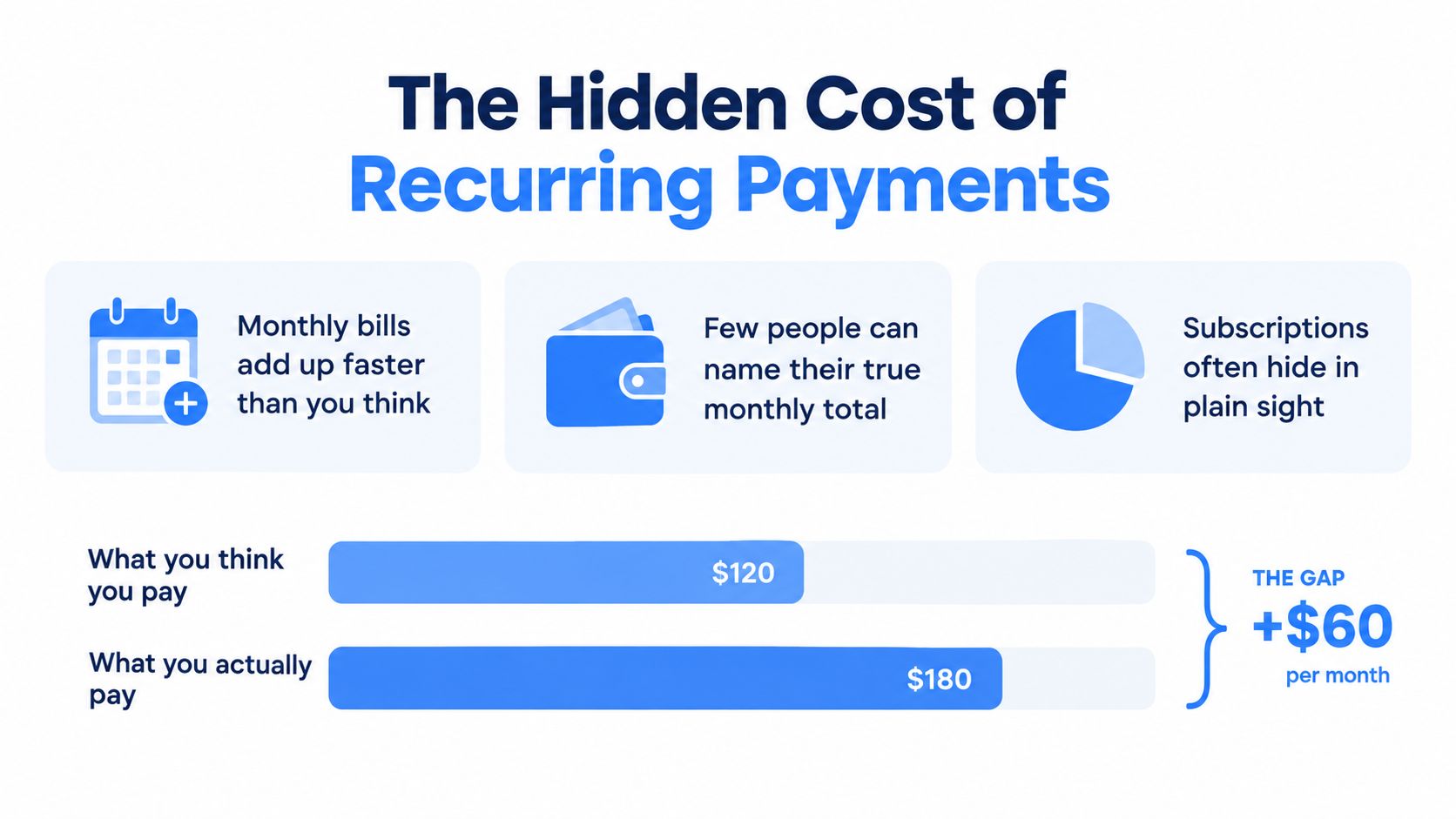
A $15 monthly charge costs $180 per year, while a $50 monthly charge costs $600, based on the annualized examples in the BLS reference above. Those amounts may look modest beside a rent payment, but several forgotten charges can, over time, become a material commitment.
Consumers also routinely underestimate their combined recurring spending. Survey coverage cited by Apprupt's subscription cancellation statistics summary reports estimated subscription spending of $86 per month, compared with itemized spending averaging $219 per month, a gap of $133 monthly, or roughly $1,596 annually. The exact lesson matters more than the label: memory is a poor accounting system.
Practical rule: Never judge a recurring charge by its monthly price alone. Judge it by its annual cost and by whether you still use what you're paying for.
The Federal Trade Commission received nearly 70 consumer complaints per day in 2024 about negative-option marketing and recurring-subscription practices, compared with 42 per day in 2021, according to coverage of the FTC's cancellation action. That rise shows why cancellation and renewal transparency matter. The cost isn't only the advertised price. It also includes the chance that you'll pay longer than intended or struggle to stop the billing.
For a fuller definition of these charges, see what recurring expenses are. Then stop asking only, “What does this cost each month?” Ask, “What will this consume before I review it again?”
Gathering Your Financial Data
You can't calculate what you don't see. Start with the accounts that fund your spending, including checking accounts, debit cards, credit cards, digital wallets, and any separate account used for household bills. Review several recent statement periods rather than relying on the transactions you remember.
Search for merchants that repeat, but don't assume repetition always looks identical. A service may bill monthly, annually, or on an irregular schedule. The merchant name can also appear differently across statements, especially when an app store or payment processor handles the transaction.
Build a usable recurring-charge inventory
Create one record for every repeating outflow. Include the merchant, amount, billing rhythm, next expected date, payment method, and whether you actively use the service. Your first pass should separate financial visibility from judgment. Don't cancel a charge just because it appears often.
| Record | What to capture |
|---|---|
| Merchant | The name shown by your bank or payment provider |
| Amount | The latest charge, plus any known price variation |
| Rhythm | Monthly, annual, weekly, or irregular |
| Next date | The next expected debit or renewal |
| Status | Essential, active discretionary, dormant, or unknown |
| Decision | Keep, review, skip, downgrade, or cancel |
Treat essential bills and optional services differently. Rent, utilities, phone service, and required work software may be necessary outflows. Streaming, gym access, food delivery, cloud storage, memberships, and unused app services deserve a separate review because they often continue without a fresh decision.
Catch dormant spending
A dormant charge is not necessarily a useless charge. It may be seasonal, shared with family, or valuable during a particular period. The key question is whether you understand the next payment and can explain why it belongs in your budget.
Bank-connected tools can reduce the hunting. FloosYo can connect through Plaid, detect repeating transactions, classify them as recurring expenses, and show merchant details. Its read-only bank access means it can read transaction information but can't move money. For charges your bank won't capture, use voice or text entry instead of allowing them to disappear from your records.
Use this guide to track spending to create a repeatable review habit. Your inventory is complete only when it includes both automatic bank charges and manual habits paid outside the connected account.
Calculating Your Annual Commitment
Annualizing a recurring payment is simple, but it changes how you evaluate the purchase. For a monthly charge, multiply the amount by twelve. A $15 monthly payment becomes $180 per year, and a $50 monthly payment becomes $600 per year, as shown in the BLS-based examples provided above.
That calculation isn't a prediction of future prices. It's a clear projection of what continuing the current charge would cost if the amount and rhythm stayed the same. Put the result beside the service's actual usefulness. A low monthly price doesn't make an unused service affordable.
Use the right conversion
Convert every rhythm into a common monthly and annual view:
- Monthly billing: Multiply the current charge by twelve.
- Annual billing: Divide the annual charge by twelve for a monthly equivalent, while retaining the full annual amount as the next cash commitment.
- Weekly billing: Multiply the charge by the number of weekly payments expected in your chosen projection period, then label the result as an estimate.
- Irregular billing: Record each known payment separately and project only the charges you can support from the available history.
Don't hide annual renewals inside a monthly average. A subscription paid once a year may have no visible monthly debit, but the full renewal still matters when you ask how much cash you have to pay before the next review.
Include the timing
A complete projection has three parts: what will be charged, when it will be charged, and what continuation costs over a year. Apple says a free-trial subscription must be canceled at least 24 hours before the trial ends to avoid renewal, according to Apple's subscription cancellation guidance. Record the trial-ending date and expected renewal amount together.
Apple also says canceling generally stops renewal at the end of the current billing cycle, rather than ending access immediately, as explained in Apple's subscription-management guidance. That makes early cancellation sensible when you've already paid for the current period. You can preserve the remaining access while preventing the next charge.
The App Store begins attempting automatic renewal during the 24 hours before a subscription expires, according to Apple's developer documentation. Set your decision deadline before that window, not at the moment you expect to see the debit.
Manual Tracking vs. Automated Tools
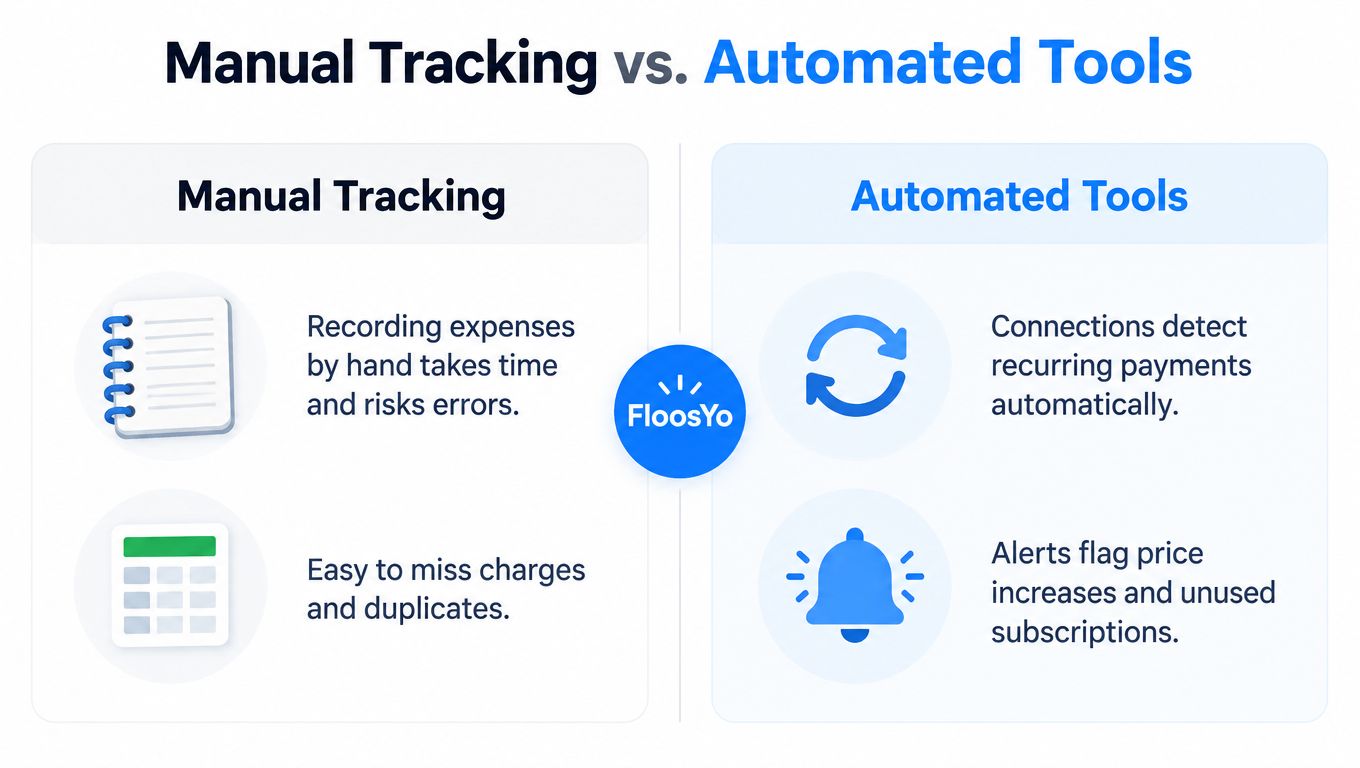
A spreadsheet can work, but it depends on discipline at every stage. You must notice the transaction, recognize the merchant, enter the amount, convert the billing rhythm, update price changes, and remember the next renewal. Miss one step and the total becomes unreliable.
Manual tracking still has a place. It gives you control over categories and helps you understand the logic behind your spending. It's also useful for cash purchases, shared expenses, and habits that never appear in a bank feed.
Where automation earns its place
Automated tools change the workload from discovery to decision-making. A connected system can look for repeating transactions, preserve their observed rhythm, and surface charges you would've forgotten to enter. That doesn't remove the need for judgment. It removes much of the clerical work that causes people to abandon the process.
| Manual tracking | Automated tracking |
|---|---|
| You search statements yourself | Repeating transactions are detected from connected accounts |
| You calculate projections | Monthly and annual views are generated from recorded rhythms |
| You remember renewal dates | Alerts can flag upcoming charges |
| You update each price change | Changes can be reviewed when new transactions arrive |
| You decide what to do | The record can support keep, skip, downgrade, or cancel decisions |
Use automation for the facts and your judgment for the choices. A tracker shouldn't decide whether a phone plan or gym membership reflects your priorities. It should show the financial consequence clearly enough that avoiding the decision becomes difficult.
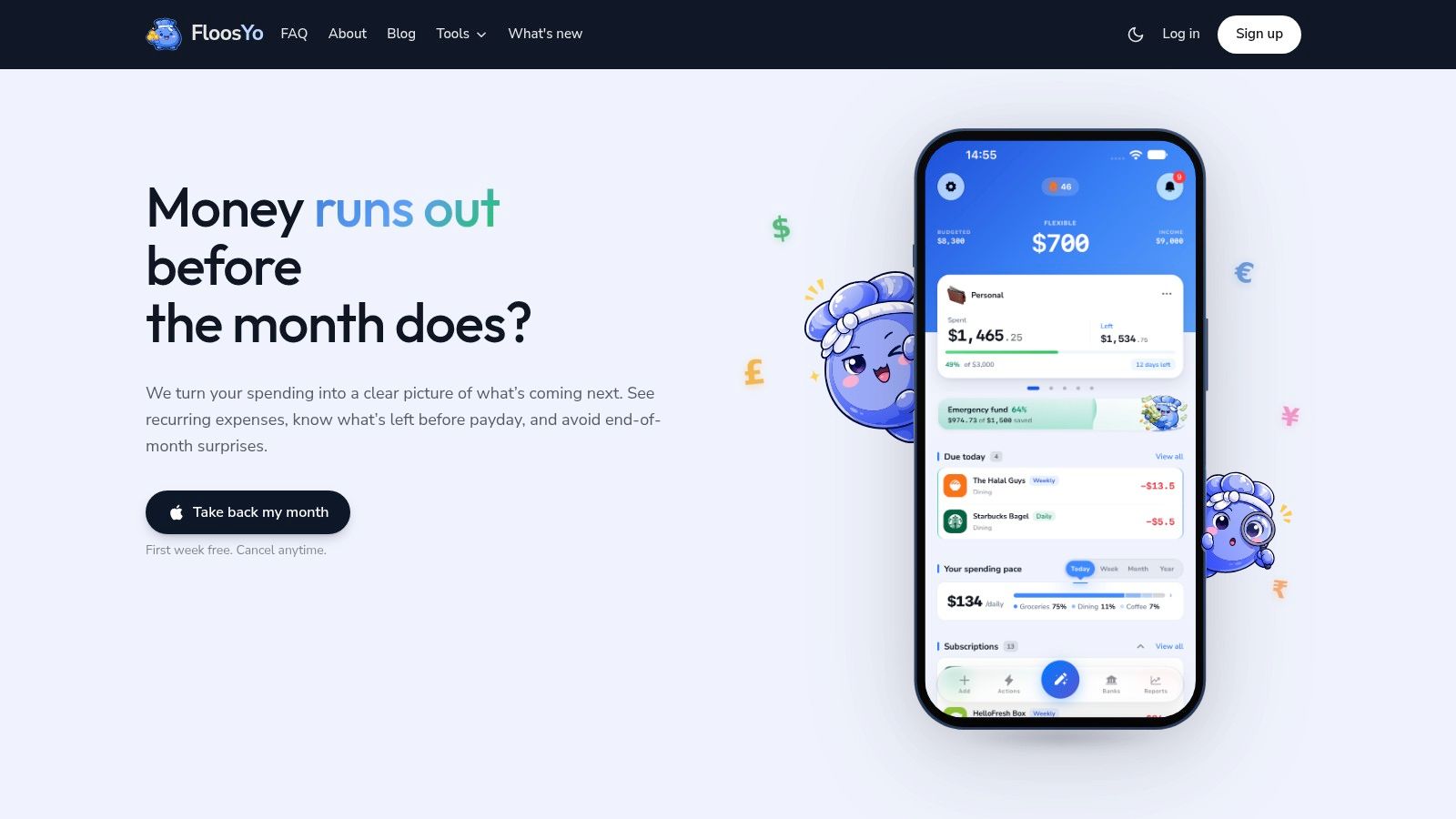
FloosYo is one example of this approach. It connects to bank data in read-only mode, detects recurring charges, projects monthly and annual totals, supports voice or text capture for missing transactions, and can show savings scenarios for skip or cancel decisions. It also offers renewal reminders and savings goals that record the impact of a decision.
The distinction is important. Traditional budget trackers often emphasize charts of what already happened. A recurring-spending system should also answer what will happen next if you take no action.
Using FloosYo to Manage Subscriptions
A bank connection gives you a starting list, not a finished answer. Review every detected payment against the bank record. Confirm the merchant, amount, billing rhythm, and next expected charge. Classify each item as active, seasonal, dormant, unknown, or necessary for a clearly defined purpose. The annual projection matters more than the last transaction because it exposes what the charge will cost if you keep doing nothing.
FloosYo connects to bank data in read-only mode, detects recurring charges, and projects monthly and annual totals. Use those projections before the next charge arrives, when you still have time to decide whether the payment deserves another cycle.
Turn detection into a decision
Review each recurring expense in this order:
- Verify the charge. Match the merchant and current amount with the bank record.
- Check the projection. Compare the monthly equivalent with the annual continuation cost.
- Set the reminder. Schedule the renewal or expected charge before the deadline for action.
- Choose an action. Keep it, skip a cycle, downgrade it, or cancel through the merchant.
- Record the result. Track the amount avoided so the decision becomes visible progress.
Voice or text entry covers expenses a bank feed cannot identify, including recurring cash purchases and bills paid through an unconnected method. Enter the amount, category, and frequency, then inspect the parsed record. A missed entry distorts the answer to how much you have to pay, so capture it as soon as you notice it.
Apple's free-trial rule makes timing important. Set a reminder several days before the trial ends, open Apple Account settings, check the renewal price, and turn off renewal if the service no longer earns its place.
Make savings visible
A skipped charge should produce a measurable result, not a vague feeling that you spent less. Assign the avoided amount to a specific savings goal and track the cumulative total. FloosYo can record the saved amount after a skipped bill, giving that money a defined destination instead of leaving it available for accidental spending.
Cancel through the merchant when you want the contract or service to end. Payment blocking or disputing a charge may leave the underlying contract active and can cause interruption, late fees, or collection problems. Check the cancellation terms and retain confirmation.
Review projected charges before clustered renewal dates. Several individually acceptable payments can become a poor combined decision when they arrive together. The useful question is not only what charged today, but what you will authorize next and what that choice will cost over the year.
Making Informed Decisions About Spending
Once every recurring charge has a monthly equivalent, annual projection, and next-action date, stop treating the list as a passive report. Decide what each payment is doing for you.
Keep a service when you use it and the cost supports a clear priority. Skip a cycle when usage is seasonal or temporary. Downgrade when the current tier exceeds your needs. Cancel when the service is dormant, duplicated, or no longer worth the projected continuation cost.
The cheapest recurring payment is the one you no longer authorize without thinking.
For bills that matter, contact the provider and ask about a lower-cost plan, a suitable feature tier, or a non-renewing option. Compare the replacement carefully. A cheaper alternative isn't a saving if it introduces fees, inferior service, or another forgotten renewal.
Don't confuse cancellation with payment blocking. Cancel through the merchant first, check the effective date, and confirm whether access continues through the paid billing period. If a charge is unauthorized or the merchant fails to honor a valid cancellation, use the appropriate dispute process and keep your records.
Review the list before upcoming renewals and after any price-change notice. Your goal isn't to eliminate every recurring expense. It's to know how much you have to pay, why you're paying it, and what you'll save when you choose not to continue.
FloosYo connects to your bank, detects recurring subscriptions and bills, converts them into monthly and yearly projections, and reminds you before renewal decisions are due. Visit FloosYo to review your recurring spending, log missing habits by voice, and turn each skip or cancellation into tracked savings.