
You check your account after payday and see the same pattern: a maintenance charge you didn't expect, an overdraft fee caused by a bill arriving early, and a subscription renewal you forgot was still active. None of these costs looks dramatic alone. Together, they can slowly shrink the money available for groceries, transport, savings goals, and ordinary daily decisions.
So how do you choose a bank in 2026? Don't start with a promotional offer or a polished app screenshot. Start by asking whether the bank can become a reliable primary financial hub for your income, payments, recurring bills, and spending decisions. The right account should make your money easier to monitor, cheaper to manage, and harder to lose track of.
Table of Contents
- Why bank choice still matters
- Fees, overdrafts, and the true annual cost of checking
- Mobile banking quality, security, and data privacy
- How to test whether a bank can be your primary financial hub
- Connecting bank choice to smarter recurring-spending habits
- Final checklist for choosing a bank that fits your habits
Why bank choice still matters
Maya opened her checking account because a branch stood near her workplace. Years later, her salary still arrives there, while her phone bill, streaming services, cloud storage, and fitness memberships renew from the same account. She rarely reviews the complete statement. Then an overdraft fee follows a low balance, and a forgotten annual renewal arrives alongside a utility payment.
The problem is a poor view of recurring outflows. A slow transaction feed, vague descriptions, weak alerts, and complicated fee rules can make routine payments easy to ignore. Bank choice therefore affects more than access to cash. It determines how clearly you can see subscription activity and how confidently you can track spending across the year.
Opening an account isn't the same as choosing your main bank
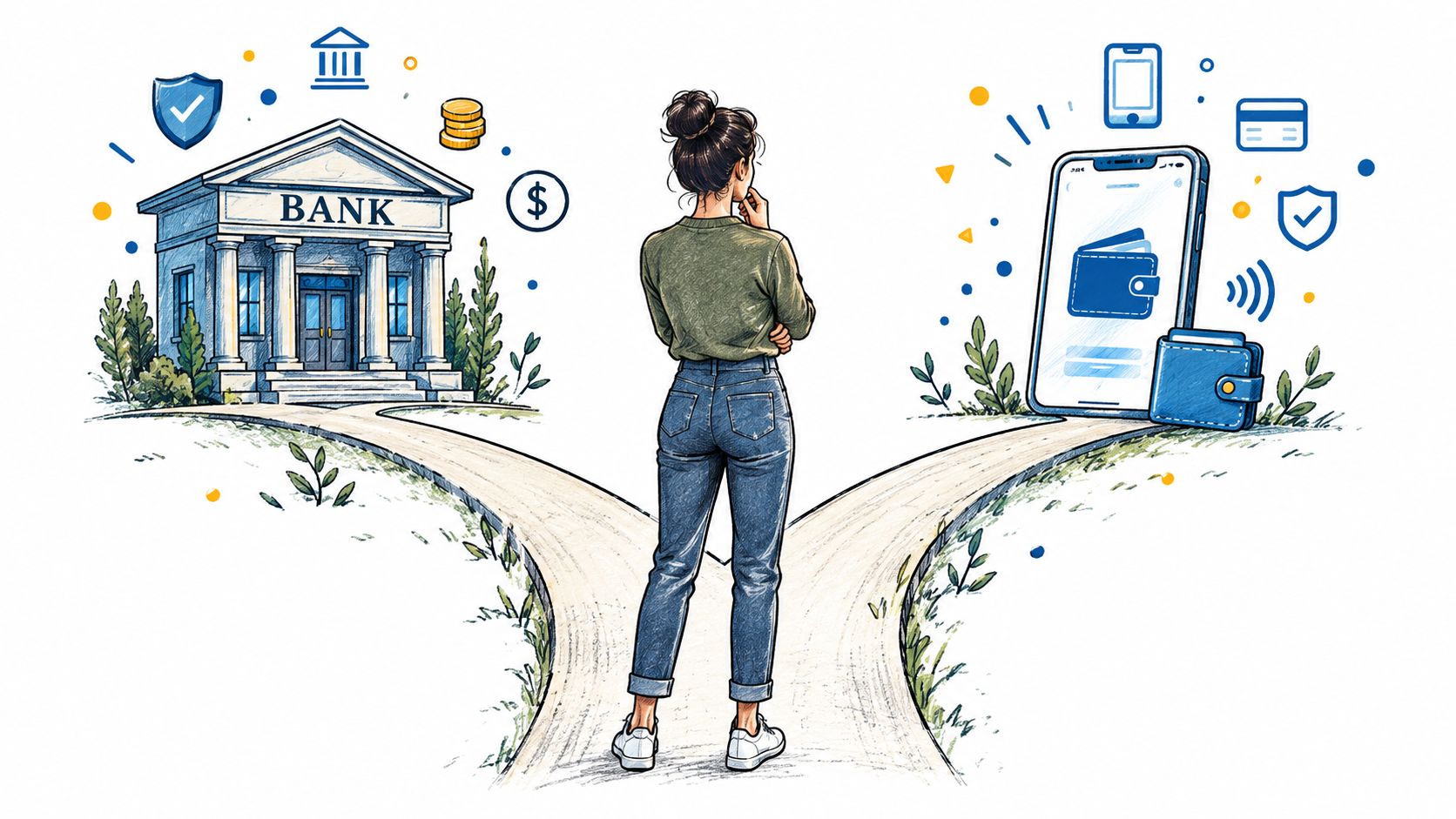
Opening an account is a transaction. Choosing your primary bank is a decision about where recurring money flows will be managed. Research from FICO's bank primacy survey found that nearly 50% of consumers treat their longest-used bank as their primary provider. Yet only 45% cited best value and 48% cited great customer service as drivers of that relationship, according to the same source.
Those figures expose a common failure in bank comparisons. People review features, open an account, and then let habit determine which institution handles their daily finances. A primary bank should support salary deposits, recurring payments, transfers, cash access, customer support, and clear transaction monitoring without adding unnecessary work.
Trust belongs on the checklist. In a 2023 survey, MX reported that 58% of consumers considered trust in a provider one of the most important factors in choosing where to bank, while 53% considered secure protection of personal financial data critical. The same survey found that 35% named trust in keeping information and money safe as the single top factor.
Practical rule: Choose the bank that makes responsible daily behavior easier, not the bank with the most attractive advertisement.
Test the account against four recurring questions: What left the account this week? Which charges repeat? What will arrive before the next payday? Can support resolve a payment problem without sending you through a maze? If the answers stay unclear, the account is costing you attention, reducing annual spending visibility, and making subscription hygiene harder even when its advertised fee looks low.
Fees, overdrafts, and the true annual cost of checking
A checking account can look free until three recurring bills arrive before payday, an ATM is out of network, and one payment pushes the balance below zero. Calculate the account's likely yearly cost before opening it. Include maintenance charges, minimum-balance penalties, ATM surcharges, transfer fees, overdraft charges, and NSF fees.
The advertised monthly price still affects consumer choice. Deloitte found that raising a checking fee from $10 to $25 reduced choice probability by 26%, while making the account free increased choice likelihood by 36%, according to Deloitte's retail-banking pricing analysis. Treat “free” as a condition to verify, not as a final answer.
Compare the fee schedule, not the welcome message
Use this checklist against the bank's actual disclosures:
| Cost area | What to check | Why it matters |
|---|---|---|
| Maintenance | Monthly charge and waiver conditions | A low fee may depend on deposits or minimum balances |
| Overdraft | Per-item charge, grace period, and daily cap | Several failed transactions can create a sudden bill |
| NSF | Fee for rejected payments | A declined payment may still carry a charge |
| Cash access | In-network ATMs and surcharge rules | Frequent cash users can lose savings through convenience fees |
| Transfers | Domestic, international, and urgent-payment charges | Occasional fees still belong in your annual estimate |
Overdraft terms deserve a separate test. The Consumer Financial Protection Bureau explains that many banks and credit unions charge $30 or more per overdraft, sometimes charging for each item and adding another fee when the balance remains negative. Bank of America's consumer guidance also describes overdraft charges of about $30 or more at many U.S. banks, while rejected payments may incur NSF fees in the roughly $15 to $20 range.
Fee structures vary sharply by institution. Bankrate's overdraft comparison lists examples from $0 at some online banks to $34 per item at Chase and $10 per item at Bank of America. Daily caps determine whether several subscription renewals create one charge or a larger stack of charges.
Run three scenarios before you apply: a normal month, a low-balance month, and a month when several recurring bills arrive close together. Add the expected fees to your annual estimate. EY research summarized by Deloitte reports that U.S. consumers pay about $82 billion annually in payments and banking fees, averaging $311 per person, and that one in three consumers has switched or is ready to switch because of fee dissatisfaction.
Check your account balance definitions so you understand the difference between posted activity, pending charges, and available funds. That distinction matters when subscription renewals cluster around payday. Choose the account whose fee rules make recurring outflows easy to monitor and annual spending easier to see.
Mobile banking quality, security, and data privacy
A banking app is now part of the account's operating cost. If it takes too long to find a pending payment, identify a merchant, or understand an available balance, you're more likely to miss a renewal or misjudge what can safely be spent.
Test the app before moving your primary income. Look for a clean transaction timeline, searchable merchant names, clear pending-versus-posted labels, instant alerts, and an obvious route to customer support. A visually attractive interface means little if the transaction feed updates slowly or hides fee explanations.
Security should be tested with the same seriousness. MX's consumer research found that 53% of consumers ranked secure protection of personal financial data as critical when choosing a provider. Ask how the institution handles multi-factor authentication, device alerts, suspicious activity, data sharing, and account recovery.
What to verify before trusting an app
- Transaction clarity: Merchant names should be recognizable, and recurring charges shouldn't appear as vague abbreviations.
- Alert control: You should be able to receive notifications for deposits, withdrawals, low balances, and card activity.
- Privacy disclosure: Read what data the bank collects, why it collects it, and whether it shares information with third parties.
- Access controls: Look for strong authentication, biometric options, device management, and a simple way to revoke access.
- Support quality: Ask a specific question before opening the account and judge the speed and precision of the response.
Read-only access is important when you connect a separate expense-tracking service. A read-only connection can import transactions without gaining the ability to move money, but you should still check the provider's security practices and privacy terms. For a practical example of how connected transaction data can support recurring-spending visibility, see this guide to an expense tracker with bank sync.
The best digital bank isn't the one with the most features. It's the one that gives you enough information to act before a charge becomes a problem.
How to test whether a bank can be your primary financial hub
A primary bank earns that role through repeated use. Test it with the money movement that will define your routine, especially incoming pay, automatic bills, subscriptions, and transfers. The goal is to see whether one account can give you a dependable view of where money enters and where recurring outflows leave.
Start by confirming deposit protection. In the United States, verify FDIC or NCUA insurance up to $250,000 per depositor, per ownership category, per institution through the institution's official information and regulator resources. A financial app or branded account may use a partner bank, so identify the institution providing the coverage.
Run a small pilot before moving your salary or every automatic payment. Open the account, add a limited balance, schedule one routine payment, and connect the services you use. Check whether the deposit arrives, the payment posts with a clear merchant name, the transaction is searchable, and the account shows upcoming or completed activity in a way you can review quickly.
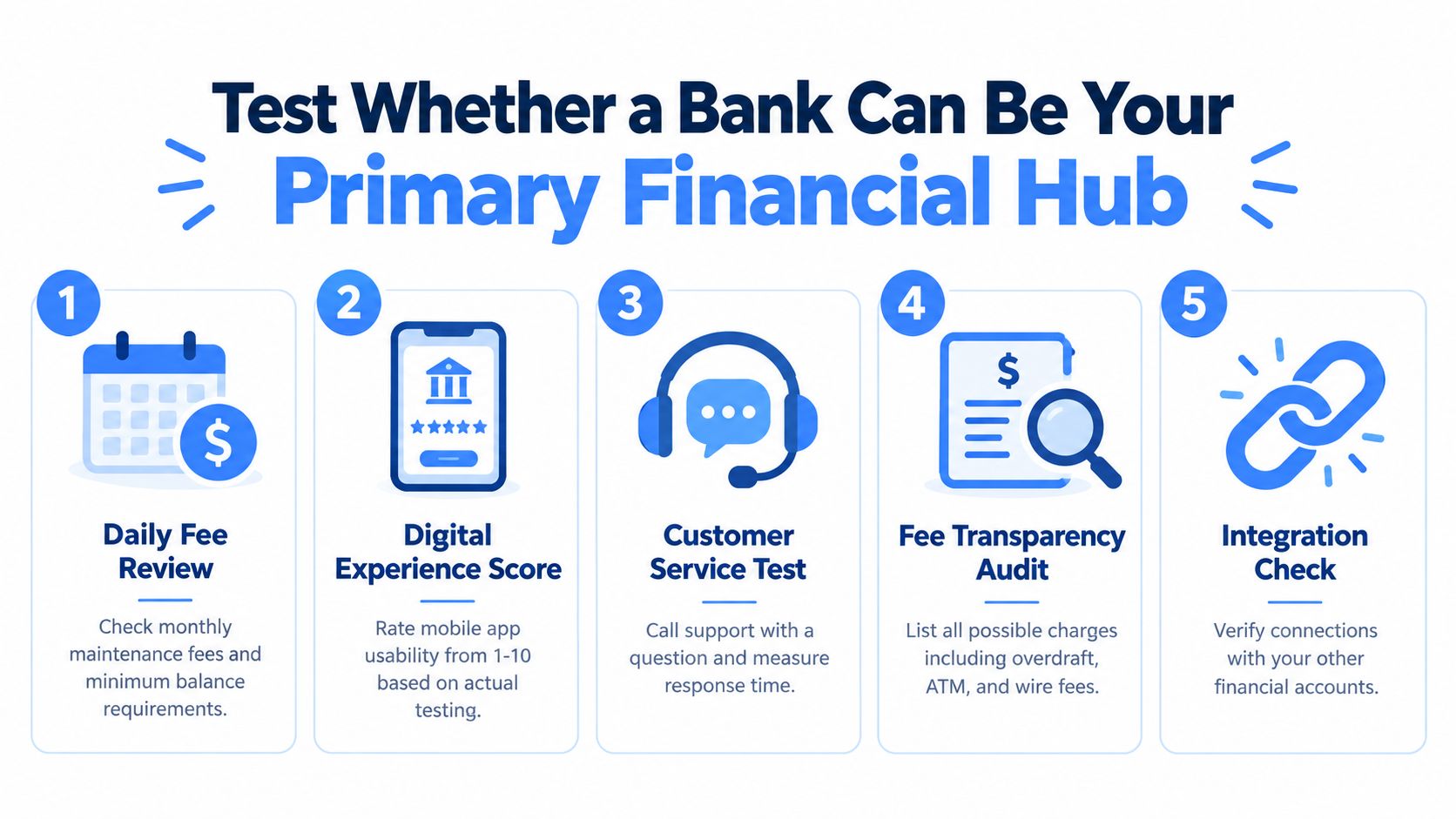
Use a five-part primacy test
- Run your real routine. Test a deposit, bill payment, transfer, and recurring charge. Confirm each one appears promptly and clearly.
- Review the account view. Search for transactions, filter activity, inspect merchant details, and check whether recurring outflows are easy to spot.
- Test support under pressure. Ask a specific question about a payment or access problem. Record how quickly support responds and whether the answer resolves the issue.
- Check integrations. Verify compatibility with your employer, billers, payment services, and expense tools. A primary account must fit the systems that already move your money.
- Review the monthly workflow. Set aside time to scan subscriptions, upcoming payments, and unusual activity. If the account makes annual spending visibility difficult, it is a poor financial hub.
Switching requires a controlled handoff. Experian's bank-switching guidance recommends updating direct deposits and automatic payments manually, then keeping the old account open until each transfer is confirmed. This prevents a bill from continuing to pull from the wrong account after the new one appears ready.
A primary bank earns the role by handling ordinary money movement reliably and making recurring outflows easy to review.
Use this bill-management app guide to evaluate tools that can work alongside your bank. The test is straightforward: can this institution receive money, send bills, expose recurring costs, and help you resolve problems without creating extra work?
Connecting bank choice to smarter recurring-spending habits
A bank statement tells you what already happened. A useful financial routine also tells you what will happen next.
Recurring spending deserves that forward-looking treatment because small charges become easy to ignore when they arrive separately. A 2026 CNET survey reported that U.S. adults spend an average of $111 per month on subscriptions, equal to $1,332 per year. The same source cited an Ohio State summary reporting more than $200 per year spent on unused subscriptions in another study.
The bank you choose affects how easy those charges are to identify. Clear merchant descriptions, reliable alerts, and searchable transactions make review faster. But the bank alone won't decide whether you keep, skip, downgrade, or cancel a service. You need a repeatable process.
Turn recurring charges into decisions
Review each recurring expense using four questions:
- Do I still use it? Check the actual habit, not the original intention.
- What does it cost yearly? Convert the monthly charge and irregular renewals into an annual projection.
- When will it renew? Record the date early enough to make a decision before the payment.
- What happens if I skip it? Compare the saved amount with the value you expect from keeping it.
FloosYo is one iOS option that connects through Plaid, imports transactions with read-only bank access, detects repeating charges, and projects monthly and annual totals. It also supports voice or text entry for expenses a bank may not capture, renewal reminders, skip-or-cancel decisions, and savings tracking when a skipped amount is assigned to a goal.
That workflow changes the purpose of bank connectivity. Instead of using a connection only to produce retrospective charts, you can use transaction history to prepare for upcoming outflows. A streaming plan, phone bill, cloud-storage charge, or food-delivery habit becomes a visible decision rather than an automatic event.
Pair visibility with a monthly habit
Set one review point before your largest cluster of recurring charges. Check what's due, identify anything unused, and project the yearly cost of the items you're considering keeping. If an expense stays, keep it intentionally. If it goes, cancel or skip it and record the expected saving.
This approach is more effective than trying to remember every subscription from memory. It also helps households with irregular income, freelancers managing work tools, and students balancing several small charges. A bank provides the record. Your review process creates control.
Final checklist for choosing a bank that fits your habits
Run this checklist before making an account your primary bank:
- Calculate the yearly fee exposure. Include maintenance requirements, ATM charges, transfer costs, overdraft, and NSF fees.
- Test the worst month. Model low balances, clustered bills, and a failed payment.
- Verify protection. Confirm applicable deposit insurance directly with the bank or credit union.
- Test the app first. Search transactions, set alerts, inspect fee disclosures, and contact support.
- Check operational fit. Confirm salary deposits, bill payments, cash access, transfers, and integrations.
- Pilot the account. Move a small amount before redirecting income and automatic payments.
- Build recurring-spending visibility. Review renewals, annualize small charges, and decide whether to keep, skip, downgrade, or cancel each item.
The bank you choose should serve as the primary hub for recurring outflows, not merely hold your balance. If transactions are easy to search and export, you can see annual spending patterns before small charges become expensive habits.
Review the account when your income, cash needs, payment patterns, or recurring expenses change. A bank that once fit may become costly or inconvenient as your routines evolve. Choose transparent fees, dependable access, clear security practices, and transaction visibility over a long feature list.
FloosYo connects to your bank to surface recurring charges, project monthly and annual costs, remind you before renewals, and support clear skip-or-cancel decisions. Visit FloosYo to bring your bank data and recurring-spending review into one practical iOS workflow.