
You returned a defective item last week, received a “refund processed” email, and still don't see the money on your card. Meanwhile, a subscription you forgot about renews, a canceled event keeps showing as a charge, and your statement balance looks higher than expected. These situations feel similar because money is leaving and returning through the same card account, but they follow different rules.
Credit card refunds are easiest to recover when you identify the correct path early. A normal merchant refund, an authorization reversal, and an issuer dispute aren't interchangeable. Recurring charges add another problem: prevention is usually faster and less stressful than trying to force a reversal after the billing date.
Table of Contents
- The Real Path of a Credit Card Refund
- Merchant Returns Versus Issuer Disputes
- Navigating Refund Timelines and Statement Cycles
- The Hidden Friction of Subscription and Event Refunds
- Proactive Tracking to Prevent Unwanted Charges
- Your Action Plan for Managing Card Reversals
The Real Path of a Credit Card Refund
You return a defective pair of shoes, hand over the receipt, and watch the store employee approve the refund. That approval doesn't put cash straight back into your available balance. The merchant still has to send a credit through the payment system, and your issuer has to receive, post, and display it.
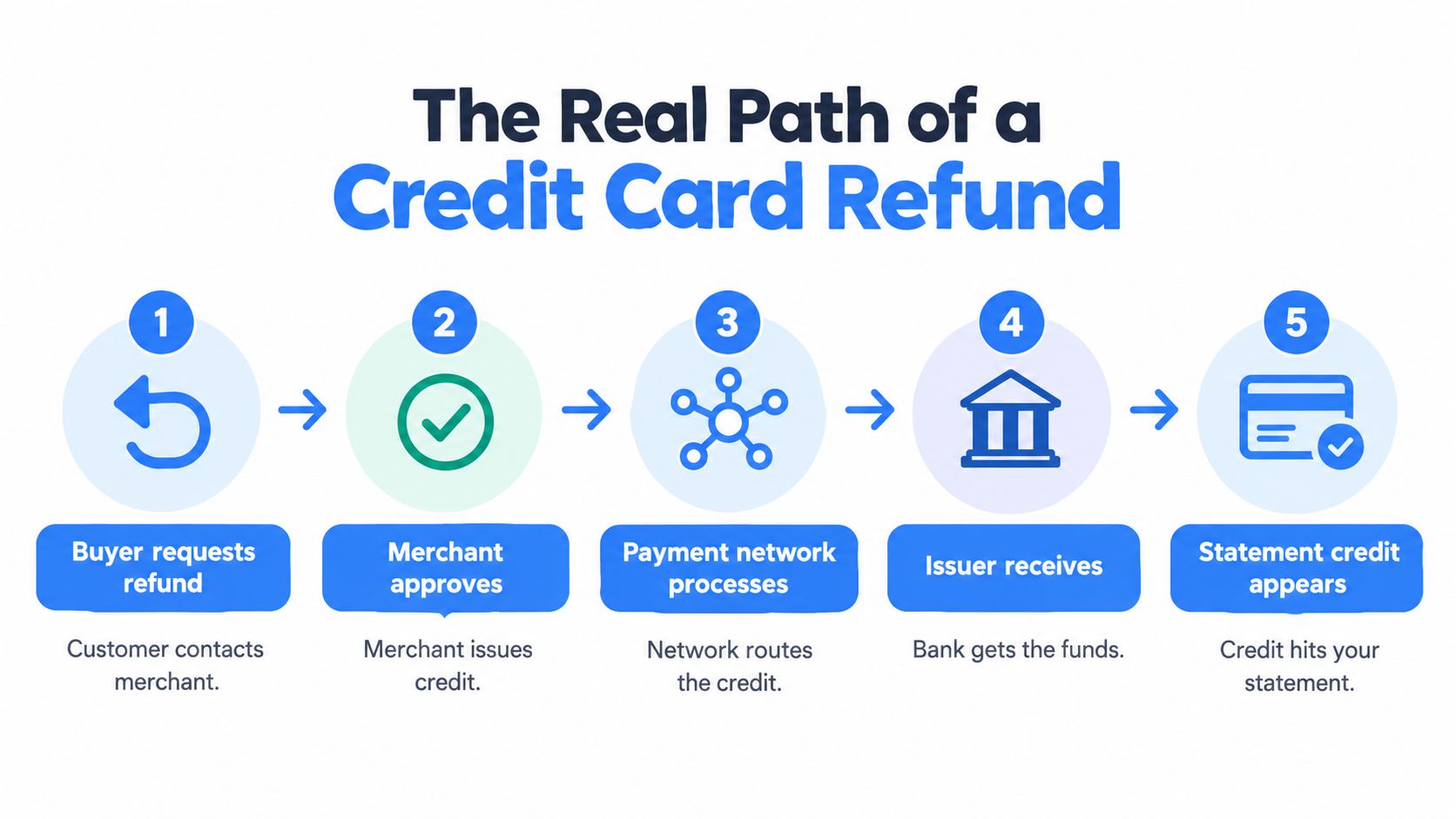
A settled card refund generally follows this route:
- You request the refund. Contact the merchant and provide the order details, transaction date, and reason for the return.
- The merchant issues the credit. The merchant submits a new credit transaction linked to the original purchase.
- The acquirer or processor handles it. The merchant's payment provider receives the refund instruction and passes it into the card network.
- The card network routes the credit. The network sends the transaction to the card issuer that manages your account.
- The issuer posts the statement credit. Your balance and transaction history update when the issuer processes the incoming credit.
Why the money takes time
A credit card refund is a new credit transaction that reverses a settled sale, not a button that edits the original purchase. The payment flow runs from the merchant to the acquirer or processor, through the card network, to the issuer, and finally to you. Mastercard's transaction processing rules describe the distinction between a refund after settlement and a void that cancels an uncaptured authorization.
The same rules explain why merchants may still bear processing costs after returning your money. Original interchange and processing fees often aren't returned with the reversed transaction, so the merchant's cost can exceed the refund amount shown on your statement.
Practical rule: Ask the merchant for the refund date and a reference or confirmation number. “We submitted it” is less useful than a record you can give your issuer if the credit doesn't appear.
Returns are now a substantial part of retail settlement. A Bank of America analysis of retail returns put the total cost of U.S. merchandise returns at $890 billion in 2024. The same analysis found overall U.S. retailer return rates at about 4.5% year to date in 2025, with department-store rates tracking roughly 16% to 17% since 2021. Refund volume depends heavily on the merchant category and customer segment, which is why a card issuer may process one type of credit differently from another.
Merchant Returns Versus Issuer Disputes
A merchant return is cooperative. You ask the seller to reverse the transaction, and the seller sends the credit back to the original card. An issuer dispute is adversarial. You tell your card issuer that the transaction is unauthorized, incorrect, or unresolved, and the issuer investigates under its dispute process.
Choose the simpler path first
Use the merchant route when the seller accepts the return, acknowledges a billing mistake, agrees to reverse an auto-renewal, or cancels a service before the payment is final. It usually gives you a direct answer, a clear refund confirmation, and fewer documentation demands.
A chargeback makes sense when the merchant refuses to help, stops responding, delivers something materially different from what you paid for, or continues charging after a documented cancellation. It also applies to unauthorized transactions, although you should contact the issuer quickly when fraud is involved.
Mastercard's chargeback guidance explains that an approved chargeback returns the purchase amount to the cardholder, while the merchant may face fees and dispute costs. That financial pressure is one reason a merchant may prefer to resolve a legitimate return directly.
The broader reversal system is large. In 2024, U.S. cardholders disputed $9.8 billion in credit card charges, resulting in $5.9 billion in chargebacks, according to the same guidance. Those figures describe disputes, not ordinary merchant refunds, but they show why issuers and merchants treat chargebacks as a formal operational process rather than a casual refund request.
Don't confuse approval with recovery
A dispute isn't an instant refund. The issuer may request receipts, delivery records, cancellation evidence, messages with the merchant, or proof that the charge continued after you withdrew authorization. A temporary credit can also be reversed if the dispute fails.
Recent complaint data makes escalation less reassuring than many consumer guides suggest. A Consumer Financial Protection Bureau complaint-outcome report found that the share of credit-card complainants receiving monetary relief fell from 31% to 32% in 2023 and 2024, to 27% in 2025 and 25.5% in 2026 so far. Don't treat a dispute as a guaranteed shortcut. Build the evidence first, then escalate when the merchant path has genuinely failed.
Navigating Refund Timelines and Statement Cycles
The phrase “refund processed” tells you that the merchant took an action. It doesn't tell you when your issuer will post the credit or which statement will display it.
Merchants typically take three to seven business days to post a refund, according to Experian's explanation of credit card refunds. The broader journey can take three to fourteen business days, depending on issuer posting and network batching. Those ranges aren't promises. A merchant may delay submission, the network may batch the transaction, and your issuer may post it according to its own processing schedule.
Statement closing dates create confusion
Suppose your card statement closes before the merchant submits the credit. The refund may affect your account balance but not appear on the statement you expected. If the merchant issues the refund after the closing date, it may show on the next statement even though it has already reduced your current balance.
That isn't necessarily a missing refund. Compare three records:
- Merchant confirmation: the date the seller approved or submitted the credit.
- Card transaction history: whether the refund is pending, posted, or absent.
- Statement activity: the statement period in which the issuer recorded the credit.
A refund issued after a statement closes may not reduce the amount shown on that statement. Read how balance forward works if the amount carried into a new period doesn't match your assumption about when the credit should appear.
Separate holds from settled credits
An authorization hold is temporary. It reserves available credit before a transaction settles and may disappear without appearing as a conventional refund. A settled purchase requires a refund if the merchant later agrees to return the money.
This distinction matters at hotels, rental counters, online checkouts, and other situations where a merchant first places a hold and later captures a different amount. Ask whether the merchant released an authorization or issued a settled-card refund. The answer determines what you should search for in your transaction history.
If the expected window passes, contact the merchant before opening a dispute. Give the merchant the original transaction date, amount, card details they can use to locate the payment, refund date, and confirmation number. If the merchant confirms submission but your issuer still can't find the credit, give the issuer that documentation instead of starting the conversation from scratch.
The Hidden Friction of Subscription and Event Refunds
A retail return usually has one obvious counterparty. A recurring charge can involve the merchant, payment processor, card issuer, and your own cancellation record. The merchant may say the service stayed available, the renewal terms were disclosed, or the cancellation arrived after billing. For a canceled event, the organizer and ticket platform may also redirect you to each other.
Do not expect the issuer to reverse an unwanted renewal automatically. Complaint analyses have found that issuers often direct consumers back to the merchant when an event refund is disputed. That creates a costly delay when another subscription payment is close and customer support is slow. Check your recurring charges before renewal with this guide to how to check subscriptions on your card.
Build proof before the next charge
For every subscription dispute, save the cancellation confirmation, the date and time of the request, the account page showing the canceled status, and related email or chat records. If you cancel by phone, record the representative's name or identifying details and write down the agreement.
The Federal Trade Commission's guidance on auto-renewals explains that a renewal notice can remind you that the subscription will expire and that you will be charged automatically. The FTC also recommends retaining a copy of the cancellation request and notes from cancellation conversations.
Use your records in this order:
- Ask the merchant to reverse the charge and confirm that the subscription is canceled.
- Review the merchant's terms for refund windows covering renewals, canceled events, or unused service.
- If the merchant refuses or does not respond, contact the issuer and describe the precise problem.
- Send the cancellation proof, merchant correspondence, charge details, and the resolution you want.
Stop the next charge separately
A refund request addresses an existing charge. It does not necessarily end the subscription behind it. Cancel the service through the merchant account, remove saved payment details when possible, and ask the issuer which controls can block or limit future recurring charges.
For event cancellations, retain the cancellation notice, ticket terms, organizer messages, and any promised refund date. A verbal promise that the money is “on the way” is not enough. Request a date, transaction reference, and written record identifying who accepted responsibility.
Refund abuse also makes legitimate cases slower or more restrictive. Mastercard has said that return fraud is growing and costing merchants billions annually. That does not weaken a valid claim. It does explain why consistent evidence gives the merchant and issuer fewer reasons to delay or reject a recurring-charge reversal.
Proactive Tracking to Prevent Unwanted Charges
The cheapest refund is the one you never need to request. A renewal reminder that arrives before the charge gives you time to cancel, downgrade, skip a cycle, or decide that the service still earns its place in your budget.
A useful tracker should answer three questions immediately:
- What repeats: Which subscriptions, bills, and everyday purchases recur?
- What they cost annually: What does each small charge become over a month and a year?
- What decision is available: Can you cancel, skip, reduce, or monitor it before renewal?
Turn visibility into a decision
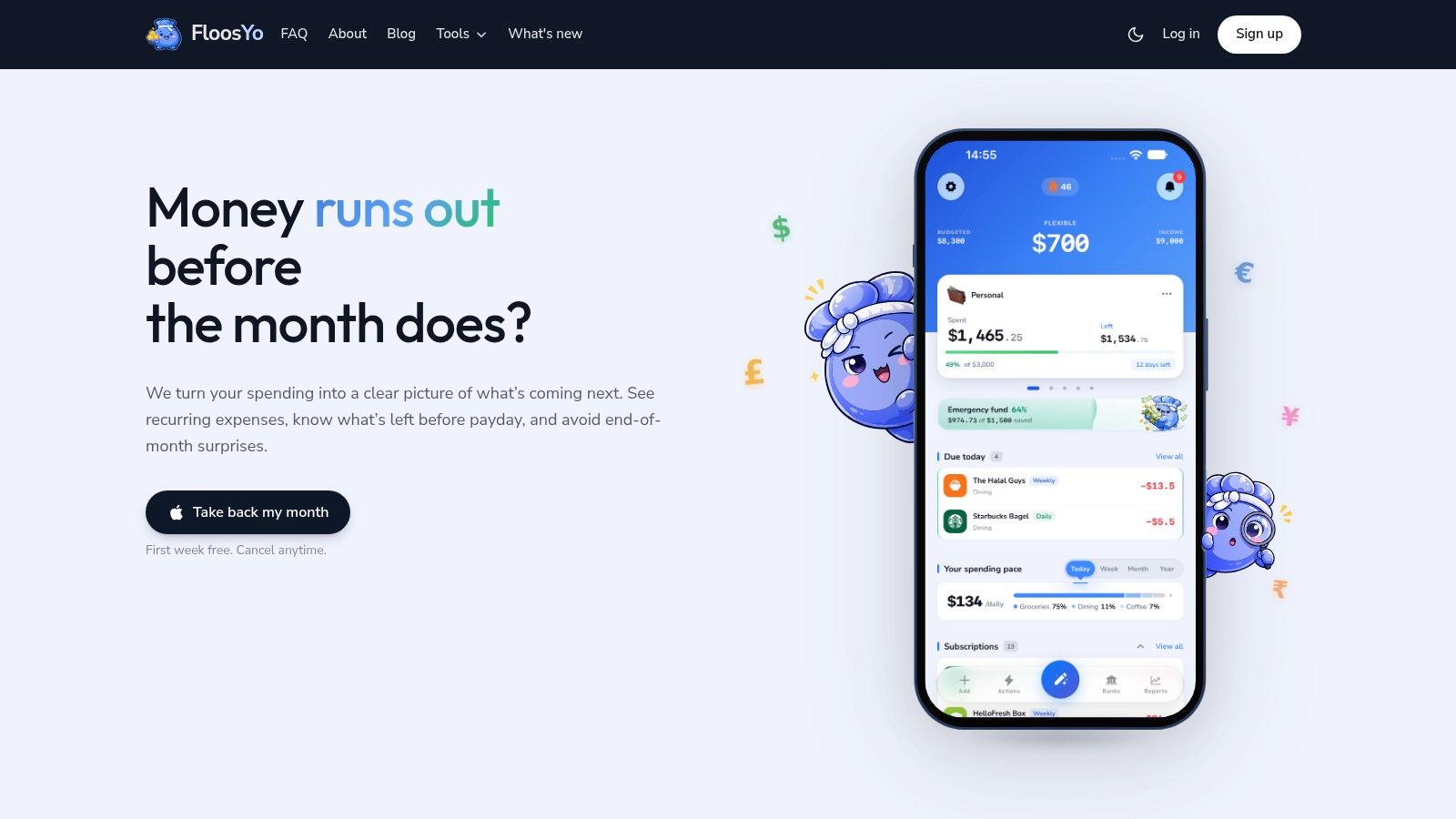
FloosYo is a personal finance iOS application that connects to your bank, finds recurring spending you may have stopped noticing, and shows what it costs over a month and a year before the next charge lands. It supports voice or text capture for expenses a bank feed doesn't identify, renewal reminders, monthly and yearly projections, and skip or stop decisions with estimated savings scenarios.
That approach is more useful than reviewing a chart after the charge has posted. A small food-delivery habit, cloud-storage plan, phone add-on, or rarely used gym membership can look harmless in isolation. The annual projection gives you a practical basis for deciding whether to keep it.
Read how an expense tracker with bank sync works to assess whether connected transaction tracking fits your routine. The right tool should reduce manual searching, not create another daily admin task.
The prevention workflow is simple:
- Review recurring charges as they appear in your bank activity.
- Check the projected yearly cost before judging a charge by its monthly amount.
- Set a reminder before renewal, not on the day the payment posts.
- Choose skip, cancel, downgrade, or monitor based on actual use.
- Track the saved amount so prevention becomes visible progress.
The application uses read-only bank access, so it can identify and organize transactions but can't move money. You still cancel services with the merchant. The value is earlier awareness, better timing, and a record of recurring outflows before they turn into refund disputes.
Your Action Plan for Managing Card Reversals
Use a decision rule, not frustration, when a card payment needs to be reversed. First identify whether the payment was a temporary authorization, a settled purchase, a merchant refund, or a recurring charge. Then collect the evidence that matches that category.
Match the response to the problem
For a standard retail return, contact the merchant, follow its return procedure, and keep the receipt and refund confirmation. Don't file a dispute just because the credit hasn't appeared immediately. Check the transaction history after the merchant's stated processing window.
For an authorization hold, ask whether the merchant released the hold or captured the payment. A released hold may disappear rather than arrive as a separate refund credit.
For a subscription renewal, cancel the service first, then request a refund for the charge already posted. Save the cancellation record, renewal notice, support messages, and merchant response.
For a canceled event, preserve the cancellation announcement, ticket terms, organizer correspondence, and any promised refund date. If the merchant or organizer refuses to act, give that complete file to your issuer.
For an unauthorized transaction, contact the issuer promptly through its fraud channel. Don't frame an unfamiliar charge as a normal return if you didn't authorize it.
Keep one clean record
Create a simple refund log with the merchant name, original charge date, amount, cancellation or return date, promised refund date, confirmation number, and next follow-up date. Store screenshots and emails in the same place. This turns a vague complaint into a timeline an agent can verify.
After the merchant confirms the credit, watch both your current balance and the next statement. If the credit doesn't appear within the stated window, contact the merchant once more. If the merchant refuses, fails to respond, or contradicts its own confirmation, contact the issuer and ask which dispute category fits the facts.
Don't spend a provisional credit until the dispute is resolved. An issuer may remove it if the merchant successfully challenges your claim. The safest practice is to treat disputed money as unavailable until the statement shows a permanent posted credit.
The strongest refund case is chronological, documented, and specific. Explain what happened, when it happened, what the merchant promised, and what remains unresolved.
The long-term fix is proactive. Review recurring charges before renewal, make a keep-or-cancel decision, and track the yearly cost of services you rarely use. That prevents surprise outflows and reduces your dependence on slow, uncertain recovery processes.
Use FloosYo to find recurring charges, project their monthly and yearly cost, and receive reminders before renewals post. Start by reviewing your next upcoming charges, then cancel or skip the expenses that no longer deserve a place in your budget.