
Your subscription didn't cancel itself just because you sent a polite email and hoped for the best. The charge still shows up, the renewal date is still real, and the merchant's system only cares about proof, timing, and the channel you used. If you want the cancellation to stick, write the cancel subscription letter, send it the right way, and keep evidence that it landed.
The smart move is simple. Gather the right account details, use a clean letter, send it before the next billing date, and keep a backup path ready if the company stalls. That's the difference between “I asked to cancel” and “I stopped the charge.”
Table of Contents
- Why Most Cancellation Letters Get Ignored
- What to Gather Before You Write a Single Word
- The Cancel Subscription Letter Template You Can Copy
- Where to Send the Letter for the Fastest Confirmation
- Timing the Letter So the Next Charge Never Lands
- Follow-Up and Escalation When the Merchant Goes Quiet
- Turning One Cancellation Into a Recurring Money Habit
Why Most Cancellation Letters Get Ignored
Cancellation letters get ignored for plain reasons. They are vague, they leave out the account number, they go to the wrong inbox, or they never state when cancellation should take effect. Billing teams process these requests like a workflow. If the letter does not give them what they need, it gets bounced back or buried.
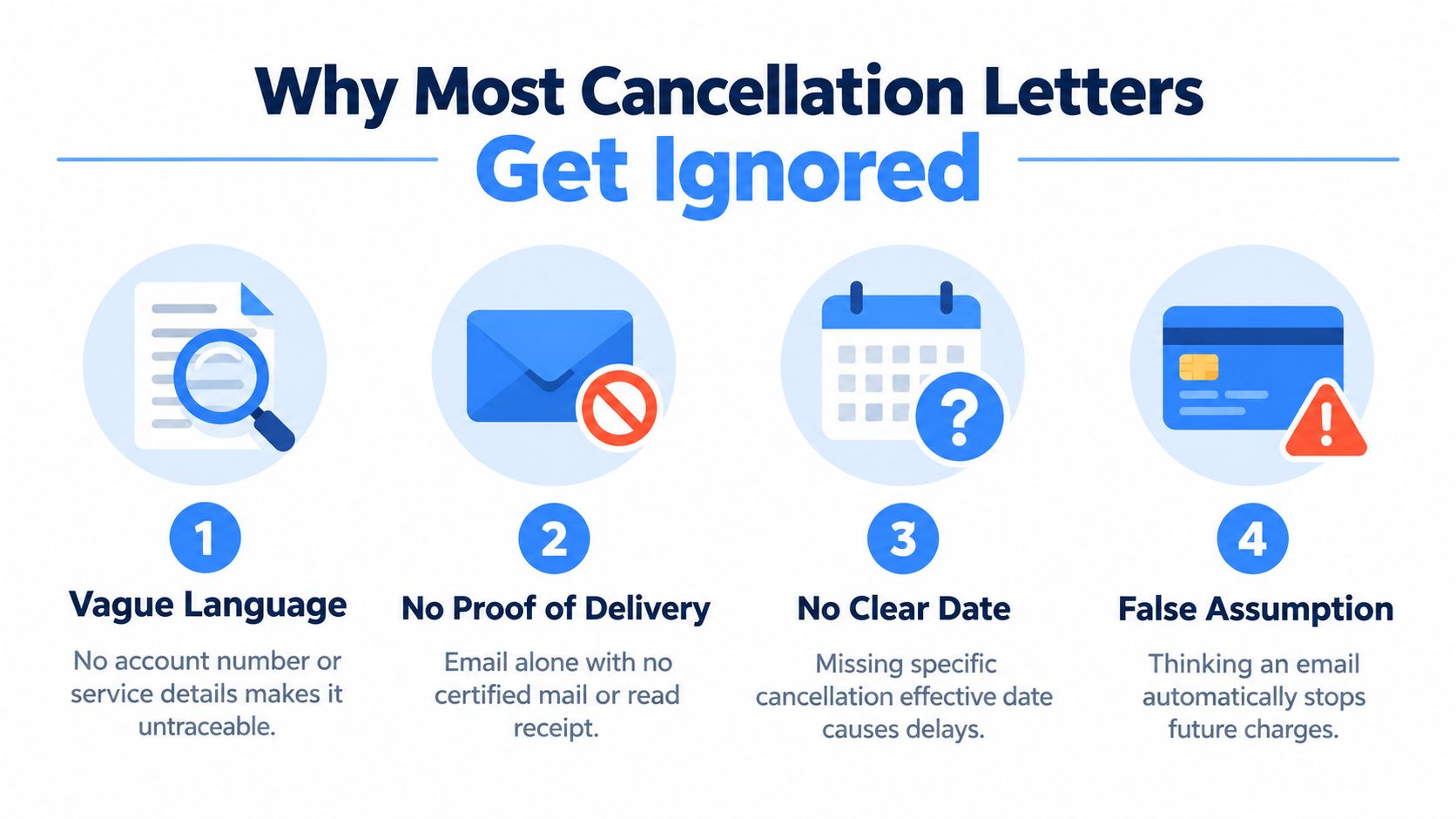
The four details that actually matter
Start with the account identifier, the billing email, and the effective cancellation date. Those three details make the request traceable and time-bound. Leave them out, and the company can say it could not find the subscription or did not know when to stop billing.
Practical rule: if support cannot find the subscription in under a minute, rewrite the letter.
Email alone does not stop recurring charges. Use a format the company already accepts, and keep the request short enough to process without guesswork. The Citizens Advice template letter is a good model for a clear cancellation request, and the FTC negative-option summary shows why companies are pushed toward clear, traceable cancellation paths and upfront disclosure of charge timing.
Write a short, exact request that names the subscription, gives the merchant the right account details, and creates proof. That gets processed the first time more often than a polished message with no usable information.
What to Gather Before You Write a Single Word
Before you draft anything, pull the details that make the request unmissable. You need the account holder name, the email on file, the customer or subscription ID, the last four digits of the card, the plan name, the signup date, the next billing date, and the merchant's stated cancellation channel from the terms of service. Don't over-collect beyond that. A longer file doesn't help if you still miss the renewal date.
If you're looking at a streaming service, open the account dashboard and find the subscription ID under the billing or membership section. Then open billing history and pull the next charge date from the latest invoice or renewal screen. That date is the one that matters, not the date you remember signing up.
Use a simple streaming example so you don't stall. If the account says the plan renews on the 18th, the cancellation message should reference that date directly. If the terms say cancellation must happen in-app, don't send three emails first and hope for magic.
Keep the list tight
- Must have: account name, email, subscription ID, plan name, last four card digits, next billing date.
- Also useful: signup date, invoice number, and screenshot of the cancellation terms.
- Nice to have, but not required: a long explanation, a detailed complaint, or a full account history.
The point is to move fast without getting sloppy. If you're already tracking recurring costs, this is the same discipline in a different format. FloosYo's recurring-spend view can help you spot what's due before it lands, and its renewal reminders are useful for this exact timing problem.
For a broader check on what you're paying for, use this subscription audit guide alongside your letter prep.
The Cancel Subscription Letter Template You Can Copy
Use this as-is, then swap in your own details:
Dear [Merchant Name] Support,
I'm writing to cancel my subscription for [Plan Name], effective [Cancellation Date]. Please stop all future recurring charges tied to this account.
My account details are below:
- Account holder name: [Full Name]
- Email on file: [Email Address]
- Subscription or customer ID: [ID]
- Last four digits of card: [1234]
- Last billing date: [Date]
Please confirm in writing that the subscription is canceled and that no further charges will be made after [Cancellation Date]. If any service access ends on a different date, include that date in your confirmation.
Thank you,
[Full Name]
[Phone Number or Other Contact Info]
If you want to keep it even shorter for a service with a strict form, keep the cancellation request, the identifying details, and the confirmation request. That's the core. Skip the story, skip the frustration, and skip any paragraph that doesn't help the billing team act.
If the charge is disputed or still appearing after cancellation, add one line: “Please refund transaction [Transaction ID] and confirm that the recurring charge has been removed.”
That version matters when the merchant keeps billing after the request. You're no longer just asking to cancel, you're documenting an unwanted recurring charge and asking for a specific remedy.
Where to Send the Letter for the Fastest Confirmation
Send the request through the channel the merchant uses to process cancellations. If the account page has an in-app or web cancellation portal, use it first. That route is usually fastest because it creates an instant timestamped record.
If there is no self-serve option, use live chat or support email and ask for a case number. Keep the subject line plain, for example Cancellation Request for [Account ID]. Send it to billing or support, not to a random address buried in a footer.
For some EU merchants, US gyms, and insurers, certified postal mail still matters because it gives you proof of delivery. Use USPS Certified Mail with return receipt or registered post when you need a paper trail. If the charge keeps showing up, use more than one channel. Send the chat or email for speed, then mail the letter so you can prove notice.
| Cancellation Channels Compared | Confirmation Speed | Proof of Delivery | Best For |
|---|---|---|---|
| In-app or web portal | Fast | Timestamped on-screen or emailed receipt | Most digital subscriptions |
| Live chat | Fast | Transcript or case number | Services without a cancel button |
| Support email | Moderate | Sent message plus reply chain | Businesses that still process requests by email |
| Certified postal mail | Slower | Delivery receipt and tracking | EU merchants, gyms, insurers, stubborn billing teams |
If you need a practical reminder system around these channels, this subscription cancellation service guide maps the next step after the letter goes out.
Timing the Letter So the Next Charge Never Lands
Send the letter early. Aim for 7 to 14 days before the renewal date, and give yourself more room if the plan renews annually or the merchant demands formal notice. The calendar matters as much as the wording, because some subscription rules require reminder notices before the next charge and some renewals open another cancellation window after notice is given (UK subscription-contract guidance).
Use the next billing date from the account settings or the latest invoice, not your memory. Then mark two deadlines, the day to send the letter and the day to confirm receipt if the merchant stays silent.
Use the billing date, not your memory
Free trials that roll into paid plans deserve extra care. Annual subscriptions need even more lead time, because a renewal notice does not stop the charge by itself. Send your request before the merchant's cutoff, not after you see the card pending.
For many services bought online, by phone, or by mail order in the UK, the cancellation window can be tied to the contract rules and the cooling-off period, so early action avoids a fight over timing (Citizens Advice template letter).
The FTC's negative-option guidance points the same way, cancellation should be no harder than signup, and the merchant should not force a confusing detour after you have already given notice (FTC negative-option summary). If you enrolled online, send the cancellation online first unless the contract clearly requires a different method.
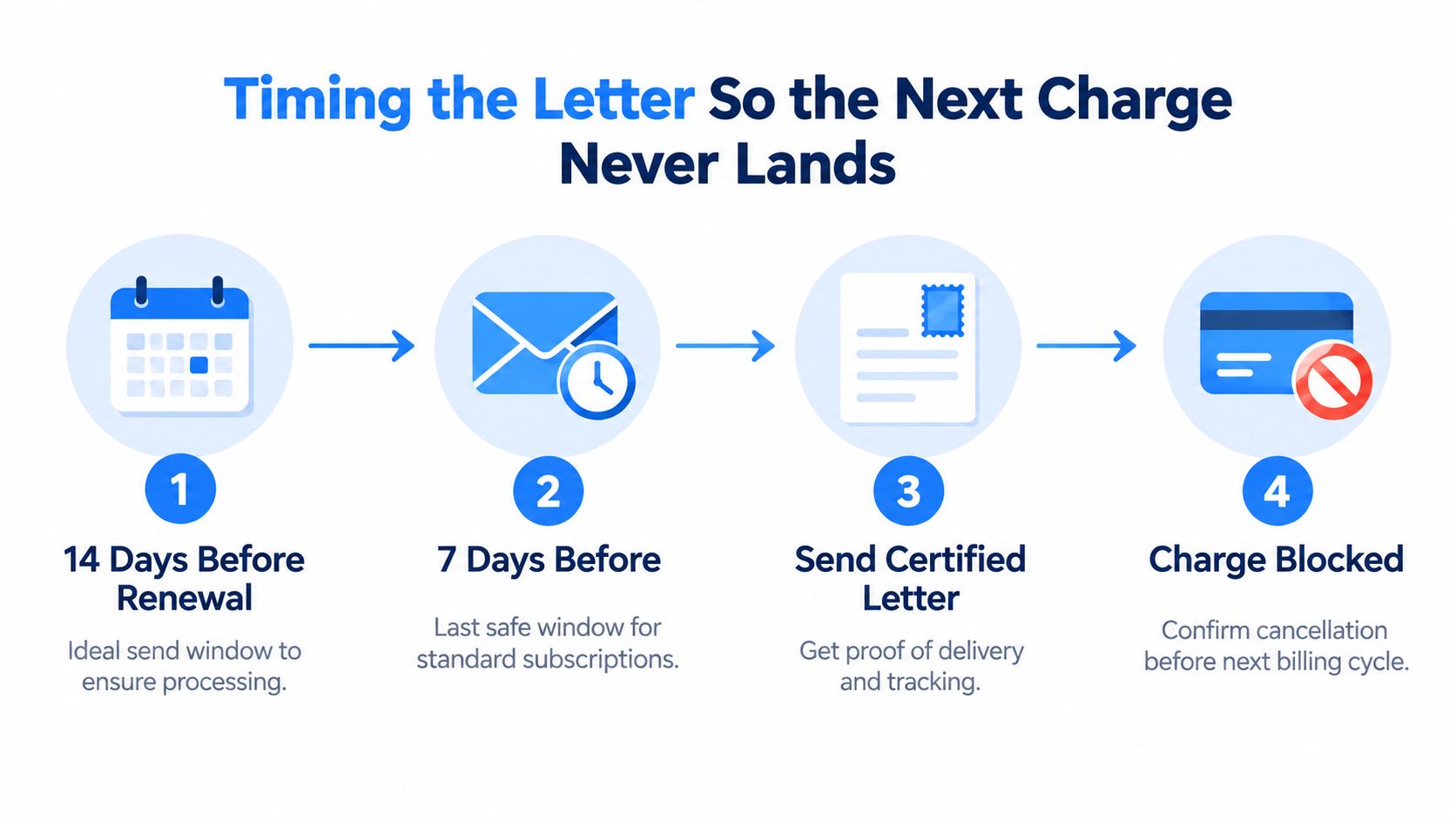
The cancellation date is usually the day the company processes your request, not the day you mailed it. Proof of delivery and a timestamp matter more than guessing when the charge will stop.
Follow-Up and Escalation When the Merchant Goes Quiet
If the merchant stays silent after 5 to 7 business days, stop waiting. Send one follow-up that re-attaches the original request, asks for written cancellation confirmation, and repeats the account details. If that still goes nowhere, move the case to live chat, then to your card issuer.
Here's a short follow-up you can copy:
Dear [Merchant Name] Support,
I'm following up on my cancellation request sent on [Date]. Please confirm in writing that [Plan Name] is canceled and that no further recurring charges will be made.
My account details are:
[Full Name]
[Email Address]
[Subscription or Customer ID]
[Last Four Digits]
Please reply with the cancellation effective date and any final service-access date.
Thank you,
[Full Name]
Keep your proof in one place. Save screenshots of the original letter, the chat transcript, the email thread, and the charge on your statement. If billing continues after cancellation, use the phrase unauthorized recurring transaction following cancellation on [date] when you contact the card issuer.
That wording turns a vague complaint into a clean dispute. If the merchant still ignores you, file a complaint with the CFPB or a state attorney general in the U.S., or contact the European Consumer Centre in the EU. For a clear send-and-proof workflow, this cancellation service guide is a useful reference once the first request gets ignored.
Turning One Cancellation Into a Recurring Money Habit
The win is not just killing one charge. It is building a habit that catches the next one before it renews. The fastest way to do that is to stop treating subscriptions like random bills and review them together on a set schedule.
Set a 90-day calendar reminder, block 20 minutes, and keep one running list with the merchant, price, renewal date, and cancellation channel. Add free trials that are close to converting, because those are the charges that slip through when nobody is watching.
Use the letter as the starting point for a repeatable review, not a one-time fix.
- Quarterly review: check every recurring charge at once, not only when a fee shows up.
- Track what you cut: log the merchant, the monthly cost, and the date you canceled.
- Set reminders before renewals: base the alert on the billing date, not the invoice after the fact.
- Review household use: ask who uses each service, then cut the ones nobody touches.
That routine matters because small monthly charges look harmless until you total them over a year. Consumer calculators turn recurring costs into annual terms by multiplying weekly charges by 52, monthly charges by 12, and quarterly charges by 4, which is a simple way to spot the leak early (subscription analyzer method). Households also miss how much sits in recurring spending until they see it in yearly terms (recurring spend overview).
FloosYo fits that review cycle. It detects recurring charges, shows monthly and yearly projections, and sends renewal reminders before the next charge lands. For a tighter routine, use this guide to manage subscriptions alongside your quarterly review, then keep the letter process tied to your calendar so the next cancellation takes less work than this one.
If you want a cleaner way to spot recurring charges before they hit, visit FloosYo and use the renewal reminders, monthly and yearly projections, and savings tracking to turn one canceled subscription into a habit you keep. Stop guessing. Review on a schedule, and let each skipped charge show you what you are saving.