
Most household budgets don't fail because of one large purchase. They fail because of a monthly charge nobody remembers approving, a renewal that arrives before either partner checks it, or a small daily habit that becomes a yearly bill. That makes recurring spending a relationship issue as much as a budgeting issue. In a 2025 survey of 600 U.S. adults, 31% said they had hidden a financial decision or expense from a partner, while 37% named different spending habits as their main relationship-finance concern (Cleo's 2025 Love & Money Report).
This list compares eight budget plans for couples, from percentage-based allocations to shared funds and annual resets. Each plan is judged by how it handles subscriptions, shared bills, and savings goals. Each also includes a sample allocation, an annualized recurring-cost view, and a negotiation template you can adapt with your partner.
Table of Contents
- 1. The 50/30/20 Budget for Couples
- 2. The Zero-Based Budget for Couples
- 3. The Separate-Accounts-with-Joint-Fund Model
- 4. The Digital Envelope System for Couples
- 5. The Income-Pooling Budget with Shared Goals
- 6. The Proportional-Income Budget for Unequal Earners
- 7. The Subscription Audit and Minimalist Spending Plan
- 8. The Annual Reset Budget for Couples
- 8-Plan Comparison: Couples Budget Strategies
- Pick One Model and Audit Recurring Charges This Month
1. The 50/30/20 Budget for Couples
The 50/30/20 method gives your combined after-tax income three jobs: 50% for needs, 30% for wants, and 20% for savings or debt repayment. Needs include housing, utilities, groceries, and insurance. Wants include dining, entertainment, gym memberships, and subscriptions.
For a couple bringing home $5,000 per month, the starting allocation is $2,500 for needs, $1,500 for wants, and $1,000 for savings. If three forgotten streaming services cost $45 monthly, they consume $540 per year. That figure makes the decision easier than a vague feeling that “we have too many subscriptions.” A $120 monthly coffee habit would cost $1,440 per year, so voice entry can help reveal whether the habit fits inside the wants allocation.
Where this plan works
This approach is useful when both partners want clear limits without reviewing every transaction. Tag each recurring charge as a need or want, then set a joint ceiling for wants. A family streaming plan may belong in shared wants, while a personal gym membership stays with the partner who uses it.
Use bank-connected tracking to categorize charges automatically, and set renewal reminders before subscriptions bill. If needs consistently exceed 50%, change the percentages rather than pretending the original split still fits.
Negotiation template: “Let's set our shared wants limit first. Which subscriptions benefit both of us, which are personal, and which should be canceled before the next renewal?”
A practical FloosYo workflow is to log untracked daily spending by voice, review monthly and yearly projections, and move canceled charges onto a savings target. The plan is simple, but it can be too broad for couples with irregular income or many annual bills.
2. The Zero-Based Budget for Couples
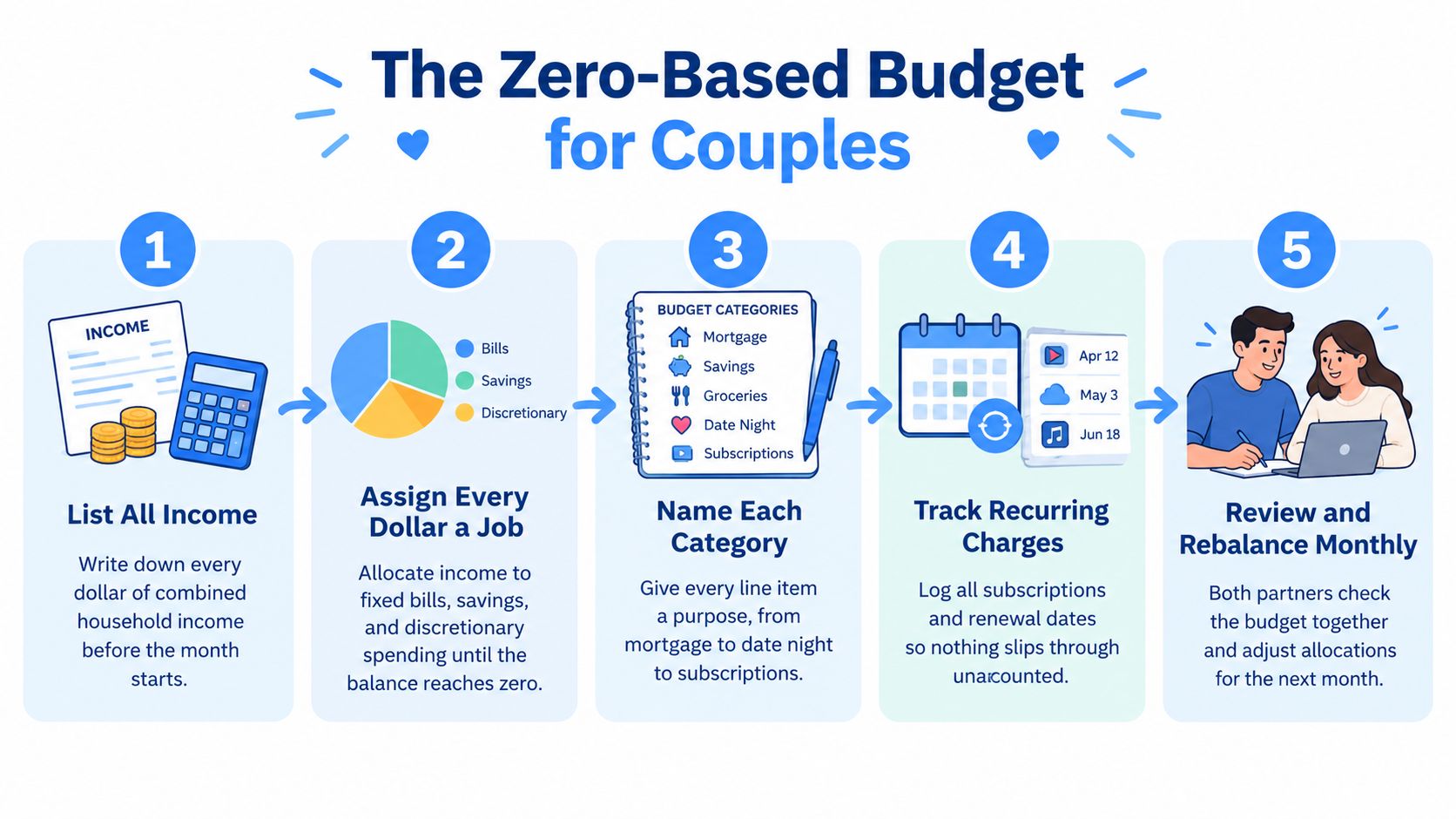
A zero-based budget assigns every dollar before the month begins. Income minus planned allocations equals zero, not because the account must be emptied, but because every dollar has a named purpose. Rent, utilities, groceries, date night, subscriptions, savings, and irregular expenses all appear before spending starts.
A couple earning $4,500 per month might allocate $1,400 to rent, $300 to utilities, $400 to groceries, $200 to car insurance, $150 to a phone bill, $80 to streaming, $100 to date night, $50 to a gym membership, and $1,320 to savings. During setup, they find two cloud-storage plans costing $9.99 each per month. Canceling one removes $119.88 from annual spending, based on twelve monthly charges.
The model is especially effective for recurring charges because an unlisted renewal has nowhere to hide. It also forces a decision when income changes. If a freelance partner brings home $3,200 instead of the expected amount, the couple can skip or downgrade lower-priority services rather than letting the month drift.
Give irregular costs a place
Track current recurring charges for two months before setting targets. Add a buffer or irregular-expense category for car maintenance, medical costs, annual fees, and other expenses that don't arrive monthly. Voice entry makes it faster to capture discretionary purchases during the month and compare them with the assigned category.
Set a renewal reminder for every subscription and bill. When an alert arrives, the couple already knows whether the charge fits the current plan.
Negotiation template: “Before the month starts, let's name every obligation, decide which charges can be skipped, and assign any remaining money to a shared goal or buffer.”
One partner can own the primary update, but both should see the plan. Zero-based budgeting gives excellent control, yet it demands regular attention. Couples who dislike detailed administration may find the next model easier.
3. The Separate-Accounts-with-Joint-Fund Model
Separate accounts with a joint fund combine financial autonomy and shared visibility. Each partner keeps personal checking and savings accounts, while both contribute to a joint account for household obligations and agreed goals. The joint account can pay housing, utilities, insurance, family streaming, shared groceries, and home services.
Suppose one partner earns $4,000 monthly and the other earns $6,000. They each contribute $2,500 to the joint fund. If household bills total $2,400, the account has a $100 monthly buffer, or $1,200 across a full year, before any other use. Shared subscriptions stay in the joint account, while individual gym memberships, hobby apps, or audiobook services remain personal.
This structure matches the reality that couples often use a hybrid arrangement. A CNBC analysis of more than 20,000 couples found that 22% used a “yours, mine, and ours” structure, while 39% kept finances separate and another 39% fully merged them. The figures support flexibility, not one universal account rule.
Define ownership before the first charge
Agree which expenses belong in the joint fund. Housing, utilities, insurance, shared groceries, and family entertainment usually qualify. Personal subscriptions should remain personal unless both partners use them.
A shared budget tool can show upcoming renewals from the joint account. If one partner forgets a gym renewal for six months, a reminder can surface the charge before another billing cycle. The annual cost of a $25 monthly membership is $300, even if the charge feels minor each month.
Use FloosYo's guide to merging finances after marriage for a broader discussion of account structures.
Negotiation template: “Let's list every shared recurring expense, choose a contribution formula, and keep personal spending private unless it affects a shared obligation.”
Review the joint balance monthly and recalculate contributions after a significant income change. The trade-off is clear: this model protects independence, but partners must agree on what “shared” means.
4. The Digital Envelope System for Couples
Digital envelopes give each spending category a fixed limit. Instead of physical cash, couples use categories for groceries, dining, entertainment, subscriptions, utilities, insurance, savings, and emergencies. Each charge reduces the relevant envelope, so partners can see what remains before approving a renewal or discretionary purchase.
A couple earning $5,000 monthly might assign $500 to groceries, $200 to dining, $150 to entertainment, $100 to subscriptions, $1,500 to utilities, $800 to insurance, $900 to savings, and $250 to emergencies. If streaming costs $80 and gym memberships cost $40, the $100 subscription envelope is already nearly full.
That creates a useful decision point. If a software service wants to renew when only $8 remains, the couple must skip it, pause another charge, or wait until next month. The envelope does not make the decision for them. It makes the trade-off visible.
Protect the envelopes from silent changes
Track actual spending for two months before setting category limits. Assign every known recurring expense to an envelope and review balances weekly. A small flex envelope can absorb an unexpected charge without forcing the couple to raid groceries or savings.
Decide who can move money between envelopes. Without that rule, one partner may expand entertainment or subscription spending and leave the other to discover the shortfall later.
Negotiation template: “If one envelope runs low, we'll decide together whether to pause a renewal, move money from a lower-priority category, or wait until next month.”
The cash envelope budgeting approach explains the underlying logic. Digital envelopes are more convenient than physical ones, but they still require weekly review. They work best for couples who want firm spending boundaries without assigning every dollar to an individual transaction.
5. The Income-Pooling Budget with Shared Goals
Income pooling places all household income in one shared operating plan. Both partners can see recurring charges, bills, savings contributions, and discretionary spending. This model offers maximum transparency, but it also removes the privacy of a separate personal allowance.
Consider a couple with $4,500 in combined monthly income. They allocate $1,400 to rent, $400 to utilities, $500 to groceries, $300 to insurance, $100 to streaming, $200 to dining, and $500 to savings. The remaining income can cover other named categories, irregular costs, and shared goals.
A $12.99 forgotten subscription costs $155.88 per year if it renews monthly. Under a pooled model, either partner can flag it in the bank feed and decide whether it serves the household. The same visibility helps with larger recurring costs. If a family phone plan renews at an inconvenient price, both partners can discuss changing providers rather than leaving the decision to whoever notices first.
Build shared decisions into the system
Set renewal reminders for every subscription and bill. Review the budget every two weeks, since a monthly meeting may allow several avoidable charges to pass. Agree on a small threshold for routine purchases or low-cost subscriptions so the couple doesn't turn every minor decision into a negotiation.
A shared goal gives cancellations a visible purpose. The FloosYo savings-goals guide shows how to connect spending decisions with a defined target.
Negotiation template: “Which recurring charges should require both approvals, and which can either of us keep without discussion? Let's connect canceled spending to one shared goal.”
Research provides a useful caution. In a two-year, six-wave experiment involving 230 engaged or newly married couples who initially kept separate accounts, couples assigned to merge money into a joint account maintained relationship quality while comparison groups experienced the typical decline (Kellogg Insight's summary of the experiment). Pooling isn't a universal requirement, but transparent interdependence can improve coordination when the rules feel fair.
6. The Proportional-Income Budget for Unequal Earners
A 50/50 split can look equal while creating very different burdens. A proportional-income plan assigns shared costs according to each partner's share of household income, then leaves the remainder for personal spending, individual obligations, or additional goals.
Suppose Partner A earns $5,000 monthly and Partner B earns $3,000. Shared expenses total $3,200. Partner A earns 62.5% of the household income and contributes $2,000. Partner B earns 37.5% and contributes $1,200. A $120 shared subscription total follows the same ratio, with Partner A covering $75 and Partner B covering $45.
This model also handles changing income. If the freelance partner's income falls from $3,000 to $2,000, the couple recalculates the contribution ratio instead of treating the original amount as permanent. The adjustment should happen before bills and renewals create pressure.
Include labor and irregular income
Update the ratio quarterly, or sooner after a major income change. For gig or freelance work, agree whether contributions use current income, a recent average, or another conservative figure. Discuss unpaid caregiving and household administration separately. A fair contribution system shouldn't treat only paid wages as valuable.
Keep personal gym memberships and hobby apps outside the shared calculation. Household subscriptions, shared phone plans, utilities, and family services use the agreed ratio.
Negotiation template: “Let's calculate each person's share from the same income definition, apply it only to shared costs, and revisit the formula after a raise, job loss, or major change in unpaid work.”
Financial communication matters even when income doesn't change. A 2025 relationship-finance survey found that 42% of 555 people in relationships identified balancing personal spending with shared responsibilities as a major challenge. The strength of proportional budgeting is fairness, but the ratio must be visible and recalculated rather than treated as a one-time verdict.
7. The Subscription Audit and Minimalist Spending Plan
This plan starts with one question: Would we buy this again today at the full price? The couple reviews bank records, identifies every recurring service and habitual purchase, then keeps only charges that provide clear value.
A six-month audit might reveal three streaming services costing $45 monthly, two fitness apps costing $25, two productivity subscriptions costing $20, and forgotten trials costing $10. Keeping one streaming service and one fitness app removes $85 per month, or $1,020 per year. A meal-planning service used once and billed at $15 monthly adds another $180 annually if canceled.
Daily habits deserve the same treatment. If voice entry records $200 monthly in coffee, food delivery, and parking, the annual projection is $2,400. The objective isn't to label every convenience purchase irresponsible. It's to let both partners choose deliberately.

Review recurring charges without policing each other
Export six months of statements and search for “subscription,” “monthly,” “renew,” and merchant names. Sort each charge into shared, personal, or ambiguous household convenience. Then choose one decision rule: keep, renegotiate, downgrade, pause, or cancel.
The Federal Trade Commission's negative-option rule says sellers must disclose key terms, obtain affirmative consent, and provide a simple cancellation mechanism. Deleting an app or blocking a payment may not end an underlying contract, so check both the renewal and any remaining obligation.
For recurring card payments, the UK Financial Conduct Authority's consumer guidance says consumers can ask the issuer or merchant to cancel by the end of the business day before the next payment is due. Keep confirmation of the request, and remember that stopping a card payment isn't necessarily the same as ending the contract.
Negotiation template: “Let's review the charge without judging who signed up. Does it help both of us, does one person own it, and what should happen before the next renewal?”
Use pre-charge alerts, a shared “no new recurring charges without discussion” rule, and a savings goal for canceled spending.
8. The Annual Reset Budget for Couples
Reserve three to four hours for a yearly money meeting. Use the time to review recurring bills, renewals, household priorities, and the goals that should receive any savings. Choose a date both partners can protect, such as the first weekend after a major annual bill is paid.
Start with a master list built from the couple's bank records. Record each recurring charge, its current cost, billing frequency, last usage date, next renewal, and the person who uses or manages it. Rate each subscription from 1 to 5. A score below 3 makes a service a candidate for cancellation, downgrade, or renegotiation.
Bring a practical decision rule to the meeting. A fitness app costing $15 monthly represents $180 per year. If car insurance costs $125 monthly, finding a $95 alternative frees $360 per year. Together, those changes create $540 in annual savings, based on the couple's own bills.
Price increases deserve their own review. If several streaming services rise by $2 to $3 monthly in total, the added cost can reach $36 per year. Downgrading one service or ending the least-used option prevents that increase from becoming a permanent household expense.
Call major providers during the meeting and ask whether a lower available rate applies. Then assign every confirmed saving to a named goal. If the couple removes $300 in annual subscriptions, they can direct exactly $300 toward travel, debt repayment, or another shared priority instead of letting it blend into everyday spending.
Negotiation template: “Let's rebuild the recurring-cost list from our bank records, decide what earned another year, and assign every canceled amount to a specific goal.”
Annualizing charges makes small decisions easier to compare. A $12 monthly subscription costs $144 per year. A $6 daily habit costs $2,190 annually. Those calculations help partners judge recurring spending against a goal in the same time frame.
Set a mid-year check-in six months later. The annual meeting establishes the plan, while the shorter review catches new charges before they become part of next year's baseline.
8-Plan Comparison: Couples Budget Strategies
| Method | Implementation Complexity 🔄 | Resource Requirements ⚡ | Expected Outcomes 📊 | Ideal Use Cases 💡 | Key Advantages ⭐ |
|---|---|---|---|---|---|
| The 50/30/20 Budget for Couples | Low, simple percentage rules, minimal setup | Low, basic tracking app or manual math | 📊 ⭐⭐⭐, clearer boundaries, moderate savings and alignment | Couples who want an easy-to-follow, low-maintenance plan | Easy to remember; reduces arguments; scalable with income |
| The Zero-Based Budget for Couples | High, every dollar planned monthly | High, time-intensive monthly work; spreadsheet/app | 📊 ⭐⭐⭐⭐, full visibility and tight control over spend | Couples seeking granular control and frequent rebalancing | Assigns every dollar; uncovers hidden subscriptions |
| Separate-Accounts-with-Joint-Fund Model | Medium, establish rules and contributions | Medium, multiple accounts and coordination tools | 📊 ⭐⭐⭐, predictable shared bills while preserving autonomy | Couples who value privacy but need joint bill management | Preserves independence; centralizes household expenses |
| The Envelope System (Digital) for Couples | Medium, category setup and discipline required | Medium, bank-connected envelopes or app, regular monitoring | 📊 ⭐⭐⭐⭐, strong prevention of overspending, category control | Couples prone to impulse spending or on tight budgets | Prevents overspending; clear visual balances per category |
| The Income-Pooling Budget with Shared Goals | Medium-High, merge finances and governance rules | Medium, single joint account and shared budgeting tool | 📊 ⭐⭐⭐⭐, maximum transparency and unified goals | Couples with high trust who want fully joint finances | Simplifies accounting; full visibility of recurring charges |
| The Proportional-Income Budget for Unequal Earners | Medium, requires calculation and periodic updates | Low–Medium, income tracking tools; occasional reconciliation | 📊 ⭐⭐⭐, fair contribution, reduces resentment risk | Couples with unequal incomes seeking equitable splits | Equitable, scales automatically with income changes |
| The Subscription Audit & Minimalist Spending Plan | Medium, one-time audit then maintenance | Low, time-heavy upfront; minimal ongoing tools | 📊 ⭐⭐⭐⭐, immediate measurable savings and lower mental load | Couples with many forgotten or low-use subscriptions | Quick cash savings; declutters recurring charges |
| The Annual Reset Budget for Couples | Medium, annual deep review and renegotiation | Low–Medium, 3–6 hours yearly, account exports, calls | 📊 ⭐⭐⭐, periodic cleanup, catches price creep and misalignments | Couples preferring annual planning cadence and reflections | Catches unnoticed price hikes; realigns priorities yearly |
Pick One Model and Audit Recurring Charges This Month
Choose the model that matches how your household earns and shares money. A pooled-income plan may suit partners who want maximum transparency, while separate accounts with a joint fund may work better when autonomy matters. Proportional contributions can reduce resentment when incomes differ, and a subscription audit is the fastest option when surprise renewals are the main problem.
Run a one-month audit of every recurring charge. Record the merchant, owner, billing rhythm, next renewal date, monthly cost, and annualized cost. The annual view changes the conversation. A $12 monthly charge is $144 per year, and a $6 daily habit repeated every day is $2,190 per year, as calculated from the household's own transactions and the annualization method described by the Bureau of Labor Statistics.
Set renewal reminders before each bill, then agree on a skip-or-cancel rule before the charge arrives. If both partners can see the same recurring list, they don't need to expose every personal purchase. They do need a shared understanding of household obligations, upcoming renewals, and savings decisions.
A useful review can be short. Discuss the next renewals, confirm which charges are shared, check the monthly and yearly projections, and move canceled spending toward one named goal. The CFP Board's consumer survey found that 46% of people in relationships considered money the most uncomfortable subject to discuss with a partner, while more than seven in ten said they consult their partner before a major or even not-so-major purchase. A recurring-expense list gives that conversation a practical structure.
FloosYo, an iOS app, reads recurring charges from a connected bank account and projects monthly and yearly totals before the next charge lands. It also supports voice entry for spending a bank feed misses, renewal reminders, skip and cancel decisions, savings tracking, and automatic funding of one goal when a skipped bill creates savings. A shared spreadsheet can do much of the same work, but the important result is a current, visible list that both partners can use.
FloosYo finds recurring subscriptions, bills, and habits from your bank connection, adds voice entry for anything missing, and shows the monthly and annual cost before renewal. Visit FloosYo to turn each upcoming charge into a clear keep, skip, or cancel decision and track the savings that follow.