
A household can look at a month of streaming, phone, cloud storage, food delivery, and utility charges and see a collection of manageable amounts. The same charges look different when every renewal lands on a calendar and the monthly outflow is projected across a year. A 2025 CNET/YouGov survey of U.S. adults found that respondents estimated their subscription spending at an average of $86 a month, while itemized records showed approximately $219 a month, a gap of about $133 monthly or $1,596 annually (survey details). Distributed charges can be difficult to notice, especially when they renew automatically on different dates.
A meaningful before-and-after home comparison isn't just a picture of a tidier budget. It shows the before state, the decision made before the next charge, the after state, and the resulting annualized impact. A renewal date gives the household a moment to decide whether to cancel, downgrade, negotiate, skip, cap, or monitor the expense. Without that date and a clear status, the charge may happen again.
FloosYo is designed around this kind of decision. It can detect recurring bank transactions, project monthly and yearly totals, and send pre-charge reminders. Voice or text entry can capture expenses the bank doesn't see, while a skip-or-stop decision and savings tracking help make the outcome visible.
Table of Contents
- 1. Streaming Stack Consolidation From Six Services to Two
- 2. Phone and Internet Plans Ending the Promotional Rate Jump
- 3. Free Trials That Quietly Convert Catching Renewals Before They Charge
- 4. Gym Memberships From Unused Monthly Fees to Pay-Per-Visit
- 5. Cloud Storage Right-Sizing Paying for the Space You Actually Use
- 6. Food Delivery Habits Setting a Weekly Cap and Tracking the Real Cost
- 7. Utility Bills Smoothing Seasonal Spikes With Budget Billing
- 8. Meal Kits and Pet Supply Subscriptions Skipping a Cycle Instead of Canceling
- Before-and-After Home Savings: 8-Point Comparison
- Build a Repeatable Savings Rhythm
1. Streaming Stack Consolidation From Six Services to Two
Before: Six streaming subscriptions renew at about $90 a month, or $1,080 a year. No single charge looks decisive, but together the services form a large annual commitment, especially if the household added them for individual shows and never revisited them.
Decision: Keep two services at about $30 a month and rotate the rest after finishing a season or a specific release. In this illustrative scenario, the difference is $60 a month, or $720 a year. That projection assumes the household cancels four subscriptions and keeps the two chosen services at the stated combined monthly cost.
Make the rotation deliberate
A couple can enter each service as a recurring expense in FloosYo, check the annual total, then set a reminder ahead of each renewal. If they finish a show, they can cancel through the service's settings or the subscriptions screen on the App Store or Google Play, then keep the confirmation email. The household can review which service members watched before deciding what stays active.
Practical rule: Decide before renewal, not after the next month's charge appears.
A reminder 3 to 5 days before the billing date can leave time to check whether anyone still uses the service. FloosYo's projections make the annual cost easier to compare, while a recorded status such as “keep,” “cancel,” or “monitor” prevents a familiar subscription from blending into the background. For a step-by-step approach to organizing renewals, use this guide to manage subscriptions.
The aim isn't to ban streaming. It's to pay for the services the household intends to watch now, rather than carrying every past choice forward indefinitely.
2. Phone and Internet Plans Ending the Promotional Rate Jump
A promotional price can turn into a higher recurring bill without changing the household's internet use. If an internet plan rises from $50 to $85 a month, the additional $35 a month becomes $420 over a year. That's an illustrative calculation, not a claim about what every provider charges.
Before: The promotion ends, and the household continues paying $85 a month without noticing that the original rate has expired.
After: The customer calls before the change, asks about a retention rate, and returns to $55 a month. Compared with the $85 rate, the difference is $30 a month, or $360 a year.
Put the end date on the calendar
Record the promotion's end date as soon as you sign up, then set a FloosYo reminder 30 days before it ends. That window gives you time to compare the full monthly cost of other plans, including equipment rental and fees, rather than relying on an advertised starting price.
A freelancer can use the same process for a phone plan. Log the recurring bill, compare prepaid alternatives before renewal, and ask the provider, “What is the lowest rate available to a customer who is considering canceling?” The point is to make a decision before the higher bill becomes the new routine.
Check whether the provider can remove equipment rental or another optional charge, and confirm what the quoted price includes. A successful negotiation is not just a lower headline price. It's a lower total outflow for a service that still meets the household's needs.
3. Free Trials That Quietly Convert Catching Renewals Before They Charge
Three trial sign-ups can become three paid subscriptions before anyone has checked whether the apps are useful. In this example, each trial converts to $12 a month, making the combined charge $36 a month after conversion.
Before: Three apps started trials in one month. In the next month, all three become paid plans, and the household doesn't remember making that choice.
After: The end date for each trial is recorded. The household keeps one app and cancels two before conversion, avoiding $24 a month, or $288 a year, based on the stated example prices.
Treat the trial end date as a decision deadline
A student can enter a reminder by voice, for example, “Remind me to cancel the photo app in ten days.” FloosYo's voice entry can parse an expense or reminder without waiting for a bank transaction to appear. A notification before the charge gives the student time to decide whether to keep the app or cancel through the App Store subscriptions screen.
Write down the end date as soon as the trial begins, and review the subscriptions list on the App Store or Google Play regularly. If you choose to cancel, allow enough time before the trial expires and check the provider's stated cutoff. The cancellation process can vary by service, so don't assume that deleting an app ends its billing.
The FTC's negative-option rule described protections involving clear terms, affirmative consent, and a simple way to cancel. The rule was later vacated by the Eighth Circuit on July 8, 2025, so it shouldn't be presented as a current nationwide cancellation guarantee (background on the rule's status). For a practical way to locate active plans, see this guide to checking subscriptions.
4. Gym Memberships From Unused Monthly Fees to Pay-Per-Visit
A gym membership should fit the member's actual routine. In this example, a $65 monthly full-access plan costs $780 a year. If the member visits about twice a month, the effective cost is roughly $32 per visit.
Before: The member pays the full fee regardless of travel, busy weeks, or how often they use the facilities.
After: They switch to a $25 monthly basic tier and add outdoor runs. The plan costs $300 a year, a difference of $480 annually from the original membership. The change preserves a fitness routine while reducing the amount paid for unused access.
Match the plan to observed use
Track visits for a month before changing the membership. A young professional who logs each visit by voice can compare actual attendance with the monthly fee, then decide whether a basic tier or pay-per-class option makes more sense during travel-heavy periods. FloosYo's voice or text capture can record the visits, while its recurring-expense view keeps the membership cost visible beside them.
A cancellation isn't the only useful outcome. A lower tier can keep the service while removing features the member rarely uses.
Before switching, check the membership's cancellation notice period and renewal date. Ask whether the basic or off-peak plan still covers the equipment, hours, or classes the member needs. If a cheaper option requires extra fees for the same use, compare the total cost rather than choosing by monthly price alone.
The after state is stronger when the household can explain the decision: the former plan cost more than the member's routine justified, and the replacement still supports that routine.
5. Cloud Storage Right-Sizing Paying for the Space You Actually Use
Storage upgrades often happen when a phone fills up or a photo backup fails. The plan can remain in place long after the immediate problem has passed.
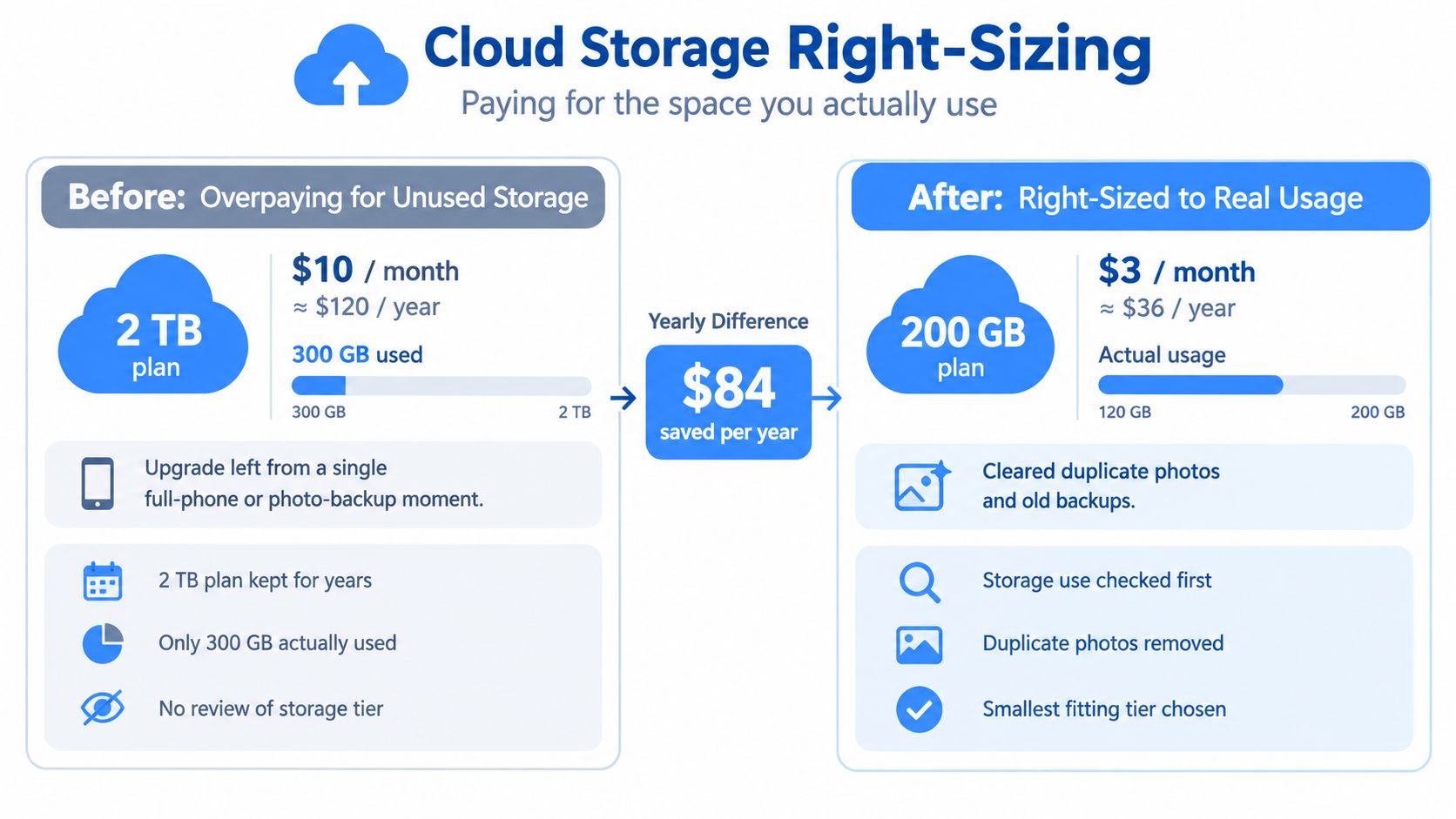
Before: A household pays about $10 a month for 2 TB while using roughly 300 GB. That plan costs about $120 a year.
After: After checking usage and clearing duplicate photos, the household moves to a 200 GB plan at about $3 a month. In this illustrative scenario, the new plan costs about $36 a year, a difference of about $84 annually.
Verify the backup before deleting
Check storage use in the phone settings or the provider's account dashboard before changing tiers. Confirm that important photos and documents are backed up before removing duplicate files or old device backups. A storage warning can identify a problem, but it doesn't tell you that the highest tier is still necessary.
A creator with two cloud subscriptions can enter both in FloosYo and compare their combined annual projection. If one plan already covers the files that matter, the creator can consolidate rather than paying for overlapping capacity. Review usage periodically, not only when a device says it's nearly full.
FloosYo can make the recurring cost visible alongside other digital services, but the household still needs to verify the replacement plan's limits and backup behavior before downgrading. For a visual comparison of a storage change, see the cloud storage cost infographic.
6. Food Delivery Habits Setting a Weekly Cap and Tracking the Real Cost
A delivery order's visible meal price doesn't show the full outflow. Add the delivery fee, service fee, and tip before comparing the order with cooking at home.
Before: A household spends about $40 a week on delivery fees and tips, which is roughly $2,080 a year if that weekly pattern continues.
After: The household plans two delivery nights a week at about $20 each and cooks other meals ahead. In this example, annual spending falls to about $900, a projected difference of about $1,180. The outcome depends on keeping to the new pattern; it isn't a guaranteed saving.
Make the limit usable, not punitive
A student can say, “Spent 18 dollars on food delivery, weekly,” and log the expense by voice. FloosYo can project the recurring habit over a month and a year, so the student can see the direction of spending before ordering again. A weekly cap and a Sunday review make it easier to decide whether another order fits the plan.
Plan one or two cooked meals ahead for the nights when delivery is most tempting. That's a specific alternative to an open-ended promise to “spend less,” and it leaves room for delivery when the household chooses it. If the weekly amount changes, update the projection rather than treating an old estimate as the current cost.
The key comparison is the full price of the order against the actual alternative, not the menu price against a grocery bill in the abstract. Record fees and tips, then decide whether the convenience is worth that cost this week.
7. Utility Bills Smoothing Seasonal Spikes With Budget Billing
Seasonal utility costs can make an ordinary month feel unexpectedly tight. In this example, a family's winter gas bill reaches $210, while a level-payment arrangement spreads the projected cost into $120 monthly payments. Those amounts describe an illustrative household scenario, not a standard utility tariff.
Before: The larger winter bill arrives without a plan for the cash outflow.
After: The household asks the utility about budget billing, checks the plan terms, and sets aside money during lower-cost months for seasonal use. A FloosYo reminder can prompt the family to review the arrangement and keep the projected monthly commitment visible.
Smooth the payment, then check the true cost
Budget billing is a cash-flow tool, not proof that the utility's annual charge has fallen. Before enrolling, review the bill history and confirm how the provider calculates payments, when it adjusts them, and whether fees or other charges apply. Check the plan again after the utility's true-up rather than assuming the same monthly amount will continue.
A family that sees a $90 summer increase in this example can create a goal in April to prepare for peak months. FloosYo's savings-goal tracking can record a planned amount, while the utility charges themselves remain visible as recurring expenses. Its bank connection is read-only, so it can track transactions but cannot move money; any transfer must be arranged separately.
Keep the comparison honest: Equal monthly payments can reduce surprises without reducing the annual bill.
For practical ways to review household utility charges, use this guide to lower bills. The aim is to make the seasonal pattern visible early enough to plan, not to treat a payment schedule as a discount.
8. Meal Kits and Pet Supply Subscriptions Skipping a Cycle Instead of Canceling
Some recurring deliveries solve a real household problem, but the delivery schedule may not match the household's needs every week. A skip option can preserve the convenience while preventing an unnecessary shipment.
Before: A meal kit costs $60 a week, but some meals go unused during busy weeks.
After: The household switches to a biweekly schedule and skips two cycles in a month in this illustrative scenario. The stated example estimates annual savings of about $1,100. Because the exact total depends on the provider's schedule and charges, check the projected amount against the actual order calendar before treating it as money saved.
Confirm the skip before the cutoff
A young professional can skip a pet-food delivery during a month of travel, then direct the $45 they expect to avoid toward a savings goal after confirming the order won't ship. Keep enough food on hand to cover the skipped delivery; avoiding an unnecessary charge shouldn't create a shortage.
FloosYo can record the recurring expense, send a reminder before the renewal or delivery cutoff, and capture a skip decision. Its savings tracking can show the amount associated with that decision. Check the provider's confirmation, since a reminder or a button press alone doesn't prove the charge was avoided.
If household use varies, adjust the delivery frequency instead of canceling outright. Set a reminder two days before the cutoff in this example, and review whether the skipped cycle changed the next delivery date or amount. That makes the after state a verified change to the schedule, not just an intention to spend less.
Before-and-After Home Savings: 8-Point Comparison
| Example | 🔄 Implementation Complexity | ⚡ Resources / Effort | 📊 Expected Outcome | 💡 Ideal Use Case | ⭐ Key Advantage |
|---|---|---|---|---|---|
| Streaming Stack Consolidation | Low: review and rotate subscriptions seasonally | Subscription list, usage review, renewal reminders | Example: reduce annual cost from about $1,080 to $360 | Households paying for several overlapping streaming services | Large, reversible savings without changing essential bills |
| Phone and Internet Plan Negotiation | Medium: compare options and contact provider | Promotion end date, bill details, negotiation call | Example: save $360 per year after renegotiating | Plans with expired promotional rates or rising bills | One call may reduce costs by hundreds of dollars annually |
| Free Trial Renewal Tracking | Low: record trial end dates and decide before renewal | Calendar or budgeting app, timely reminders | Example: avoid $288 per year by canceling two of three trials | Anyone signing up for app or service trials | Prevents unwanted charges while preserving the option to test services |
| Gym Membership Right-Sizing | Low to medium: track visits and compare membership options | Visit count, contract terms, alternative plans | Example: save $480 per year by switching to a lower-cost option | Members who use a gym less often than expected | Cost-per-visit makes unused capacity easy to identify |
| Cloud Storage Right-Sizing | Low to medium: check usage and safely remove unnecessary files | Storage dashboard, backup verification, tier comparison | Example: save about $84 per year by moving to a fitting tier | Users paying for substantially more storage than they use | Lowers costs while retaining the storage capacity actually needed |
| Food Delivery Spending Cap | Medium: track orders and build a manageable routine | Order totals, weekly cap, meal planning | Example: reduce annual spending from about $2,080 to $900 | Households ordering delivery frequently without tracking fees | Makes small, repeated expenses visible and adjustable |
| Utility Budget Billing | Low to medium: review bills and enroll with the provider | 12-month bill history, utility plan details, optional savings buffer | More predictable monthly payments; total usage costs may remain unchanged | Households facing seasonal bill spikes | Smooths cash flow and can reduce reliance on credit |
| Meal Kit and Pet Supply Delivery Scheduling | Low: adjust frequency or skip cycles before cutoff dates | Delivery schedule, cutoff reminders, supply buffer for pet food | Example: a meal-kit schedule change may save about $1,100 per year | Subscribers with variable needs or unused deliveries | Reduces waste while keeping the subscription available |
Build a Repeatable Savings Rhythm
A before-and-after home financial review works best when it shows what changed before a charge landed. Start with recurring transactions from bank records, then add expenses the bank may not identify on its own, such as a trial deadline or a delivery cutoff. FloosYo can detect repeating charges, project monthly and annual totals, and use voice or text entry for items that need to be added manually.
Give every expense a status: cancel, downgrade, negotiate, skip, cap, or monitor. “Monitor” is a real decision when a service is useful but the next renewal, price change, or use pattern needs attention. A status also stops an undecided charge from looking as if the household has already chosen to keep it.
Next, put a decision date ahead of each renewal. A pre-charge reminder is more useful than a retrospective alert because it gives the household time to check the terms, contact a provider, or cancel through the correct account. FloosYo can send renewal notifications and consolidate expenses falling due together, so several decisions don't have to be reconstructed from scattered billing emails.
Record what happened after the decision. If the household canceled a service, confirm the cancellation and watch for the next expected charge. If it negotiated a lower rate, compare the new bill with the old one. If it skipped a delivery, verify that the order was skipped. Projected savings become trustworthy only when the avoided charge is confirmed.
Then track the outcome in the same annual terms used to assess the problem. A small monthly change can look different when repeated over a year, but the projection should reflect the new amount and schedule. FloosYo's savings goals can help record savings from a skipped expense, while the household should avoid counting an expected saving before the charge is avoided.
The Federal Reserve's household survey found that 55% of U.S. adults in 2024 had set aside enough to cover three months of expenses, while 63% said they could cover a hypothetical $400 emergency using cash, savings, or a credit card paid off at the next statement (Federal Reserve findings on savings and investments). These measures describe different levels of financial capacity. For a household, reducing recurring outflows can create room in the monthly plan, but it doesn't automatically create a reserve. Decide where confirmed savings should go, and record the transfer separately.
A concise household audit can follow the same rhythm each time:
- Cancel subscriptions nobody uses, and keep the confirmation.
- Negotiate phone or internet rates before a promotional price ends.
- Set trial reminders as soon as a free trial begins.
- Downgrade memberships and storage plans to match actual use.
- Skip deliveries when the household doesn't need the next shipment.
- Cap flexible habits such as delivery, then review the total.
- Monitor bills that remain useful but may change at renewal.
- Fund a goal only with savings the household has confirmed.
Small decisions become meaningful when the household repeats them before the next charge, verifies the result, and records what changed. The objective isn't to remove every convenience. It's to make each recurring payment a deliberate choice rather than an automatic one.
FloosYo brings recurring charges, monthly and yearly projections, voice entry, and pre-charge reminders into one iOS app, so you can decide what to keep, skip, or stop before the next renewal. Start reviewing your household's recurring spending with FloosYo and turn confirmed changes into visible savings progress.