
Your child finishes the dishes, tidies a room, or helps with yard work, but the money lesson often ends when cash changes hands. The harder part is helping them see what consistent effort becomes over time, how spending affects a goal, and why some household responsibilities aren't paid tasks at all.
Allowance and chores can create that lesson when the rules are visible and the results are tracked. A child can record completed work, see weekly earnings projected across a month or year, and make a deliberate choice about saving or spending. Tools such as FloosYo add a practical layer by logging income, projecting totals, and making recurring household money decisions easier to discuss.
The right model depends on your child's age, temperament, and the behavior you want to teach. These seven systems give you workable starting points, along with the trade-offs that matter in daily family life.
Table of Contents
- 1. The Earned Allowance System
- 2. The Fixed Allowance System
- 3. The Hybrid Allowance and Chores Model
- 4. The Chore-Chart Incentive System
- 5. The Responsibility-Based Allowance System
- 6. The Negotiated Chore-Rate System
- 7. The Consequence-Based Allowance Reduction System
- 7-System Allowance & Chores Comparison
- Next Steps Choose, Track, and Refine Your System
1. The Earned Allowance System
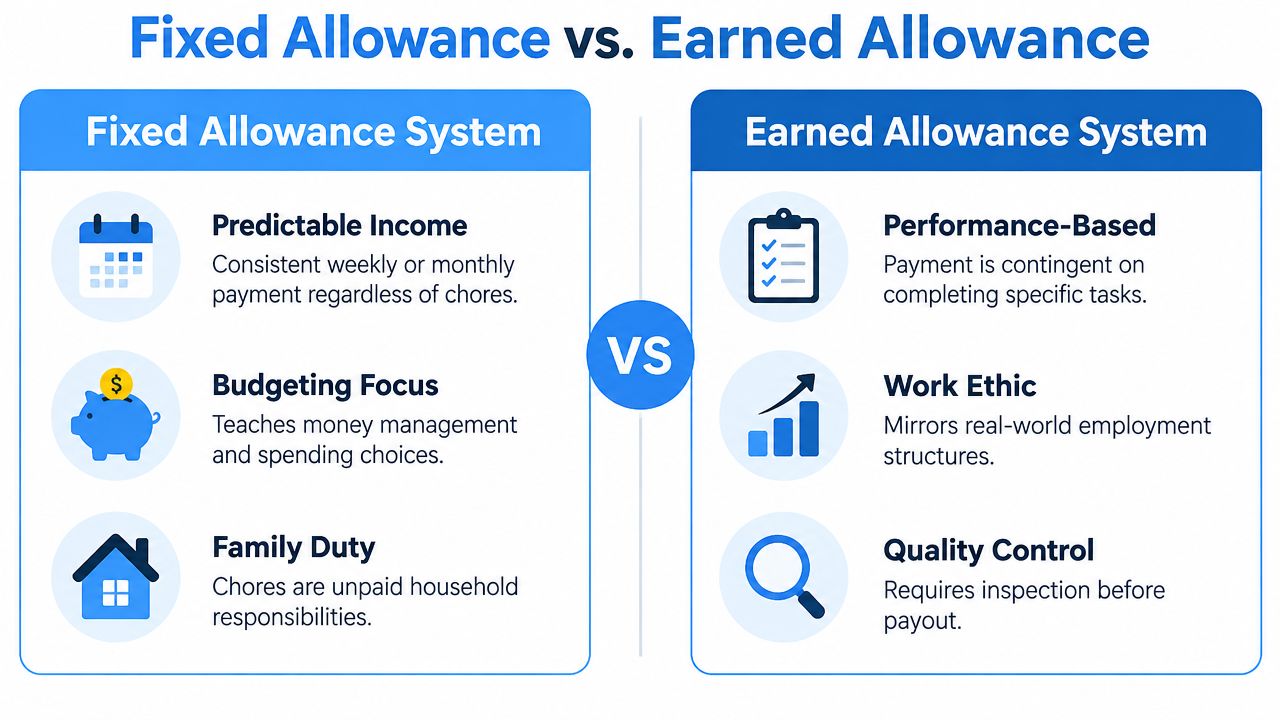
The earned allowance model connects payment directly to completed chores. A child receives money only after finishing an agreed list to the expected standard. That makes the relationship between effort and income easy to understand, but it also means parents must inspect work, resolve disagreements, and avoid turning every household contribution into a negotiation.
A younger child might earn $10 per week for washing dishes, sorting laundry, and helping with yard work. A teenager could receive $50 per month for keeping a room to inspection standards and contributing to general cleaning. Siblings can also pool their earnings toward a shared purchase while recording each contribution separately, so cooperation doesn't erase individual accountability.
Make the agreement visible
Post the chores, payment amounts, deadlines, and quality standards where everyone can see them. Explain what “done” means before the first payment, then give feedback promptly. If a task takes longer because a child is still learning, adjust the expectation rather than penalizing the learning process.
A tiered system can work well. Basic completion earns the standard amount, while careful or unusually thorough work earns a clearly defined bonus. Voice or app logging also helps settle the familiar “I already did it” dispute by creating a record during the week.
Practical rule: Pay for completed work, not vague intentions. Keep the standard predictable, fair, and achievable.
Use FloosYo to record each payment and show how weekly earnings project over a month or a year. That view turns a single chore payment into a visible lesson about consistency. The weakness is administrative effort. If parents don't update the list or inspect work consistently, children quickly learn that the system is negotiable.

2. The Fixed Allowance System
A fixed allowance separates money management from household labor. Children receive a regular amount whether or not they complete chores, while chores remain expected responsibilities of family membership. This model works best when the primary lesson is spending, saving, prioritizing, and living with the consequences of limited funds.
A 10-year-old might receive $8 each week for snacks, small toys, or entertainment. A teenager might receive $60 each month for personal items such as phone credit, streaming subscriptions, or social activities. Families can use age-based amounts, such as $2 for a 6-year-old, $5 for a 10-year-old, and $15 for a 14-year-old each week, provided the amounts fit what each child is expected to manage. These examples are practical starting points, not universal rates.
Separate duties from decisions
Pay on the same day and at the same time. Consistency gives children a predictable planning rhythm. Explain that dishes, tidying, and basic contributions aren't optional paid work, then let the child make genuine choices with the allowance.
Don't rescue every poor decision. If the money runs out, waiting until the next payment can teach more than a lecture, provided the child still has access to necessities. Track the allowance as recurring income in FloosYo and show the monthly and annual total. A savings goal makes the trade-off concrete, especially when the child sees how skipping discretionary spending moves the target closer.
For a simple physical version of the same habit, parents can use this guide to making an envelope for money. The main risk is that children may not connect money with effort. The model addresses that by making chores a separate, clearly explained expectation rather than removing responsibilities.
3. The Hybrid Allowance and Chores Model
The hybrid model is often the most flexible because it distinguishes between baseline membership money and optional extra work. Every child receives a core allowance, while more demanding, seasonal, or additional chores provide opportunities to earn more. Children learn that not every family responsibility has a price, but extra effort can increase available spending money.
A family might provide a $10 weekly base allowance, then offer $8 for washing a car, $6 for deep-cleaning a bathroom, or $10 for organizing a garage. Another household might provide a $15 monthly base allowance and pay $3 to $5 per optional task such as washing windows or sorting a pantry. Spring cleanup and holiday decorating can create temporary opportunities without changing the year-round baseline.
Show the two income streams
Write two lists. The first contains unpaid chores everyone is expected to complete. The second contains paid extras, with prices that reflect time, difficulty, and supervision. Allow children to propose tasks outside the menu, but agree on the rate before the work begins.
FloosYo can record base allowance and optional earnings separately. Voice logging lets a child record a completed extra task before asking for payment, reducing forgotten work and repeated arguments. Monthly projections are especially useful here because the base is predictable while extra income varies.
The trade-off is complexity. Two lists require maintenance, and children may focus only on paid extras while neglecting basic duties. Review the lists together and keep the distinction firm.
4. The Chore-Chart Incentive System
Points, stickers, and tokens can motivate younger children without making cash the reward for every task. The child completes a chore, marks visible progress, and exchanges accumulated points for predetermined privileges or experiences. The system emphasizes habit formation and follow-through rather than a direct labor-to-cash transaction.
A kitchen chart might award one sticker for each daily task, with five stickers leading to a movie night and 10 stickers leading to a trip to the park. An app could assign 10 to 50 points per chore, with 200 points earning a video game night or special dessert. Another structure might give one point for daily chores, five for a weekly deep-cleaning task, and 25 points for the child to choose dinner.
Keep progress immediate
Put the chart in a hallway or kitchen where the child sees it every day. Offer a mix of quick rewards and delayed rewards, then refresh the options periodically so the system doesn't become background decoration. Celebrate the milestone itself, not just the prize.
Voice reminders or simple notifications can prompt morning routines, after-school tasks, or bedtime preparation. As children grow older, introduce small cash decisions alongside the chart rather than abandoning the habit system abruptly. The principal weakness is that points don't teach budgeting unless parents add a separate money routine. A child may become excellent at collecting stickers without learning to compare wants, save for a goal, or track spending.
For a broader visual explanation of chore-based routines, this short chore-chart video can help parents discuss the approach with younger children. Use it as a conversation starter, then design rewards around your own household rather than copying someone else's chart.
5. The Responsibility-Based Allowance System
This approach bundles chores into the broader idea of being a dependable family member. Children receive regular money because they're expected to contribute, but payment isn't calculated task by task. The family sets an ongoing rotation, reviews overall reliability, and avoids making every dish or load of laundry feel like a commercial transaction.
A 12-year-old might receive $12 weekly while keeping a room tidy, helping with dishes, and contributing on weekends. A teenager might receive $40 monthly while rotating between laundry, yard work, and kitchen duties. Some families reserve a reduction of 25% for serious, repeated lapses rather than taking money away for one missed task.
Define responsibility before paying
Sit down on a clear start date and define what responsible contribution means. List recurring chores, explain the rotation, and make clear that children will take turns rather than own one task permanently. Pay on schedule when expectations are broadly met, then use a monthly conversation to address patterns.
Praise specific behavior, such as completing dishes without a reminder. That reinforces dependability instead of encouraging children to calculate the price of every action. FloosYo can show how regular allowance supports a savings goal and turns reliable contributions into a planning habit. This guide to setting savings goals can support that conversation.
The model's strength is its tone. It reinforces family membership and accountability together. Its weakness is ambiguity. If parents don't define what counts as a serious lapse, children may see reductions as arbitrary. Write the expectations down and apply them consistently.
6. The Negotiated Chore-Rate System
Negotiated rates turn allowance into a structured conversation about value, effort, skill, and changing circumstances. Parents and children agree on prices, record them, and review the arrangement at predictable times. The child gains agency, while the parent keeps responsibility for deciding what the household can actually afford.
A quarterly review might involve a child proposing $8 for washing the car, a parent countering with $6, and both agreeing on $7 after discussing time and difficulty. When a teenager becomes capable of more complex work, the family can add new tasks and revise old rates. The point isn't to reproduce a labor market at home. It's to make the reasoning behind payment visible.
Negotiate with evidence
Choose review points such as the start of a school year, summer break, or another recurring family date. Bring a record of completed tasks and previous earnings, then ask the child to explain why a raise is justified. A stronger argument might involve additional time, greater skill, or responsibility for a task the child previously couldn't handle.
Write the final rates down, and save a photo so nobody relies on memory. Explain household constraints plainly without exposing children to adult financial anxiety. If the family needs to reduce optional spending, discuss which tasks remain worthwhile and which can wait.
Avoid punishment-based rate cuts. A negotiated system works when the rates feel stable enough to plan around. Serious repeated irresponsibility can trigger a separate consequence, but changing the price after work is completed destroys trust. The trade-off is time. These conversations take longer than announcing a fixed amount, yet they teach children to support requests with reasons rather than demands.
7. The Consequence-Based Allowance Reduction System
This model starts with a baseline allowance and reduces it when a child neglects responsibilities or breaks clearly stated rules. Unlike earned allowance, payment isn't conditional from the beginning. Unlike the responsibility-based model, the consequence schedule is explicit and financial.
A child might receive $20 weekly, with $2 removed for a missed chore and $5 for a serious rule violation. A teenager might receive $50 monthly, losing $3 for a missed weekly rotation or $10 for a defined breach such as ignoring an agreed curfew. A household could apply a 50% reduction after three or more missed days in one week, while restoring the full amount the following week when responsibilities are met.
Make recovery possible
Post the reduction schedule before using it. Minor lapses should have small, proportional consequences, while serious repeated irresponsibility can carry a larger reduction. Track the starting amount, each reduction, and the remaining balance so the child can see a path back to the full allowance.
Distinguish an honest mistake from deliberate defiance. A reminder may be enough for the first, while a known refusal may justify the stated consequence. Voice or app logging helps record completed work and reductions close to the event, rather than reconstructing the week from memory.
A consequence should teach recovery, not convince a child that success is impossible.
Review the system monthly. If the child keeps losing money and has stopped trying, the schedule is too harsh or the expectations aren't realistic. The model can teach accountability, but it fails when parents use deductions impulsively, add new penalties after the fact, or connect money to unrelated behavior without warning.
7-System Allowance & Chores Comparison
| System | Implementation complexity 🔄 | Resource requirements ⚡ | Expected outcomes 📊⭐ | Ideal use cases 💡 | Key advantages ⭐ |
|---|---|---|---|---|---|
| The Earned Allowance System | Medium–High; requires chore lists, inspections | Moderate; regular parental oversight and tracking | Strong work-ethic & accountability; reinforces task→pay (⭐⭐⭐⭐) | Teaching link between work and income; school-age children | Clear task→payment mapping; motivates quality; real-world mirror |
| The Fixed Allowance System | Low; set-and-forget schedule | Low; routine payments, minimal tracking | Improves budgeting and planning; weak work-for-pay lessons (⭐⭐⭐) | Teaching budgeting/financial planning; younger children | Predictable income; reduces chore-payment conflict; simple admin |
| Hybrid Allowance + Chores Model | High; manage base + optional paid tasks | Moderate; track base allowance and extras | Balances membership and earning; encourages extra effort (⭐⭐⭐⭐) | Families wanting stability plus incentives; mixed-age households | Stability + performance rewards; flexible earning opportunities |
| Chore-Chart Incentive System | Low; visual chart or app upkeep | Low; chart, stickers or app, occasional rewards | Builds habits and intrinsic motivation; not cash-focused (⭐⭐⭐) | Young children, habit formation, visual learners | Visual progress tracking; low cash handling; fun engagement |
| Responsibility-Based Allowance System | Medium; define expectations and rotation | Low; communication and periodic reviews | Fosters belonging and steady responsibility; less pay-for-performance (⭐⭐⭐) | Emphasizing family membership and shared duties | Avoids transactional dynamics; simplifies expectations |
| Negotiated Chore-Rate System | High; scheduled negotiations and documentation | Moderate; prep time, record-keeping | Teaches negotiation and market reasoning; agency (⭐⭐⭐⭐) | Teens learning negotiation/finance; families open to collaboration | Builds negotiation skills; transparent and adaptable rates |
| Consequence-Based Allowance Reduction System | Medium; set deduction rules and enforcement | Moderate; monitor behavior and record reductions | Teaches consequences via pay loss; risk of resentment if harsh (⭐⭐⭐) | Emphasizing accountability while keeping baseline allowance | Mirrors real-world pay loss; flexible, restorable consequences |
Next Steps Choose, Track, and Refine Your System
Start with the behavior you want to develop. Choose earned allowance if you want a direct work-to-income lesson. Choose fixed allowance if you want children to practice spending and saving while chores remain family responsibilities. Choose the hybrid model when you want both principles in the same household. Younger children may respond better to visible points, while older children can handle negotiated rates, responsibility-based expectations, or carefully defined consequences.
Write the system down before introducing it. Include the payment schedule, chore standards, optional tasks, savings expectations, and what happens after a missed responsibility. A child shouldn't have to guess whether payment depends on quality, completion, or overall dependability.
Use FloosYo to make the money side visible. Log allowance as income, separate baseline payments from extra earnings, record reductions, and project the total across a month or year. A child who sees that regular contributions create a larger future balance can connect today's routine with a concrete goal. Voice entry is useful when a quick spoken record is more realistic than opening a spreadsheet.
Review the arrangement monthly. Ask three questions: Are the chores appropriate for the child's age and ability? Does the payment or reward encourage the behavior you actually value? Can the child explain where the money is going and what they want it to accomplish?
Evidence also supports caution about treating chores as a complete financial-education system. OECD/PISA research summarized in this coverage of chores and financial literacy found that receiving allowance or pocket money for regularly doing chores was associated with lower financial-literacy performance in participating countries and economies after student characteristics and money experiences were controlled. The practical lesson isn't that paid chores always fail. It is that parents should pair payment with conversations, goal-setting, spending decisions, and reflection.
A strong routine is simple enough to run every week and explicit enough to survive disagreement. Track the work, show the projection, and adjust when the child grows. Over time, allowance and chores become more than a reward system. They become repeated practice in responsibility, choice, and planning.
FloosYo connects to your bank, identifies recurring spending, and shows monthly and yearly projections before the next charge arrives, while voice entry lets you log allowance, chores, and other money the bank can't see. Visit FloosYo to track family income, set a savings goal, and turn consistent allowance decisions into visible progress.