
Renting can reduce upfront cash needs, maintenance exposure, and commitment risk. In Zillow's reported 2026 analysis, renting was cheaper than buying in every major U.S. market measured, with average savings of $1,066 per month, but the better choice still depends on comparing the complete annual cost of both options.
The popular advice says to compare rent with a mortgage payment and stop there. That shortcut misses the money tied up before purchase, repairs, property taxes, insurance, depreciation, renewal increases, moving costs, and the cost of leaving. It can also miss the recurring charges that make a rental arrangement more expensive than it first appears.
A sound comparison totals the yearly outflow on both sides. For renting, include the payment, required coverage, fees, deposits, utilities or services not included, and likely renewal or exit costs. For ownership, include the full cash commitment, maintenance, taxes, insurance, and the financial risk of selling or disposing of the asset.
FloosYo supports that comparison from the spending side. It can detect recurring charges, accept voice or text entries for expenses a bank connection doesn't capture, project monthly and yearly totals, and prompt a concrete decision before the next charge. That decision might be to skip, stop, downgrade, renegotiate, or monitor the commitment.
Table of Contents
- 1. Lower Monthly Cash Outflow Through Visibility
- 2. No Maintenance, Repair, or Upkeep Costs
- 3. Flexibility to Upgrade, Downgrade, or Exit Without Penalty
- 4. Reduced Risk from Obsolescence or Wear
- 5. Easier Budgeting and Cost Predictability
- 6. No Property Taxes, Licensing, or Registration Fees
- 7. Reduced Insurance and Liability Exposure
- 8. Ability to Cancel or Reduce Spending Without Sunk-Cost Loss
- 8-Point Rental Advantages Comparison
- Turn Rental Flexibility Into a Yearly Decision
1. Lower Monthly Cash Outflow Through Visibility
Renting does not automatically cost less overall. Its clearest cash-flow advantage is often timing: you avoid committing a large sum before knowing how long you will need the asset or location. Buying can concentrate cash in a down payment, closing costs, or equipment acquisition. Renting distributes that commitment across scheduled payments.
That distribution can preserve liquidity for emergency reserves, regular bills, or a planned move. The Federal Reserve housing findings report that 46% of renters said renting was cheaper than owning, while 58% said it was more convenient and 47% said ownership carried greater financial risk. These responses do not establish that every lease is cheaper, but they show why monthly cash flow and risk should be assessed alongside the advertised price.
The practical test is simple: calculate how much leaves your account this month, then project the commitment across a full year. Include deposits, fees, services not covered by the payment, renewal changes, and exit costs before comparing the result with ownership.
Make the payment visible before it renews
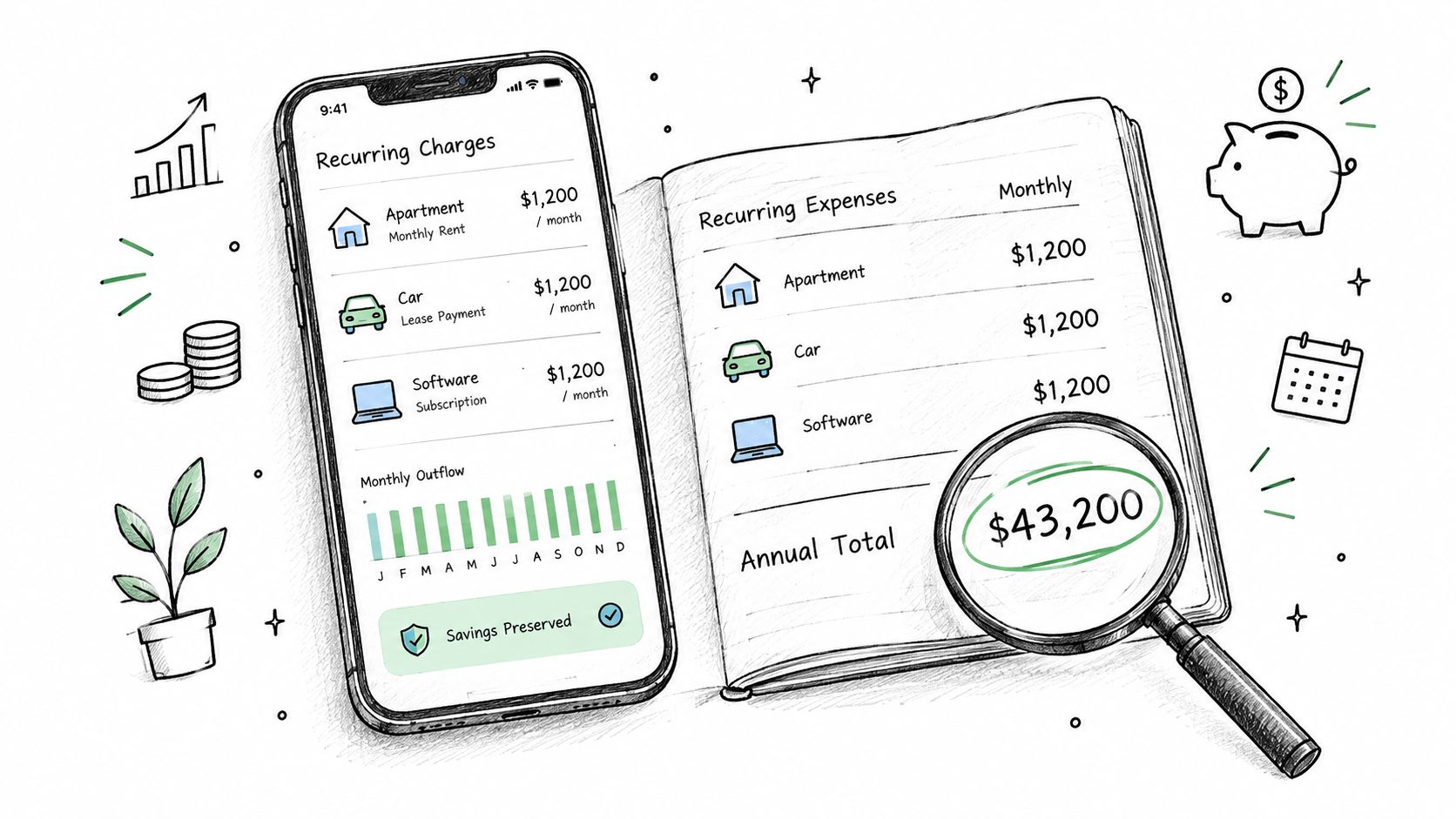
FloosYo can place apartment rent, a car lease, equipment rental, and recurring software charges in one view. Bank connections can capture regular payments, while voice or text entries can record deposits, fees, and charges that transaction descriptions do not identify clearly. A cash flow forecasting app can convert those records into monthly and annual projections instead of leaving the review until after money has gone out.
Compare the rental projection with the ownership alternative. If you stop an equipment rental you no longer need, record the avoided payment as a defined saving and assign it to an emergency reserve or upcoming move. The improvement comes from acting on the freed cash, not merely from seeing a lower recurring charge.
2. No Maintenance, Repair, or Upkeep Costs
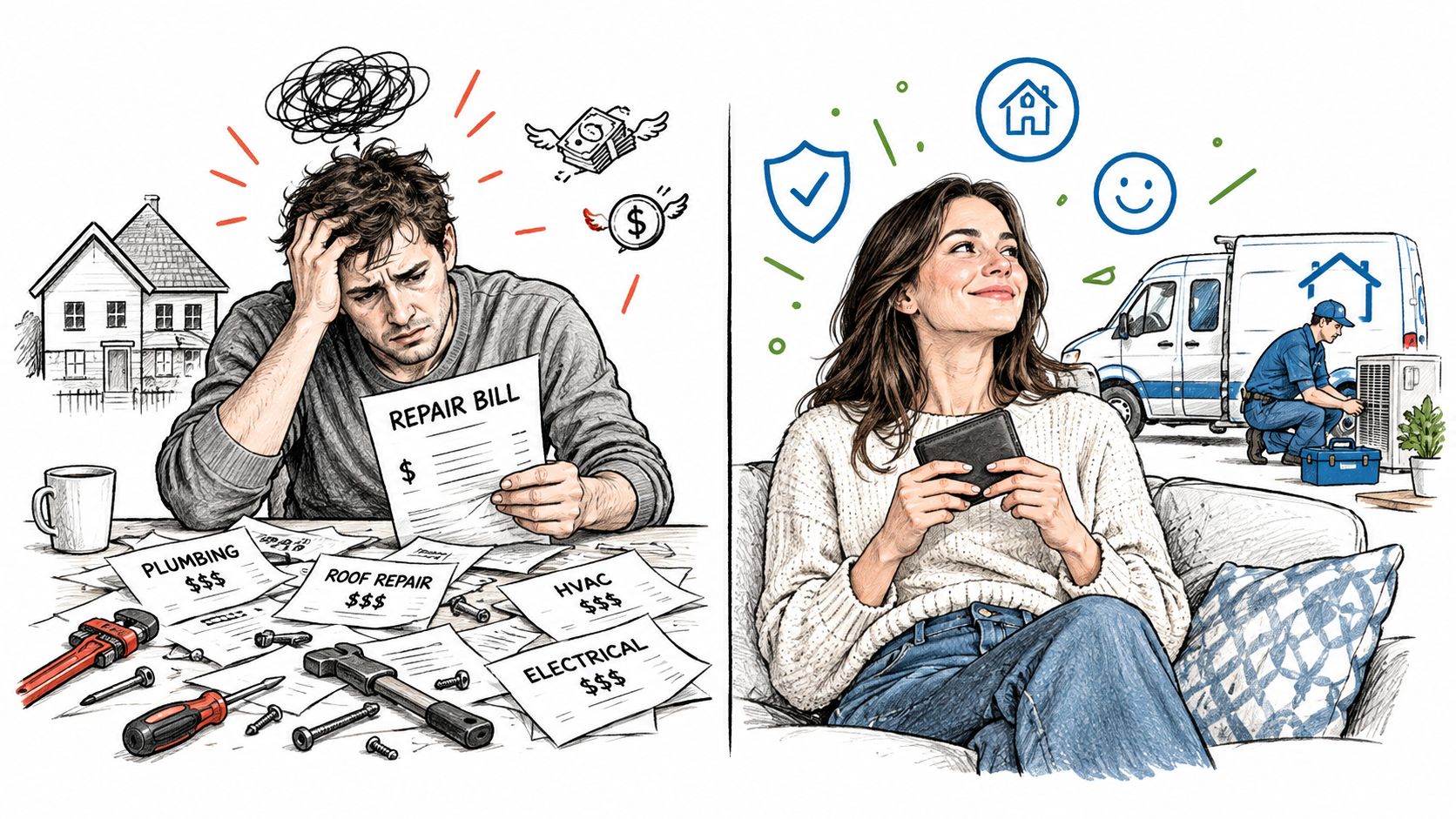
A rental can shift a major source of cost uncertainty from the renter to the owner or service provider. Depending on the agreement, the renter may avoid paying for structural repairs, appliance replacement, equipment servicing, or major mechanical failures. The contract determines the result: some leases assign limited maintenance duties to the renter or charge for damage caused by misuse.
The Financial Planning Association review notes that renters may face less uncertainty because landlords usually handle repair and maintenance costs. For a household with uneven income, avoiding one sudden ownership expense can matter more than a small difference between scheduled monthly payments.
Maintenance is still part of the rental price. A provider may build expected upkeep into rent, service fees, or the equipment rate. The renter should check exclusions, deductibles, damage rules, response commitments, and any separate charges before treating the arrangement as a saving.
FloosYo can record the recurring rental payment alongside occasional service charges and project both across a full year. Compare that annual rental outflow with the ownership alternative, including a realistic reserve for repairs. If the contract excludes an appliance failure or charges for a service visit, record that exposure rather than assuming the monthly payment covers it.
Document an apartment, vehicle, or rented item's condition at the start with dated photos and written notes. Report problems promptly in writing, and keep the agreement available when deciding whether a charge is legitimate. Those records can prevent an avoidable dispute from becoming an unexpected outflow.
Practical rule: Count maintenance as a rental advantage only when the contract assigns the cost and responsibility to someone else.
The value is usually steadier cash flow, not free upkeep. A renter may pay a predictable scheduled amount, while an owner must keep funds available for repairs that arrive irregularly and at inconvenient times. Review the contract at renewal, then update the yearly projection if coverage, fees, or responsibilities change.
3. Flexibility to Upgrade, Downgrade, or Exit Without Penalty
Renting can make a changing life easier to finance. A tenant can choose a different home when a lease ends, a driver can return a vehicle at the end of its contracted term, and a service user can cancel between billing cycles. Ownership usually requires a sale, transfer, disposal process, or acceptance of a loss before the next arrangement begins.
Flexibility has a financial value that a simple monthly comparison misses. A worker who may relocate can avoid concentrating cash in an asset that becomes difficult to sell. A household whose space needs change can consider a smaller or larger rental without carrying the full cost of an unwanted purchase.
The contract still controls the outcome. Early termination fees, notice periods, mileage limits, cleaning requirements, deposits, and restoration obligations can turn an apparently flexible arrangement into an expensive exit.
Decide before the renewal date
FloosYo can attach renewal reminders to an apartment lease, car lease, cloud service, or streaming subscription. Before the charge arrives, use the skip or stop decision to model what happens if you cancel, downgrade, or leave. For a large rental, record the lease-end date as a planning event rather than treating it as an administrative detail.
A practical review asks:
- Does the arrangement still fit? Compare current use with the original reason for renting.
- What does exit cost? Check notice rules, fees, deposits, and transport or replacement expenses.
- What does staying cost? Include a new rate, added services, and another full renewal period.
- What does changing save? Use the projected difference, then assign it to one savings goal.
Renting is strongest when the option to move, reduce, or replace has genuine value. If the provider imposes heavy exit costs or the renter repeatedly renews without reviewing the terms, much of that advantage disappears.
4. Reduced Risk from Obsolescence or Wear
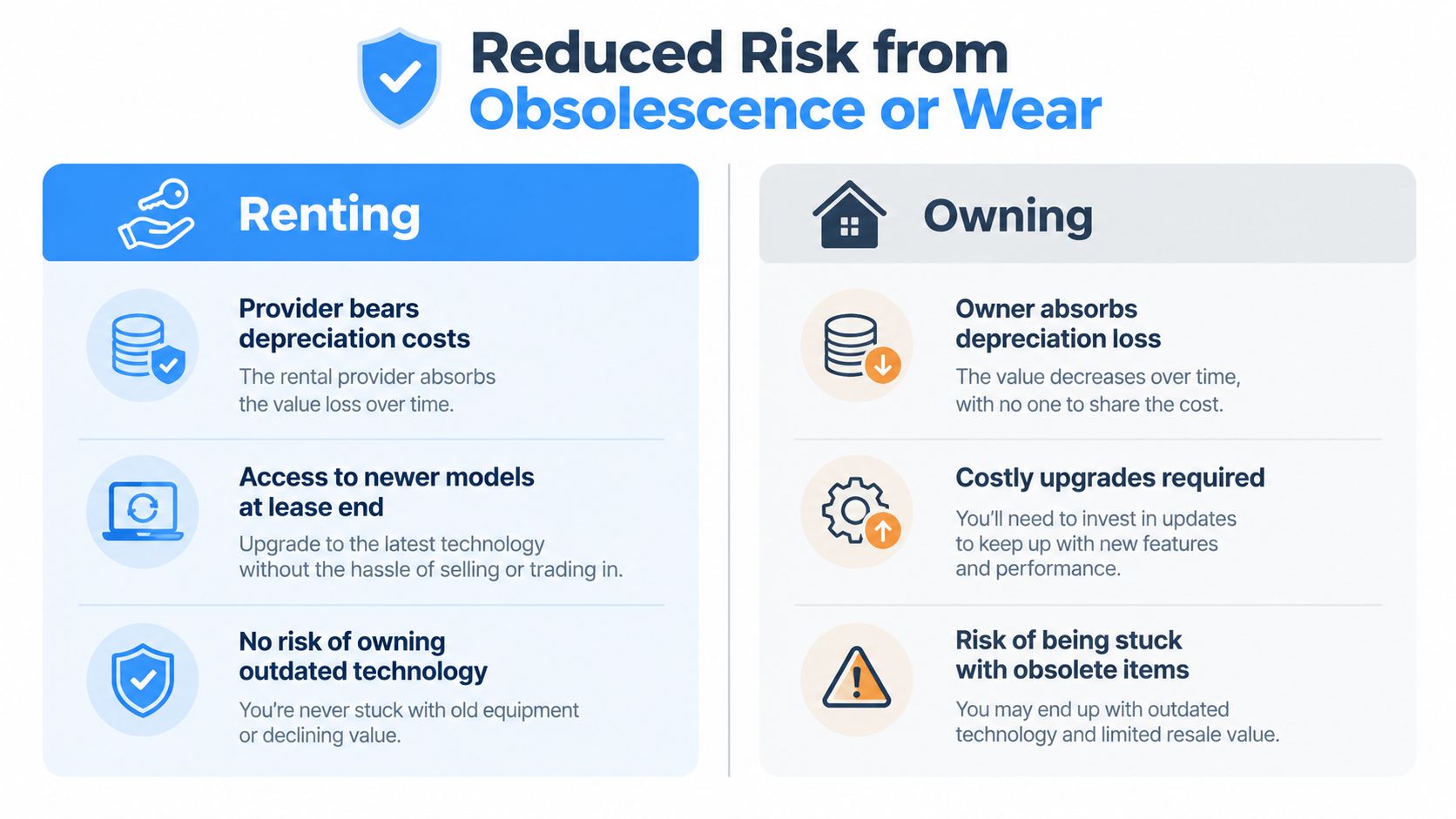
Ownership makes the renter or buyer responsible for what happens after the purchase. The asset can become outdated, inefficient, damaged, or difficult to resell, even when it still works. Renting limits that exposure because the user can return the asset under the agreement and choose a newer arrangement later.
This is especially relevant for technology, vehicles, and specialized equipment. A company that rents equipment for occasional work avoids storing and maintaining an item that sits unused. A driver may prefer a contracted vehicle term rather than managing resale value and the deterioration of an older car.
The trade-off is that the renter doesn't own the residual value. A purchase can retain useful value, while a rental ends with no asset to sell unless the agreement includes a purchase option. The comparison therefore needs to consider use, replacement frequency, and disposal risk rather than assuming that “newer” always means cheaper.
Compare the whole replacement cycle
Use FloosYo's yearly projection to place rental payments beside the likely ownership cycle. Include the purchase outflow, maintenance, replacement, and disposal costs on the ownership side. For the rental side, include renewal increases, required fees, usage limits, and any end-of-term charge.
A software subscription may keep a current version available, but its recurring charge continues even when the service is used lightly. An owned tool may become inefficient, yet it can remain available for occasional work. The better choice depends on whether continuous access, flexibility, and lower obsolescence exposure justify the repeated payment.
Renting reduces the risk of being stuck with an outdated asset. It doesn't remove the need to evaluate how often you replace it.
Set a reminder before the renewal date of a device, vehicle, or software service. At that point, choose among continuing, downgrading, stopping, or switching. A renewal decision made before billing is more useful than discovering the annual cost after the charge has posted.
5. Easier Budgeting and Cost Predictability
Renting is not automatically predictable or cheaper. Its budgeting advantage depends on separating the scheduled payment from costs outside the agreement. Apartment rent may stay fixed during a lease, a vehicle lease can hold one payment for its term, and cloud storage may renew at the same amount. Utilities, insurance, deposits, service fees, usage charges, and renewal increases can still change the annual total.
Housing affordability also varies by household. Earlier comparisons show why a lower fixed commitment can preserve monthly cash flow for people managing tight budgets, but the rental payment still needs to be tested against the full ownership outflow.
Project recurring commitments annually
FloosYo can detect recurring charges and project their monthly and yearly totals before the next billing event. That view matters because stated estimates often miss subscriptions. One analysis found that people estimated $86 per month, while itemized spending averaged $219, a gap of $133 per month, or about $1,596 per year (subscription spending analysis).
Record the rental payment alongside renters insurance, parking, storage, equipment, and digital services. Separate the charges that belong to the rental decision from general household spending, then compare the combined yearly outflow with the ownership alternative.
The same method applies to household connectivity. A 2025 consumer-spending analysis reported average monthly totals of $68.36 for internet, $57.96 for mobile, $101.11 for TV, and $51.71 for streaming, totaling $279.14 per month and $3,349.67 per year (consumer recurring-cost analysis). Use this spending-tracking guide to identify overlooked charges and decide which recurring commitments to cancel, reduce, or retain.
Review the projection before renewal. A predictable payment is useful only when the renter checks the full yearly cost and acts before a new term creates another commitment.
6. No Property Taxes, Licensing, or Registration Fees
Renters often avoid paying ownership-specific taxes and administrative fees directly. An apartment tenant generally doesn't receive the property-tax bill for the building, and a person renting equipment may not handle the ownership registration associated with that asset. The provider may include those costs in the price, so “avoided” doesn't mean “free.”
This distinction improves the comparison. A buyer's scheduled payment isn't the complete ownership outflow if taxes, registration, licensing, local fees, or similar obligations arrive separately. A renter's payment may look more expensive until those fragmented ownership charges are added to the annual total.
The responsibility varies by contract and jurisdiction. Vehicle leases, commercial rentals, and equipment agreements can allocate taxes and registration differently, and some charges may appear as separate line items.
Put the provider's costs on the correct side
When comparing an apartment with a purchase, list the ownership taxes and fees as annual expenses rather than mentally treating them as part of the payment. Then examine the rental agreement for pass-through charges, tax adjustments, administrative fees, or renewal clauses connected to the provider's costs.
FloosYo can record the recurring rental payment and capture additional outflows through voice or text when the bank connection doesn't identify them cleanly. Create a yearly projection that includes every charge the renter pays. Don't label the provider's tax burden as a saving unless the contract confirms that the renter won't pay it separately.
A useful review at renewal asks whether the new price reflects a changed service level or merely a higher cost of maintaining the same arrangement. If the increase makes the rental less attractive, compare a move, downgrade, or different provider before accepting another term.
The advantage is administrative simplicity and fewer direct ownership obligations. It becomes meaningful only after the renter checks what has been included, passed through, or excluded.
7. Reduced Insurance and Liability Exposure
Renting can reduce the scope of insurance and liability a user must arrange, particularly when the rented asset is part of a larger property or service arrangement. An apartment renter may insure personal belongings and personal liability, while the building owner carries coverage for the structure. An equipment provider may handle some servicing or liability requirements under the contract.
That doesn't eliminate risk. A renter can still be responsible for damage caused by negligence, lost equipment, excluded events, or claims that exceed the policy. Required coverage, deductibles, and exclusions deserve the same attention as the rental payment.
The comparison should therefore distinguish between lower responsibility and no responsibility. If a renter's policy is required, include it as a recurring cost. If the provider includes coverage, confirm exactly what it protects and whether the renter remains exposed to a deductible or excess charge.
Track coverage beside the rental
Add renters insurance, vehicle coverage, equipment protection, or other required policies to FloosYo alongside the rental payment. The app's monthly and yearly projections make a small recurring premium visible in the same view as the larger commitment. Pre-charge notifications can also support an annual policy review before automatic renewal.
Ask the provider:
- What does the contract cover? Identify the building, asset, contents, liability, and damage responsibilities.
- What remains mine? Check deductibles, exclusions, limits, and intentional or accidental damage rules.
- When does coverage renew? Set a reminder early enough to compare terms and cancel lawfully if needed.
- What happens after a loss? Understand replacement, repair, return, and excess obligations before signing.
A renter can benefit from a narrower insurance obligation, but the value comes from matching coverage to actual exposure. Paying for overlapping protection is another recurring drain worth reviewing before renewal.
8. Ability to Cancel or Reduce Spending Without Sunk-Cost Loss
Renting gives users a cleaner stopping point than ownership. If a rented service no longer delivers enough value, the user can often stop at the end of a billing period rather than sell an asset, absorb depreciation, or accept a disposal loss. Contract terms still matter, especially for leases with fixed terms or early termination penalties.
This advantage is partly financial and partly behavioral. People keep paying for recurring services because the charge is easy to miss, the cancellation process takes effort, or the original purchase creates a feeling that they must keep using what they already paid for.
Recurring charges are particularly easy to lose track of. 74% of respondents said monthly subscription charges are easy to forget, and 42% said they had stopped using a subscription while still paying for it (recurring-charge survey). Another survey found that 35% of Americans had enrolled in automatic payments without fully realizing it (automatic-payment survey).
Turn cancellation into a measured action
FloosYo can show the projected saving from skipping or stopping a recurring charge, then record that amount in a savings goal. Its renewal reminders create a decision point before billing, while voice or text entry helps capture a service that doesn't appear clearly in the bank feed.
Use this subscription-management guide when reviewing cancellation timing and recurring commitments. For each rental or subscription, decide whether to continue, monitor, downgrade, skip a cycle, or stop. The goal isn't to cancel everything. It's to stop paying for commitments that no longer match current use.
A renter should also check deposits, notice requirements, return conditions, and final bills. The absence of a resale loss doesn't guarantee a cost-free exit, but it can make the decision more direct than unwinding ownership.
8-Point Rental Advantages Comparison
| Item | 🔄 Implementation complexity | ⚡ Resource requirements | ⭐ Expected outcomes | 📊 Ideal use cases | 💡 Key tips |
|---|---|---|---|---|---|
| Lower Monthly Cash Outflow Through Visibility | 🔄 Low, connect accounts & log rents | ⚡ Low, preserves upfront capital | ⭐⭐⭐⭐ Preserve liquidity; smoother monthly cash flow | Renters, subscription-heavy users, cash-constrained households | 💡 Log all rentals; use yearly projections; set renewal reminders |
| No Maintenance, Repair, or Upkeep Costs | 🔄 Low, choose rentals, minimal admin | ⚡ Low, avoids large repair capital & time | ⭐⭐⭐⭐ Eliminates surprise repair expenses | Tenants, car lessees, equipment renters | 💡 Document condition at start; read maintenance clauses; report issues promptly |
| Flexibility to Upgrade, Downgrade, or Exit Without Penalty | 🔄 Moderate, monitor contracts and timings | ⚡ Medium, time to switch; possible fees | ⭐⭐⭐⭐ High adaptability to changing needs | Short-term movers, growing/shrinking households, service testers | 💡 Review exit clauses; model cancel/upgrade costs; set renewal alerts |
| Reduced Risk from Obsolescence or Wear | 🔄 Low, no disposal or resale logistics | ⚡ Low, avoids depreciation losses | ⭐⭐⭐⭐ Maintain access to current models; lower obsolescence risk | Tech users, fleets, rapidly evolving equipment | 💡 Compare multi‑year rental vs purchase; track renewal dates |
| Easier Budgeting and Cost Predictability | 🔄 Low, fixed payments simplify tracking | ⚡ Low, predictable monthly outflows | ⭐⭐⭐⭐ Better forecasting; fewer surprise bills | Households needing stable budgets; finance planners | 💡 Connect accounts; enable alerts; review at renewals |
| No Property Taxes, Licensing, or Registration Fees | 🔄 Low, taxes handled by owner/lessor | ⚡ Low, avoids annual tax & fee cash flows | ⭐⭐⭐ Significant annual savings where applicable | Apartment renters, leased vehicles, equipment renters | 💡 Add estimated taxes when comparing renting vs buying; check for lease pass-throughs |
| Reduced Insurance and Liability Exposure | 🔄 Low, simpler insurance needs | ⚡ Low, lower premiums; bundled coverage possible | ⭐⭐⭐ Lower insurance cost and liability exposure | Renters, lessees, low-liability occupants | 💡 Factor renters insurance into budget; review coverage annually |
| Ability to Cancel or Reduce Spending Without Sunk-Cost Loss | 🔄 Low, cancel at term or short notice | ⚡ Low, immediate stop to recurring costs | ⭐⭐⭐⭐ Enables decisive cost-cutting and reduces sunk‑cost bias | Subscription users, trialers, cost-cutters | 💡 Use skip/stop tools; set renewal reminders; log freed funds to savings goals |
Turn Rental Flexibility Into a Yearly Decision
The advantages of renting become persuasive when they survive a complete annual comparison. Start with the rental payment, then add required insurance, utilities or services not included, deposits or fees, renewal increases, usage limits, and likely exit costs. For a home, include the costs attached to the lease. For a vehicle or equipment rental, include mileage, service, return, and replacement conditions.
Then build the ownership side without using the mortgage or purchase payment as a shortcut. Include the upfront capital commitment, maintenance, insurance, taxes, licensing, registration, depreciation, resale uncertainty, and disposal or selling costs. Ownership can create long-term value, but that value isn't the same as monthly cash flow, and it doesn't remove the need to fund repairs or absorb market risk.
The broader evidence supports a balanced conclusion. Renting has historically been a major housing choice in the United States. The American Historical Association records that only about 37 out of every 100 nonfarm families owned their homes in 1890, rising to 41 out of 100 in 1920 and 46 out of 100 in 1930 (American Historical Association housing history). Renting isn't a new fallback. It has long served households that value mobility, access, and lower responsibility over direct ownership.
Current market evidence also shows why the decision must remain local and personal. Reported Zillow analysis found renting cheaper than buying in all 50 of the largest U.S. markets, with a typical monthly gap of $1,066, while 39.2% of rental listings offered concessions (rental market coverage). Those figures describe a market benchmark, not a promise for your lease. A renter still needs to check rent increases, concessions that expire, fees, location, stability, and the value of having ownership equity.
Renting is strongest when flexibility, predictable outflows, and reduced responsibility matter more than long-term ownership value. It can also support a stronger balance sheet when a renter intentionally redirects verified savings toward emergency reserves, debt repayment, or another defined priority. The discipline is in redirecting the difference, not merely spending it elsewhere.
Use FloosYo as a yearly decision system. Connect the bank, add unseen expenses by voice or text, review monthly and annual projections, set renewal reminders, and test skip or stop scenarios before charges land. When a decision frees cash, route the verified saving toward one goal at a time so the advantage becomes visible instead of disappearing into ordinary spending.
FloosYo connects recurring charges to monthly and yearly projections, accepts voice or text entries for expenses your bank feed misses, and reminds you before renewals. Visit FloosYo to compare rental commitments, act on overlooked charges, and track the savings created by each skip, downgrade, or cancellation.