
The most popular advice about 30-day challenges is also the least reliable: complete a month and you'll have a permanent habit. Real behavior change doesn't follow a universal deadline. A foundational study by Phillippa Lally and colleagues followed university volunteers for approximately 12 weeks and found that reaching 95% of an individual's eventual automaticity took a median of 66 days, with modeled times ranging from 18 to 254 days (Lally et al.). A 2024 review likewise found median or mean habit-formation times varied by measurement method, with medians from 59 to 66 days, means from 106 to 154 days, and individual results spanning approximately 4 to 335 days (systematic review and meta-analysis).
That makes a 30-day challenge more useful, not less. Treat it as a focused experiment with one repeatable daily task, one clear progress measure, and a review point on day 30. The strongest ideas below use three practical lenses: spending control, recurring-cost reduction, and sustainable routines. Reminders, home-screen widgets, voice entry, and a specific savings goal reduce the friction between noticing a decision and recording it.
Table of Contents
- 1. 30-Day Subscription Audit
- 2. 30-Day No-Spend Challenge
- 3. 30-Day Meal Prep Mastery
- 4. 30-Day Digital Detox Challenge
- 5. 30-Day Transport Optimization Challenge
- 6. 30-Day Utility and Energy Reduction Challenge
- 7. 30-Day Mindful Spending Challenge
- 8. 30-Day Skill Monetization Challenge
- 9. 30-Day Debt Payoff Acceleration Challenge
- 10. 30-Day Habit Stacking for Saving
- 11. 30-Day Negotiation and Optimization Challenge
- 12. 30-Day Provider Switching Challenge
- 13. 30-Day Automation and Smart Savings Challenge
- 14. 30-Day Financial Reflection and Goal Setting Challenge
- 15. 30-Day Declutter and Monetize Challenge
- 30-Day Self-Improvement: 15-Item Comparison
- Turn One Month of Progress Into a System
1. 30-Day Subscription Audit
Forgotten subscriptions are easiest to challenge when you stop treating them as background noise. For 30 days, review bank transactions, app-store charges, phone bills, cloud storage, streaming services, gyms, and work tools. Record the merchant, amount, billing rhythm, next renewal date, and whether you actively use the service.
Use FloosYo's voice entry to log a charge while you're reviewing it, then check its monthly and yearly projection before deciding. A small monthly charge can look very different when repeated across a year. For example, a monthly charge of 10 monetary units becomes 120 units annually, while a weekly charge of 5 units becomes approximately 260 units across 52 weeks, based on the annualization method described in the verified financial guidance.
Practical rule: Keep a service only when you can name its next useful use. Otherwise, skip, downgrade, or cancel it.
Set renewal reminders for anything you keep. Record cancellation dates, reference numbers, and confirmation emails. Review family plans and overlapping tools, but don't consolidate purely for a lower price if the arrangement creates access or privacy problems. For a deeper cancellation workflow, use this guide to stop subscriptions before the next charge.
2. 30-Day No-Spend Challenge
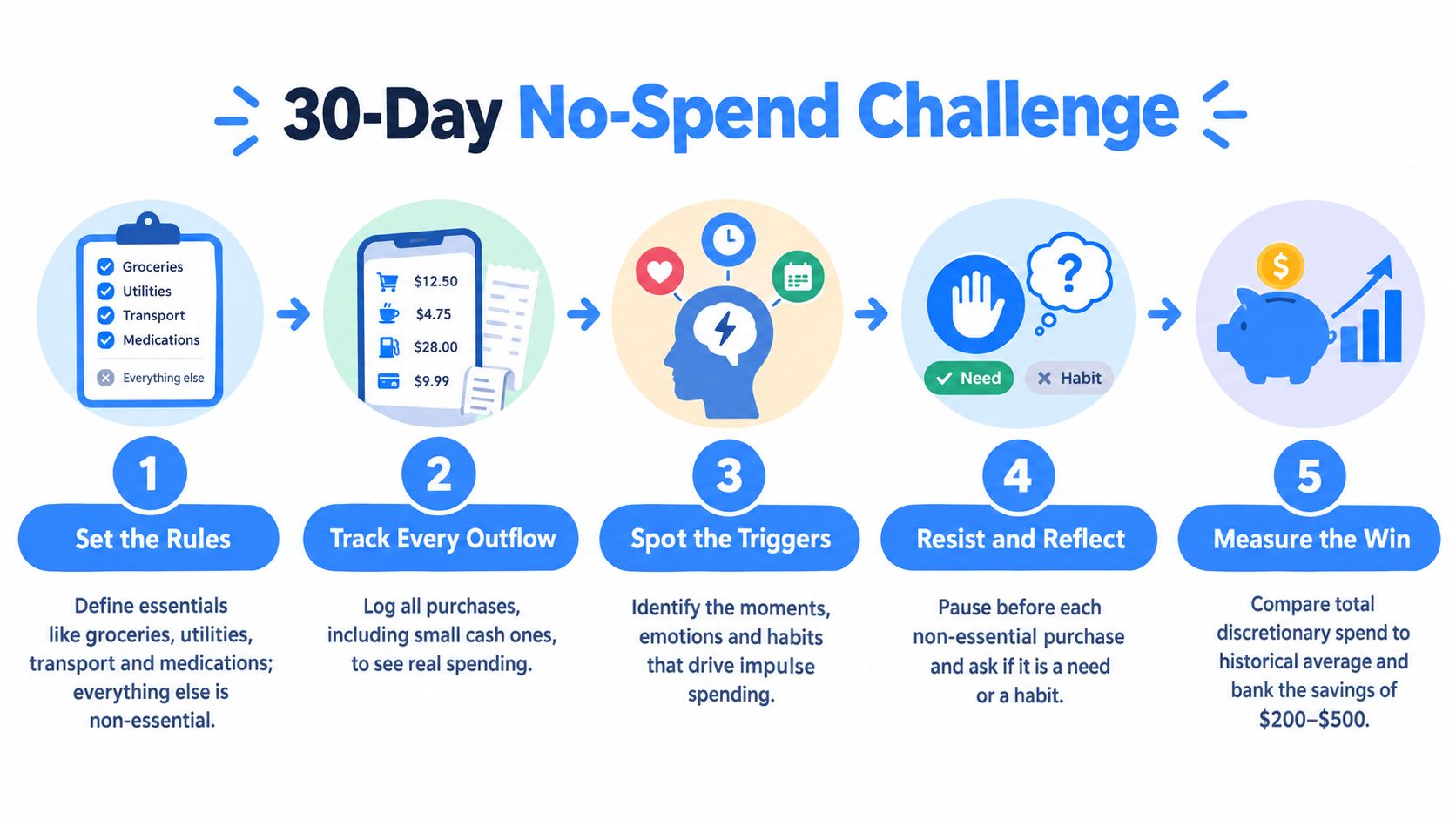
A no-spend challenge works best when you define essentials before day one. Keep groceries, utilities, transport, medications, and other unavoidable needs. Pause discretionary purchases, then log every exception without restarting the challenge.
The daily action is simple: record each outflow immediately, including cash purchases and small convenience items. FloosYo's voice entry helps you capture a purchase before memory rounds it down or drops it entirely. At the end of the month, compare actual discretionary spending with your normal pattern and identify which categories you missed.
Use a decision process rather than a shame-based rule:
- Plan essentials: Shop from a list and prepare social activities before the day begins.
- Log slips: One purchase is information, not failure. Record it and continue.
- Review the result: Separate spending you missed from spending you merely tolerated.
- Choose deliberately: Reintroduce only the categories that add enough value to justify their cost.
The challenge should end with a sustainable rule, such as preparing snacks at home, limiting convenience purchases, or setting a defined amount for social activities. Track total discretionary outflow and number of unplanned purchases, not a perfect streak.
3. 30-Day Meal Prep Mastery
Meal preparation turns a repeated spending decision into a planned routine. Start with three or four simple recipes, buy overlapping ingredients, and prepare food on a schedule that fits your week. Two cooking sessions can work better than one large batch if freshness or variety keeps derailing you.
For each grocery trip, use FloosYo's voice entry to capture the total. Divide the cost of a batch by the number of portions, then compare that figure with what you usually spend on takeout, delivery, or convenience food. Keep the calculation practical, not obsessive. The point is to see whether preparation lowers outflow while remaining realistic for your household.
A single person might prepare lunches with eggs, lentils, canned fish, chicken thighs, rice, vegetables, or seasonal produce. A family can protect one evening from decision fatigue by choosing a repeatable dinner format. If friends are dining out, eat at home first or bring a meal when appropriate, then join the social part without allowing the entire evening to become an unplanned expense.
Track two measures each day: meals prepared and food spending recorded. On day 30, compare total grocery and restaurant outflow, then keep the recipes that were affordable, acceptable, and easy to repeat. For planning realistic food costs, consult this guide to the average grocery bill.
A short visual walkthrough can help you turn the plan into a repeatable kitchen routine.
4. 30-Day Digital Detox Challenge
Digital exposure often creates spending opportunities before you've decided to buy. Shopping apps, targeted promotions, streaming choices, social comparison, and repeated product recommendations can turn idle screen time into an outflow. Remove the easiest triggers for 30 days instead of relying on willpower.
Set app limits before the challenge begins. Delete shopping apps from your phone, sign out of social platforms, and keep access through a computer when you need it. Replace the freed time with walking, library books, home exercise, cooking, or another low-cost activity that doesn't lead directly to a checkout screen.
Log two things in FloosYo: screen-related spending urges and actual purchases. A voice note such as “wanted new headphones, skipped” creates a record of the decision without turning the challenge into a diary. At day 30, compare spending with your usual month and identify which apps or notifications caused the most pressure.
Re-enable only essential apps. Keep permanent limits on the ones that repeatedly trigger shopping, paid content, or unnecessary upgrades. The useful result isn't a perfect digital score. It's a clearer environment in which your purchases reflect decisions rather than exposure.

5. 30-Day Transport Optimization Challenge
Track every journey for 30 days, including the mode, fare, parking, tolls, and ride-hailing cost. Don't judge the trip while logging it. First build a clear picture of which journeys are expensive because of distance, timing, convenience, or habit.
Then compare modes by journey type. A commuter might test public transport for workdays, walk short errands, or combine cycling with transit. A household might compare whether every car trip is necessary, whether a shared vehicle can cover certain journeys, or whether a transit pass suits the actual schedule.
FloosYo's voice entry is useful for cash fares, parking charges, and rideshare transactions that may not arrive clearly in bank data. Annualize the frequent trips before changing them. Seeing the projected yearly outflow makes a repeated ride easier to compare with a pass, carpool arrangement, or walking route.
“Choose the cheapest option you can repeat without making the rest of your week unworkable.”
Track cost per journey type and number of lower-cost trips. Don't force a transport change that makes work, caregiving, safety, or accessibility impossible. Direct the amount you avoid spending toward a concrete goal, such as vehicle maintenance or a reserve for necessary transportation.
6. 30-Day Utility and Energy Reduction Challenge
Start with evidence, not guesses. Save the previous utility bill, photograph available meter readings, and identify the home behavior most likely to affect the next bill. Heating and cooling, hot water, always-on devices, and long showers are practical places to begin.
Change one behavior at a time. Set an agreed household temperature range, unplug devices that don't need constant power, use power strips, shorten showers, and improve drafts where a low-cost fix makes sense. Don't create conflict by imposing a target that other household members can't maintain.
Log utility bills in FloosYo and compare the next amount with the baseline after accounting for weather, occupancy, and billing timing. The app's monthly and yearly projections can show what a lower recurring bill would mean over a year, but treat that as an outflow projection, not a guaranteed result.
A useful daily measure is completed energy-saving actions. A useful monthly measure is the next bill, interpreted carefully. On day 30, keep the single change that required the least effort and delivered a noticeable effect. Use any confirmed reduction to fund one modest efficiency improvement, such as a timer outlet, LED bulb, or weatherstripping.
7. 30-Day Mindful Spending Challenge
Choose one purchase threshold and apply a waiting period to non-essential purchases above it. The exact threshold should fit your circumstances. The important part is consistency, not selecting a dramatic number.
When an urge appears, record the item, reason, price, and intended use. Add it to a wish list, then wait before buying. During that pause, ask whether you need it, whether you'll use it, and whether it supports one of your stated priorities. This separates a genuine need from fatigue, stress, social pressure, or a promotional message.
Track purchases completed, purchases skipped, and the trigger behind each urge. You'll learn more from “bought after a tiring workday” than from a generic label such as “impulse.” Use a 24-hour or 48-hour pause when a purchase deserves more scrutiny, but don't apply the rule to essentials or time-sensitive necessities.
At day 30, look for patterns. If most abandoned purchases came from one app, remove it. If stress caused the largest share of urges, choose a replacement action that costs nothing or little. The objective is not refusing everything. It's making the final decision after the urgency has faded.
8. 30-Day Skill Monetization Challenge
Use this challenge to create income from an existing skill, unused possessions, or a small service. Choose one primary route for the month. Selling items, tutoring, writing, design, pet care, or local assistance can all work, but scattering effort across several ideas makes progress difficult to judge.
Begin with the least-friction task. List a few unused items, offer one clearly defined service, or contact people who already know the quality of your work. Record time spent, inquiries, completed work, fees, and net income. FloosYo's income tracking can show deposits moving toward a named goal without mixing them into everyday spending.
A freelancer should calculate whether the work is worth repeating by comparing net income with time and effort. A tutor should record preparation time as well as teaching time. A seller should account for platform fees, packaging, delivery, and returns. Don't treat gross receipts as available savings.
Keep the work that produces a fair return and a repeatable schedule. Drop the work that consumes time without a clear benefit.
Route completed income toward one goal, such as necessary equipment, a household reserve, or a planned purchase. On day 30, continue only if the activity fits your skills, schedule, and financial priorities.
9. 30-Day Debt Payoff Acceleration Challenge
Focus on one balance and direct every available saving toward principal, while continuing required payments on other obligations. You can choose the smallest balance for visible momentum or prioritize the balance with the highest cost, but avoid adding new fees or creating a cash shortfall.
Start by recording the current balance, required payment, due date, and any relevant terms. Then identify money that can be redirected from canceled subscriptions, skipped discretionary purchases, or completed work. FloosYo can track recurring obligations and show projected outflows, but it can't move money because its bank access is read-only.
Set an additional payment rule before day one. It might be a fixed amount whenever income arrives or a defined share of confirmed savings. Don't promise an amount your cash flow can't support. A missed extra payment shouldn't trigger abandonment. Record it, reassess, and continue with the next affordable payment.
Track principal reduction and remaining balance. Don't frame interest as a benefit or use it as a reason to borrow. On day 30, decide whether the additional payment can continue without undermining essential expenses. If it can, schedule the next review and keep the same target until the balance is cleared or your circumstances change.
10. 30-Day Habit Stacking for Saving
Attach one brief money action to a routine you already complete. After morning coffee, record yesterday's unusual spending. After lunch, check the next recurring charge. After dinner, review one savings goal. A stable routine gives each action a dependable cue.
Track one clear signal each day, such as entries completed, charges reviewed, or the goal balance updated. For recurring costs, record the monthly amount and its yearly equivalent. Seeing the longer-term cost makes a small subscription or forgotten renewal easier to judge.
Use this simple stack:
- After coffee: Record unusual spending from the previous day.
- After lunch: Check the next renewal or bill.
- After dinner: Review the amount assigned to one goal.
Keep each action short. A voice note, reminder, or home-screen widget can reduce the effort. Start with one stack, then add another only after the first fits your routine.
A missed cue does not require a reset. Use a replacement cue while traveling or working different hours. The Lally study found that missing one opportunity did not materially disrupt habit formation, with early repetitions producing the largest gains in automaticity (longitudinal habit-formation study). On day 30, keep the reminder, review the monthly and yearly totals, and set the next goal review.
11. 30-Day Negotiation and Optimization Challenge
Contact one provider at a time and ask for a lower-cost arrangement, a downgrade, a pause, or a plan that matches your actual use. Phone, internet, gym, cloud storage, and other recurring services may offer options you won't see on the standard account page.
Prepare before you call. Record the current amount, renewal date, usage level, competitor terms, and the outcome you want. Keep the conversation factual. Ask for the change, request written confirmation, and save the agent name, reference number, promised start date, and cancellation terms.
If a service is difficult to leave, treat that friction as a warning. The U.S. Federal Trade Commission has proposed a “click to cancel” provision requiring cancellation to be as easy as signing up, while California-related rules described in legal guidance use a similar ease-of-cancellation principle (FTC proposal). You don't need to wait for a regulatory rule to apply that standard to your own choices.
Track calls completed, confirmed monthly reduction, and new terms. Schedule two or three focused sessions across the month, then stop. The best result may be a lower bill, a better-fitting plan, or a clear decision to leave.
12. 30-Day Provider Switching Challenge
Negotiation isn't always the right move. If a provider no longer offers acceptable value, compare alternatives and switch deliberately. Concentrate on one category, such as internet, phone, or energy supply, so you can verify terms instead of chasing every possible discount.
Start by checking contract length, cancellation windows, installation requirements, porting needs, equipment returns, and any introductory pricing. Compare the full projected outflow, not just the first advertised bill. A lower initial charge may stop being attractive if it creates a large later increase or a costly setup requirement.
Schedule the new service before canceling the old one when continuity matters. Keep screenshots, confirmation numbers, and the final account statement. If a household member depends on the service for work, school, healthcare, or accessibility, include that constraint in the decision.
Use FloosYo to create a reminder for the new renewal date and record the expected recurring amount. On day 30, measure confirmed monthly change, service continuity, and whether the new terms are easier to understand. A switch is successful only when the lower outflow doesn't introduce a new operational problem.
13. 30-Day Automation and Smart Savings Challenge
Automate a defined amount toward a named goal only after checking that the transfer fits your actual cash flow. Suitable goals include car maintenance, planned travel, education, household needs, or a general reserve. Keep the amount modest enough that one irregular week won't force you to reverse the decision.
FloosYo supports savings goals with automatic funding when a user skips a bill, allowing the saved amount to move toward one selected goal. Its savings goal app workflow keeps the result connected to the decision that created it. That connection matters. A skipped charge becomes visible progress rather than an amount that disappears into a general account.
Name the goal clearly and review the automation during the month. Don't set multiple transfers that compete with one another. Avoid any strategy based on interest, yield, or speculative returns. This challenge is about directing money you choose not to spend toward a defined purpose.
Track scheduled contribution, completed contribution, and goal balance. On day 30, keep the automation if it remained comfortable and useful. If cash flow changed, reduce or pause it without treating the adjustment as failure. A durable system responds to real income rather than punishing normal variation.
14. 30-Day Financial Reflection and Goal Setting Challenge
Use the month to turn scattered intentions into one measurable priority. Begin by reviewing income, recurring outflows, upcoming renewals, and spending that no longer reflects your needs. Don't create a large list of goals. Choose one result for the next 30 days and one longer-term direction.
A household might redirect confirmed subscription savings toward a planned home expense. A graduate might combine spending reductions with a career-related goal. A freelancer might focus on smoothing variable income by recording deposits and upcoming commitments. The action must fit the situation, not an ideal budget template.
Write the goal in operational terms. “Spend less” is too vague. “Review every recurring charge before renewal” or “transfer each confirmed avoided expense to one named goal” gives you something to complete and measure. FloosYo's monthly and yearly projections help translate a current decision into a longer outflow view.
Review weekly, then conduct a proper day-30 assessment. Measure actual outflow change, completed decisions, and whether the routine felt sustainable. If the goal is still relevant, schedule the next review. If it isn't, redesign it rather than carrying forward a target that no longer serves your household.
15. 30-Day Declutter and Monetize Challenge
Choose one area, such as a wardrobe, storage shelf, unused electronics, hobby equipment, or household duplicates. Each day, identify an item, verify its condition, photograph it, price it, and list it on one primary platform. A focused process beats opening several selling accounts and leaving half-finished listings everywhere.
Describe defects accurately, clarify collection or shipping arrangements, and keep records of platform fees and delivery costs. Bundle related items when that reduces work and improves usefulness for the buyer. Price competitively, but don't accept an offer that makes the time and handling unreasonable.
Track items listed, items sold, and net proceeds. Put confirmed proceeds toward a named goal instead of immediately replacing the clutter with another purchase. If an item doesn't sell after a reasonable review, lower the price, bundle it, donate it, or recycle it responsibly.
A day-30 review should answer three questions: which category created the most space, which listings required too much effort, and where will the net proceeds go? Keep the listing process only if it remains useful. Decluttering is successful when it improves space and creates a deliberate financial result, not when every possession becomes a sales project.
30-Day Self-Improvement: 15-Item Comparison
| Challenge | 🔄 Implementation (complexity) | ⚡ Resources & Effort (time / tools) | 📊 Expected outcomes (typical) | 💡 Ideal use cases | ⭐ Key advantages |
|---|---|---|---|---|---|
| 30-Day Subscription Audit | Moderate, bank connect, review & cancellations | Low–moderate time; phone/email & tracking tool | Annual waste recovered commonly $50–$200 (can be higher) | Users with many recurring charges or subscription creep | Reveals hidden charges; one-time high-impact savings |
| 30-Day No-Spend Challenge | Low, set rules, track daily outflows | Moderate discipline; planning (meals, logistics) | Monthly savings $200–$500 typical | Those wanting to reset impulses and save fast | Rapid, measurable savings; habit awareness |
| 30-Day Meal Prep Mastery | High, planning, batch cooking, portioning | High upfront time; grocery planning & storage | Monthly savings $200–$600 common | Frequent takeout buyers or families | Best savings-to-effort ratio; better nutrition |
| 30-Day Digital Detox Challenge | Moderate, set limits, remove apps, track mood | Moderate willpower; alternative activities required | 15–30% lower discretionary spend; better sleep & focus | App-driven impulse shoppers and heavy social-media users | Cuts ad exposure; improves focus and impulse control |
| 30-Day Transport Optimization Challenge | Moderate, trip logging and mode modeling | Daily trip tracking; research transit/carpool options | Transport spend reduction ~25–40% possible | Commuters using rideshare/solo driving | Reveals hidden transport costs; reduces emissions |
| 30-Day Utility & Energy Reduction Challenge | Moderate, meter readings and behavior changes | Daily monitoring; some low-cost fixes | Bill reductions 10–25%; emissions down ~20–30% | Households with high utility usage or old appliances | Persistent savings from behavioral changes |
| 30-Day Mindful Spending Challenge | Low, waiting rule + logging | Low time per decision; consistent reflection | Saves $150–$400/month; 40–50% of above-threshold buys abandoned | Impulse buyers wanting values-aligned spending | Reduces buyer's remorse; low-friction habit |
| 30-Day Side Hustle / Skill Monetization | Moderate–high, setup, listings, client work | Significant time; platform fees; skill application | Income $300–$1,000+ in a month (varies) | Those with marketable skills or clutter to sell | Generates new income; scalable over time |
| 30-Day Debt Payoff Acceleration | Moderate, select target debt, extra payments | Requires extra cashflow; tracking payments weekly | Principal reduction $500–$2,000 typical | People with high-interest or manageable cashflow | Interest savings and motivational progress |
| 30-Day Habit Stacking for Saving | Low–moderate, design and attach actions | Minimal daily time (2–5 min); initial setup | Improved consistency; long-term behavioral savings | Busy people wanting low-friction budgeting | Automates actions; durable behavior change |
| 30-Day Negotiation & Optimization Challenge | Moderate, research, calls, follow-up | 2–3 hours spread over month; documentation | 10–30% reductions; $50–$150/month typical | Subscribers of phone, internet, insurance, gym | Often quick bill cuts; builds negotiation skills |
| 30-Day Provider Switching Challenge | Moderate, compare, schedule, switch logistics | Time to compare, manage porting/installations | Often larger savings than negotiation (varies) | Markets with competing providers and promos | Can yield bigger discounts; leverages competition |
| 30-Day Automation & Smart Savings Challenge | Moderate (setup), recurring transfers & round-ups | One-time setup; periodic review; bank/tools access | Predictable automated savings; fewer late fees | People wanting passive saving or paycheck allocation | Removes willpower; ensures pay-yourself-first |
| 30-Day Financial Reflection & Goal Setting | Moderate, full review and plan drafting | Time to gather docs; weekly checkpoints | Clear 3–6 month plan; better allocation of funds | Those needing direction or planning for life events | Strategic clarity; reduces reactive decisions |
| 30-Day Declutter & Monetize Challenge | Low–moderate, inventory, photo, list, ship | Time for listings & shipping; modest fees | Immediate cash (often hundreds); space cleared | People with unused items seeking quick cash | Converts assets to cash; reduces clutter |
Turn One Month of Progress Into a System
Choose one challenge, not five. The best starting point is the behavior with the clearest connection between a daily action and a financial result. If surprise renewals are the problem, start with the subscription audit. If small purchases disappear from memory, choose mindful spending or voice-based daily logging. If food delivery dominates your outflow, choose meal preparation.
Set a day-one baseline before changing anything. Record the current recurring charges, the last available bill, the usual number of discretionary purchases, or the time spent on the behavior. A baseline doesn't need to be perfect. It needs to be specific enough that you can compare the result at the end of the month.
Select no more than two progress measures. For a recurring-cost challenge, use completed renewal decisions and projected yearly outflow. For a spending challenge, use actual discretionary spending and the number of unplanned purchases. For a routine challenge, use completed actions and the amount redirected to one goal. More measures often create more tracking work without improving the decision.
FloosYo can reduce the friction at each stage. Its bank connection reads transactions, detects repeating charges, and presents recurring expenses with categories and merchant details. Voice or text entry covers cash purchases and anything the bank doesn't identify cleanly. Monthly and yearly projections show the cost of repeating a charge, while renewal notifications arrive before the billing event so you can decide whether to keep, skip, or cancel.
Use the day-30 review to examine four facts:
- What changed: Compare actual spending, time, or completed actions with your baseline.
- What it projects: Calculate the recurring monthly and yearly effect of the decisions you made.
- What interrupted you: Record missed days, changed income, travel, illness, or household constraints.
- What felt sustainable: Keep the action that fits your real schedule, not the one that looked most impressive.
A 2024 meta-analysis found that behavior-change interventions lasting roughly 30 to 90 days appear in the research, but a one-month format is generally shorter than the time many people need to reach stable automaticity (systematic review). Use day 30 as a transition point. If the action is becoming easier, continue it. If it remains effortful but valuable, simplify the cue or reduce the target. If it no longer fits, redesign the challenge instead of preserving it for its own sake.
Front-load the first week. A 2025 randomized three-arm walking trial asked participants to reach 7,000 steps per day during a 30-day intervention using goal-setting, self-monitoring, and personalized or standard communications. Daily step counts increased significantly, with the largest improvement in the first 10 days before stabilizing, and the study reported a significant time effect of η²p = 0.042, p < 0.001 (mHealth trial). For a money challenge, use the first 7 to 10 days to identify one recurring charge, establish its baseline, show its monthly and yearly projection, and complete one concrete decision.
Then extend the useful part. Keep the smallest action that still produces a meaningful signal. Schedule the next review for a later cycle, and use reminders, widgets, voice entry, and automatic goal funding to make continuation easier. Don't reset the entire system after a missed day. Return to the cue, record the decision, and continue.
The practical rule is simple: keep the smallest useful habit, schedule the next review, and expand only after the first routine is stable. Thirty days can give you evidence. Your follow-up system turns that evidence into a lasting choice.
FloosYo finds recurring spending through your bank connection, captures missed transactions with voice or text entry, and shows monthly and yearly projections before the next charge lands. Use FloosYo to set renewal reminders, record skip or stop decisions, and move confirmed savings toward one visible goal.